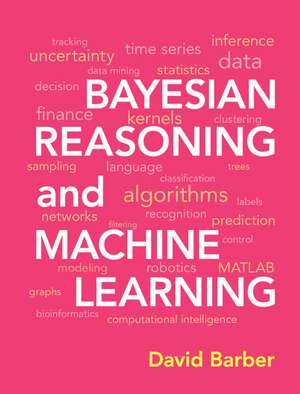
Bayesian Reasoning and Machine Learning
Autor David Barberen Limba Engleză Hardback – 15 feb 2019
Resursele software, în special pachetul de instrumente MATLAB care însoțește volumul, transformă Bayesian Reasoning and Machine Learning dintr-un manual teoretic într-un instrument de lucru aplicat. Considerăm că forța acestui volum rezidă în capacitatea de a face metodele complexe de învățare automată accesibile studenților care nu dețin un doctorat în matematică. Ne-a atras atenția modul în care David Barber utilizează modelele grafice pentru a oferi o structură coerentă întregului domeniu, facilitând tranziția de la raționamentul de bază la tehnici avansate de inferență. Abordarea diferă de cea din Pattern Recognition and Machine Learning de Christopher M. Bishop prin faptul că este mai puțin abstractă și mult mai orientată către implementarea practică, fiind special concepută pentru cei care doresc să dezvolte abilități de rezolvare a problemelor reale imediat. În timp ce alte lucrări pot fi dense din punct de vedere formal, textul de față menține un echilibru riguros, dar accesibil, integrând 260 de exerciții care ghidează cititorul prin procesul de învățare. Structura cărții este una progresivă, fiind împărțită în cinci secțiuni logice: începe cu bazele inferenței în modelele probabilistice, continuă cu învățarea în aceste modele și conceptele fundamentale de machine learning, explorând apoi modelele dinamice și, în final, metodele de inferență aproximativă. Această organizare permite o parcurgere sistematică, unde fiecare capitol construiește pe fundația celui anterior. În contextul operei sale, acest titlu reprezintă o extensie naturală a expertizei autorului, completând viziunea sa asupra analizei datelor, așa cum este prezentată și în Bayesian Time Series Models, dar cu o aplicabilitate mult mai largă în inteligența artificială modernă.
Preț: 547.92 lei
Preț vechi: 684.90 lei
-20%
Carte disponibilă
Livrare economică 14-28 noiembrie
Livrare express 31 octombrie-06 noiembrie pentru 68.11 lei
Specificații
ISBN-10: 0521518148
Pagini: 740
Ilustrații: 287 b/w illus. 1 table 260 exercises
Dimensiuni: 175 x 250 x 44 mm
Greutate: 1.43 kg
Editura: Cambridge University Press
Locul publicării:Cambridge, United Kingdom
V-ar putea interesa
-
 Just Enough Data Science and Machine LearningMark LevenePreț: 352.28 lei
 -
 -8%Preț: 327.97 lei357.72 lei
 -
 Probabilistic Graphical ModelsDaphne Koller-18%Preț: 791.04 lei968.33 lei
 -
 Machine LearningKevin P. Murphy-20%Preț: 731.65 lei918.37 lei
 -
 Probabilistic Machine LearningKevin P. Murphy-20%Preț: 862.38 lei1080.57 lei
 -
 Gaussian Processes for Machine LearningCarl Edward Rasmussen-26%Preț: 350.95 lei477.34 lei
 -
 An Introductory Handbook of Bayesian ThinkingStephen C. Loftus-32%Preț: 369.37 lei545.69 lei
 -
 A First Course in Machine LearningSimon RogersPreț: 424.01 lei
 -
 Pattern Recognition and Machine LearningChristopher M Bishop-20%Preț: 646.10 lei807.62 lei
 -
 The Elements of Statistical LearningTrevor Hastie-20%Preț: 582.77 lei728.46 lei
 -
 -39%Preț: 394.79 lei646.62 lei
 -
 -31%Preț: 607.05 lei885.58 lei
 -
 Machine Learning For DummiesLuca Massaron-20%Preț: 149.88 lei187.36 lei
 -
 Machine Learning: An Algorithmic Perspective, Second EditionStephen Marsland-20%Preț: 625.22 lei781.53 lei
 -
 Machine Learning Algorithms in DepthVadim Smolyakov-20%Preț: 445.58 lei556.96 lei
 -
 -20%Preț: 242.09 lei302.62 lei
 -
 Applied Machine LearningDavid Forsyth-20%Preț: 596.35 lei745.43 lei
 -
 Materials Data ScienceStefan Sandfeld-19%Preț: 624.52 lei771.02 lei
 -
 Probability and Statistics for Machine LearningCharu C. Aggarwal-20%Preț: 445.19 lei556.49 lei
 -
 Statistics for ScientistsUmberto Michelucci-20%Preț: 279.62 lei349.53 lei
De ce să citești această carte
Recomandăm această carte oricărui programator sau student care dorește să înțeleagă logica din spatele algoritmilor de machine learning fără a se pierde în demonstrații matematice excesive. Câștigați o înțelegere profundă a modelelor grafice și a metodelor bayesiene, susținută de exerciții practice și un toolbox MATLAB care vă permite să aplicați imediat conceptele învățate în proiecte de cercetare sau aplicații industriale.
Despre autor
David Barber este un cercetător recunoscut în domeniul informaticii și inteligenței artificiale, cu o expertiză vastă în metodele bayesiene și modelele probabilistice. În cariera sa academică, s-a concentrat pe dezvoltarea unor cadre de învățare automată care să fie atât riguroase, cât și aplicabile în scenarii de calcul complexe. Lucrarea sa, Bayesian Reasoning and Machine Learning, publicată de Cambridge University Press, a devenit un text de referință în universități, fiind apreciată pentru claritatea pedagogică. Expertiza sa este reflectată și în alte contribuții importante, precum Bayesian Time Series Models, unde explorează tehnici de ultimă oră pentru analiza datelor temporale.
Descriere scurtă
Cuprins
Recenzii
'With approachable text, examples, exercises, guidelines for teachers, a MATLAB toolbox and an accompanying website, Bayesian Reasoning and Machine Learning by David Barber provides everything needed for your machine learning course. Only students not included.' Jaakko Hollmén, Aalto University
'The chapters on graphical models form one of the clearest and most concise presentations I have seen … The exposition throughout uses numerous diagrams and examples, and the book comes with an extensive software toolbox - these will be immensely helpful for students and educators. It's also a great resource for self-study.' Arindam Banerjee, University of Minnesota
'I repeatedly get unsolicited comments from my students that the contents of this book have been very valuable in developing their understanding of machine learning … My students praise this book because it is both coherent and practical, and because it makes fewer assumptions regarding the reader's statistical knowledge and confidence than many books in the field.' Amos Storkey, University of Edinburgh