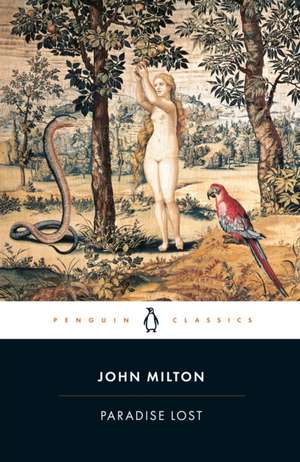
Paradise Lost
Autor John Milton Editat de John Leonarden Limba Engleză Paperback – 27 feb 2003
In his epic poem Paradise Lost Milton conjured up a vast, awe-inspiring cosmos ranging across huge tracts of space and time. And yet, in putting a charismatic Satan and naked Adam and Eve at the centre of this story, he also created an intensely human tragedy on the Fall of Man. Written when Milton was in his fifties - blind, bitter and briefly in danger of execution - Paradise Lost's apparent ambivalence has led to intense debate about whether it manages to 'justify the ways of God to men' or exposes the cruelty of authority.
Edited with an introduction and notes by JOHN LEONARD
Preț: 75.07 lei
Puncte Express: 113
Carte disponibilă
Livrare economică 14-28 noiembrie
Livrare express 03-07 noiembrie pentru 31.50 lei
Livrare prin curier în România Termenul estimat este afișat lângă disponibilitate.
Transport gratuit de la 400.00 lei Plată online sau ramburs, în funcție de opțiunile comenzii.
Retur gratuit în 14 zile Comandă securizată și suport în română.
Specificații
ISBN-13: 9780140424393
ISBN-10: 0140424393
Pagini: 512
Dimensiuni: 128 x 195 x 26 mm
Greutate: 0.34 kg
Ediția:Revised
Editura: Penguin Books
Colecția Penguin Classics
Locul publicării:London, United Kingdom
ISBN-10: 0140424393
Pagini: 512
Dimensiuni: 128 x 195 x 26 mm
Greutate: 0.34 kg
Ediția:Revised
Editura: Penguin Books
Colecția Penguin Classics
Locul publicării:London, United Kingdom
V-ar putea interesa
-
 Preț: 28.01 lei
 -
 CLASSICS PARADISE LOST AND PAJohn MiltonPreț: 28.01 lei
 -
 Uncle Tom's CabinHarriet Beecher StowePreț: 28.01 lei
 -
 To the LighthouseVirginia WoolfPreț: 28.01 lei
 -
 Temple of DawnYukio Mishima-18%Preț: 59.29 lei72.38 lei
 -
 Decay of the AngelYukio Mishima-26%Preț: 58.13 lei78.63 lei
 -
 The Doors of PerceptionAldous Huxley-27%Preț: 57.12 lei77.73 lei
 -
 Brave New WorldAldous HuxleyPreț: 64.37 lei
 -
 BloodlandsTimothy Snyder-16%Preț: 79.43 lei95.07 lei
 -
 The People Of The LieM. Scott Peck-19%Preț: 64.48 lei79.20 lei
 -
 The Red Badge of Courage and Other StoriesStephen Crane-18%Preț: 53.67 lei65.33 lei
 -
 Lord of the FliesWilliam GoldingPreț: 83.25 lei
 -
 One Day in the Life of Ivan DenisovichAleksandr SolzhenitsynPreț: 38.49 lei
 -
 The Marriage of Heaven and HellWilliam Blake-21%Preț: 69.50 lei87.67 lei
 -
 The Bell JarSylvia PlathPreț: 71.58 lei
 -
 Preț: 308.22 lei
 -
 A Shakespeare Story: The Taming of the ShrewAndrew Matthews-30%Preț: 34.27 lei48.61 lei
 -
 Preț: 130.27 lei
 -
 UlyssesJames JoycePreț: 41.38 lei
 -
 Much Ado About NothingWilliam ShakespearePreț: 28.01 lei
Notă biografică
John Milton (1608-1674) spent his early years in scholarly pursuit. In 1649 he took up the cause for the new Commonwealth, defending the English revolution both in English and Latin - and sacrificing his eyesight in the process. He risked his lifeby publishing The Ready and Easy Way to Establish a Free Commonwealth on the eve of the Restoration (1660). His great poems were published after this political defeat.
John Leonard is a Professor of English at the University of Western Ontario.
John Leonard is a Professor of English at the University of Western Ontario.
Descriere
Descriere de la o altă ediție sau format:
'Of man's first disobedience, and the fruitOf that forbidden tree, whose mortal tasteBrought death into the world...Sing heavenly muse'From almost the moment of its first publication in 1667, Paradise Lost was considered a classic. It is difficult now to appreciate both how audacious an undertaking it represents, and how astonishing its immediate and continued success was. Over the course of twelve books Milton wrote an epic poem that would 'justify the ways of God to men', a mission that required a complex drama whose source is both historical and deeply personal. The struggle for ascendancy between God and Satan is played out across hell, heaven, and earth but the consequences of the Fall are all too humanly tragic - pride, ambition, and aspiration the motivating forces. In this new edition derived from their acclaimed Oxford Authors text, Stephen Orgel and Jonathan Goldberg discuss the complexity of Milton's poem in a new introduction, and on-page notes explain its language and allusions. ABOUT THE SERIES: For over 100 years Oxford World's Classics has made available the widest range of literature from around the globe. Each affordable volume reflects Oxford's commitment to scholarship, providing the most accurate text plus a wealth of other valuable features, including expert introductions by leading authorities, helpful notes to clarify the text, up-to-date bibliographies for further study, and much more.
'Of man's first disobedience, and the fruitOf that forbidden tree, whose mortal tasteBrought death into the world...Sing heavenly muse'From almost the moment of its first publication in 1667, Paradise Lost was considered a classic. It is difficult now to appreciate both how audacious an undertaking it represents, and how astonishing its immediate and continued success was. Over the course of twelve books Milton wrote an epic poem that would 'justify the ways of God to men', a mission that required a complex drama whose source is both historical and deeply personal. The struggle for ascendancy between God and Satan is played out across hell, heaven, and earth but the consequences of the Fall are all too humanly tragic - pride, ambition, and aspiration the motivating forces. In this new edition derived from their acclaimed Oxford Authors text, Stephen Orgel and Jonathan Goldberg discuss the complexity of Milton's poem in a new introduction, and on-page notes explain its language and allusions. ABOUT THE SERIES: For over 100 years Oxford World's Classics has made available the widest range of literature from around the globe. Each affordable volume reflects Oxford's commitment to scholarship, providing the most accurate text plus a wealth of other valuable features, including expert introductions by leading authorities, helpful notes to clarify the text, up-to-date bibliographies for further study, and much more.
Recenzii
"[A]n exemplary job both of presenting the major topics of Paradise Lost and of entering the selva oscura of Milton criticism. . . . Students and scholars alike will appreciate the balanced approach to the complexities, difficulties, and conundrums of Milton's poem and the criticism on it. Kastan's prose is not just lively but chiseled, and it is destined to affect students."
—Patrick Cheney, Studies in English Literature, 1500-1900
"Kastan is an exemplary editor, attuned to emerging critical currents, yet steeped in the scholarship of an earlier tradition, aware of the text's provenance and reception, alert to its topicality. His introduction, a model of theoretically informed, politically committed, historically grounded criticism, makes this edition of Paradise Lost all you would expect from one of the most erudite and perceptive figures in the field."
—Willy Maley, Modern Language Review
"This is a superb edition, a model of careful editing and judicious annotation."
—Leslie Brisman, Department of English, Yale University
"Thank you for sending this impressive edition. . . . Having edited Paradise Lost myself (Norton, 2005), I was curious and keen to see Professor Kastan's. I agree wholeheartedly with the claim (more diplomatically put) that the punctuation of the 17th century editions has no authority and that its proponents are avoiding the problem of syntax. The notes are learned and informative, without excess, and it's good to have the text of Edward Phillips' Life."
—Gordon Teskey, Harvard University
"This is an excellent edition of the poem. . . . Well edited, accessible, and engaging Introduction. Also nicely produced—a sturdy, attractive book on good paper. I love it!"
—Lisa Schnell, University of Vermont
"This is the best edition of Milton. . . . The introductory material and support apparatus provide the contextual information necessary for my students to not only understand Milton's text, but to appreciate it as well. I will certainly be using this edition again and again."
—Tim Melnarik, Department of English, California State University, San Bernardino
"Suitable, not overwhelming, notes and apparatus. You may be sure I'll order it in future."
—Dr. Stephen Teichgraeber, Concord Academy
—Patrick Cheney, Studies in English Literature, 1500-1900
"Kastan is an exemplary editor, attuned to emerging critical currents, yet steeped in the scholarship of an earlier tradition, aware of the text's provenance and reception, alert to its topicality. His introduction, a model of theoretically informed, politically committed, historically grounded criticism, makes this edition of Paradise Lost all you would expect from one of the most erudite and perceptive figures in the field."
—Willy Maley, Modern Language Review
"This is a superb edition, a model of careful editing and judicious annotation."
—Leslie Brisman, Department of English, Yale University
"Thank you for sending this impressive edition. . . . Having edited Paradise Lost myself (Norton, 2005), I was curious and keen to see Professor Kastan's. I agree wholeheartedly with the claim (more diplomatically put) that the punctuation of the 17th century editions has no authority and that its proponents are avoiding the problem of syntax. The notes are learned and informative, without excess, and it's good to have the text of Edward Phillips' Life."
—Gordon Teskey, Harvard University
"This is an excellent edition of the poem. . . . Well edited, accessible, and engaging Introduction. Also nicely produced—a sturdy, attractive book on good paper. I love it!"
—Lisa Schnell, University of Vermont
"This is the best edition of Milton. . . . The introductory material and support apparatus provide the contextual information necessary for my students to not only understand Milton's text, but to appreciate it as well. I will certainly be using this edition again and again."
—Tim Melnarik, Department of English, California State University, San Bernardino
"Suitable, not overwhelming, notes and apparatus. You may be sure I'll order it in future."
—Dr. Stephen Teichgraeber, Concord Academy
Cuprins
Acknowledgments
Introduction
Note on the Text
Paradise Lost
Introduction
Note on the Text
Paradise Lost
- Andrew Marvell, “On Paradise Lost”
- The Verse
- Book 1
- Book 2
- Book 3
- Book 4
- Book 5
- Book 6
- Book 7
- Book 8
- Book 9
- Book 10
- Book 11
- Book 12
- Reproductions of the 1674 Paradise Lost
- The Cosmography of Paradise Lost
- Illustrations of Paradise Lost
- Selections from the Bible
- Genesis 1–3: The Creation
- Genesis 18: Angels and God
- Job 1: Satan
- John 1.1–14: The Son
- 1 Timothy 2.8–15: Eve in the New Testament
- Revelation 12: The War in Heaven
- from Hesiod, Theogony
- John Milton’s Early Plans for Paradise Lost
- from John Milton, Areopagitica (1644)
- from John Milton, De Doctrina Christiana (c. 1658–74)
- from The Epistle
- from Chapter 2, Of God
- from Chapter 5, Of the Son of God
- from Chapter 7, Of the Creation
- from Chapter 30, Of the Holy Scripture