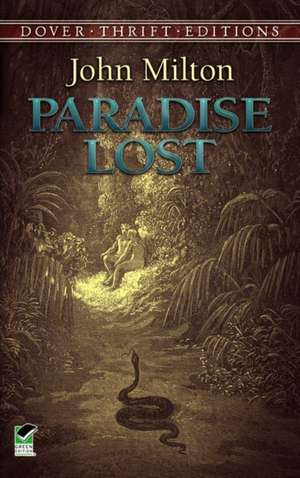
Paradise Lost
Autor John Miltonen Limba Engleză Paperback – 10 iun 2005
In sublime poetry of extraordinary beauty, Milton's poem references tales from Ovid's "Metamorphoses," the "Iliad" and "Odyssey," and Virgil's "Aeneid." But one need not be a classical scholar to appreciate "Paradise Lost." In addition to its imaginative use of language, the poem features a powerful and sympathetic portrait of Lucifer, the rebel angel who frequently outshines his moral superiors. With Milton's deft use of irony, the devil makes evil appear good, just as satanic practices may seem attractive at first glance.
"Paradise Lost" has exercised enormous influence on generations of artists and their works, ranging from the Romantic poets William Blake and Percy Bysshe Shelley to Joseph Haydn's oratorio "The Creation" and J. R. R. Tolkien's "The Lord of the Rings."
Preț: 94.76 lei
Puncte Express: 142
Carte disponibilă
Livrare economică 17 noiembrie-01 decembrie
Livrare prin curier în România Termenul estimat este afișat lângă disponibilitate.
Transport gratuit de la 400.00 lei Plată online sau ramburs, în funcție de opțiunile comenzii.
Retur gratuit în 14 zile Comandă securizată și suport în română.
Specificații
ISBN-13: 9780486442877
ISBN-10: 048644287X
Pagini: 480
Dimensiuni: 134 x 214 x 40 mm
Greutate: 0.34 kg
Editura: Dover Publications
ISBN-10: 048644287X
Pagini: 480
Dimensiuni: 134 x 214 x 40 mm
Greutate: 0.34 kg
Editura: Dover Publications
V-ar putea interesa
-
 The Phantom of the OperaGaston LerouxPreț: 28.01 lei
 -
 CLASSICS PARADISE LOST AND PAJohn MiltonPreț: 28.01 lei
 -
 Uncle Tom's CabinHarriet Beecher StowePreț: 28.01 lei
 -
 To the LighthouseVirginia WoolfPreț: 28.01 lei
 -
 Temple of DawnYukio Mishima-18%Preț: 59.29 lei72.38 lei
 -
 Decay of the AngelYukio Mishima-26%Preț: 58.13 lei78.63 lei
 -
 The Doors of PerceptionAldous Huxley-26%Preț: 57.18 lei77.73 lei
 -
 Brave New WorldAldous HuxleyPreț: 64.37 lei
 -
 BloodlandsTimothy Snyder-16%Preț: 79.50 lei95.07 lei
 -
 The People Of The LieM. Scott Peck-18%Preț: 65.18 lei79.20 lei
 -
 The Red Badge of Courage and Other StoriesStephen Crane-17%Preț: 54.25 lei65.33 lei
 -
 Lord of the FliesWilliam GoldingPreț: 83.25 lei
 -
 One Day in the Life of Ivan DenisovichAleksandr SolzhenitsynPreț: 38.49 lei
 -
 The Marriage of Heaven and HellWilliam Blake-20%Preț: 70.13 lei87.67 lei
 -
 The Bell JarSylvia PlathPreț: 71.58 lei
 -
 Preț: 308.22 lei
 -
 A Shakespeare Story: The Taming of the ShrewAndrew Matthews-27%Preț: 35.92 lei49.40 lei
 -
 Preț: 130.27 lei
 -
 UlyssesJames JoycePreț: 41.38 lei
 -
 Much Ado About NothingWilliam ShakespearePreț: 28.01 lei
Descriere
The completed texts of two of the greatest epic poems in English literature are combined in one volume where each provides a profound exploration of the moral problems of God's justice. Each work demonstrates Milton's genius for classicism, innovation, narrative and drama. Includes a new introduction and extensive footnotes.
Notă biografică
John Milton was an English poet, scholar, and civil servant, born in 1608 in London. He excelled in his studies at St. Paul's School and later at Christ's College, Cambridge, where he pursued classical studies and developed a passion for poetry and languages. A deeply religious and intellectual man, Milton was influenced by the Reformation's humanist ideals, which later shaped his views on politics, religion, and society.During the English Civil War, Milton became an outspoken advocate for the Parliamentary cause and opposed monarchy, aligning with the Puritans. He authored numerous political tracts on topics like freedom of speech and divorce, most notably Areopagitica, which argued for the freedom of the press. His political writings and role as Secretary for Foreign Tongues under Oliver Cromwell highlighted his belief in personal liberty and constitutional reform, ideas considered radical at the time.Milton's later years were marked by hardship, including blindness and the political shift after the monarchy's restoration. However, during this period, he composed Paradise Lost, an epic poem that delves into themes of sin, redemption, and free will. Widely regarded as his masterpiece, it secured Milton's legacy as one of the greatest English poets, influencing countless writers and thinkers. Through Paradise Lost and other works, Milton's complex views on faith, authority, and human nature continue to resonate in literary and philosophical discussions.
Recenzii
"[A]n exemplary job both of presenting the major topics of Paradise Lost and of entering the selva oscura of Milton criticism. . . . Students and scholars alike will appreciate the balanced approach to the complexities, difficulties, and conundrums of Milton's poem and the criticism on it. Kastan's prose is not just lively but chiseled, and it is destined to affect students."
—Patrick Cheney, Studies in English Literature, 1500-1900
"Kastan is an exemplary editor, attuned to emerging critical currents, yet steeped in the scholarship of an earlier tradition, aware of the text's provenance and reception, alert to its topicality. His introduction, a model of theoretically informed, politically committed, historically grounded criticism, makes this edition of Paradise Lost all you would expect from one of the most erudite and perceptive figures in the field."
—Willy Maley, Modern Language Review
"This is a superb edition, a model of careful editing and judicious annotation."
—Leslie Brisman, Department of English, Yale University
"Thank you for sending this impressive edition. . . . Having edited Paradise Lost myself (Norton, 2005), I was curious and keen to see Professor Kastan's. I agree wholeheartedly with the claim (more diplomatically put) that the punctuation of the 17th century editions has no authority and that its proponents are avoiding the problem of syntax. The notes are learned and informative, without excess, and it's good to have the text of Edward Phillips' Life."
—Gordon Teskey, Harvard University
"This is an excellent edition of the poem. . . . Well edited, accessible, and engaging Introduction. Also nicely produced—a sturdy, attractive book on good paper. I love it!"
—Lisa Schnell, University of Vermont
"This is the best edition of Milton. . . . The introductory material and support apparatus provide the contextual information necessary for my students to not only understand Milton's text, but to appreciate it as well. I will certainly be using this edition again and again."
—Tim Melnarik, Department of English, California State University, San Bernardino
"Suitable, not overwhelming, notes and apparatus. You may be sure I'll order it in future."
—Dr. Stephen Teichgraeber, Concord Academy
—Patrick Cheney, Studies in English Literature, 1500-1900
"Kastan is an exemplary editor, attuned to emerging critical currents, yet steeped in the scholarship of an earlier tradition, aware of the text's provenance and reception, alert to its topicality. His introduction, a model of theoretically informed, politically committed, historically grounded criticism, makes this edition of Paradise Lost all you would expect from one of the most erudite and perceptive figures in the field."
—Willy Maley, Modern Language Review
"This is a superb edition, a model of careful editing and judicious annotation."
—Leslie Brisman, Department of English, Yale University
"Thank you for sending this impressive edition. . . . Having edited Paradise Lost myself (Norton, 2005), I was curious and keen to see Professor Kastan's. I agree wholeheartedly with the claim (more diplomatically put) that the punctuation of the 17th century editions has no authority and that its proponents are avoiding the problem of syntax. The notes are learned and informative, without excess, and it's good to have the text of Edward Phillips' Life."
—Gordon Teskey, Harvard University
"This is an excellent edition of the poem. . . . Well edited, accessible, and engaging Introduction. Also nicely produced—a sturdy, attractive book on good paper. I love it!"
—Lisa Schnell, University of Vermont
"This is the best edition of Milton. . . . The introductory material and support apparatus provide the contextual information necessary for my students to not only understand Milton's text, but to appreciate it as well. I will certainly be using this edition again and again."
—Tim Melnarik, Department of English, California State University, San Bernardino
"Suitable, not overwhelming, notes and apparatus. You may be sure I'll order it in future."
—Dr. Stephen Teichgraeber, Concord Academy
Cuprins
Acknowledgments
Introduction
Note on the Text
Paradise Lost
Introduction
Note on the Text
Paradise Lost
- Andrew Marvell, “On Paradise Lost”
- The Verse
- Book 1
- Book 2
- Book 3
- Book 4
- Book 5
- Book 6
- Book 7
- Book 8
- Book 9
- Book 10
- Book 11
- Book 12
- Reproductions of the 1674 Paradise Lost
- The Cosmography of Paradise Lost
- Illustrations of Paradise Lost
- Selections from the Bible
- Genesis 1–3: The Creation
- Genesis 18: Angels and God
- Job 1: Satan
- John 1.1–14: The Son
- 1 Timothy 2.8–15: Eve in the New Testament
- Revelation 12: The War in Heaven
- from Hesiod, Theogony
- John Milton’s Early Plans for Paradise Lost
- from John Milton, Areopagitica (1644)
- from John Milton, De Doctrina Christiana (c. 1658–74)
- from The Epistle
- from Chapter 2, Of God
- from Chapter 5, Of the Son of God
- from Chapter 7, Of the Creation
- from Chapter 30, Of the Holy Scripture