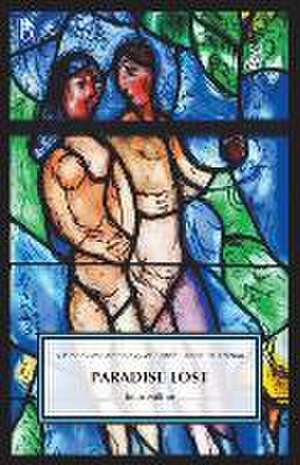
Paradise Lost
Autor John Milton Editat de Abraham Stollen Limba Engleză Paperback – 30 aug 2023
This new edition, based on the 1674 text, guides readers through the poem’s interpretive challenges with a compact but thorough introduction and a readable and helpfully annotated text. Illuminating contextual materials, including related works by Milton, classical and biblical sources, material on the composition of the poem, and illustrations of Paradise Lost from the seventeenth to the twentieth centuries, are also included.
Preț: 143.80 lei
Puncte Express: 216
Carte disponibilă
Livrare economică 14-28 noiembrie
Livrare express 03-07 noiembrie pentru 38.63 lei
Livrare prin curier în România Termenul estimat este afișat lângă disponibilitate.
Transport gratuit de la 400.00 lei Plată online sau ramburs, în funcție de opțiunile comenzii.
Retur gratuit în 14 zile Comandă securizată și suport în română.
Specificații
ISBN-13: 9781554813506
ISBN-10: 1554813506
Pagini: 462
Dimensiuni: 140 x 216 x 22 mm
Greutate: 0.57 kg
Editura: BROADVIEW PR
Colecția Broadview Press
Locul publicării:Peterborough, Canada
ISBN-10: 1554813506
Pagini: 462
Dimensiuni: 140 x 216 x 22 mm
Greutate: 0.57 kg
Editura: BROADVIEW PR
Colecția Broadview Press
Locul publicării:Peterborough, Canada
V-ar putea interesa
-
 Preț: 28.01 lei
 -
 CLASSICS PARADISE LOST AND PAJohn MiltonPreț: 28.01 lei
 -
 Uncle Tom's CabinHarriet Beecher StowePreț: 28.01 lei
 -
 To the LighthouseVirginia WoolfPreț: 28.01 lei
 -
 Temple of DawnYukio Mishima-18%Preț: 59.29 lei72.38 lei
 -
 Decay of the AngelYukio Mishima-26%Preț: 58.13 lei78.63 lei
 -
 The Doors of PerceptionAldous Huxley-27%Preț: 57.12 lei77.73 lei
 -
 Brave New WorldAldous HuxleyPreț: 64.37 lei
 -
 BloodlandsTimothy Snyder-16%Preț: 79.43 lei95.07 lei
 -
 The People Of The LieM. Scott Peck-19%Preț: 64.48 lei79.20 lei
 -
 The Red Badge of Courage and Other StoriesStephen Crane-18%Preț: 53.67 lei65.33 lei
 -
 Lord of the FliesWilliam GoldingPreț: 83.25 lei
 -
 One Day in the Life of Ivan DenisovichAleksandr SolzhenitsynPreț: 38.49 lei
 -
 The Marriage of Heaven and HellWilliam Blake-21%Preț: 69.50 lei87.67 lei
 -
 The Bell JarSylvia PlathPreț: 71.58 lei
 -
 Preț: 308.22 lei
 -
 A Shakespeare Story: The Taming of the ShrewAndrew Matthews-30%Preț: 34.27 lei48.61 lei
 -
 Preț: 130.27 lei
 -
 UlyssesJames JoycePreț: 41.38 lei
 -
 Much Ado About NothingWilliam ShakespearePreț: 28.01 lei
Recenzii
Reviled as a regicide, isolated in a personal darkness, and aging, John Milton did not relinquish his voice. He somehow used that tireless voice, rather, to create Paradise Lost, one of the enduring masterpieces of English literature. Despite its difficulties—idiosyncratic syntax, densely packed ideas, capacious structure, and epic form—the poem still has the power to dislodge modern readers from our ordinary habits of reading and push us to experience new perspectives and new ideas.
This new edition, based on the 1674 text, guides readers through the poem’s interpretive challenges with a compact but thorough introduction and a readable and helpfully annotated text. Illuminating contextual materials, including related works by Milton, classical and biblical sources, material on the composition of the poem, and illustrations of Paradise Lost from the seventeenth to the twentieth centuries, are also included.
“Who better than the distinguished literary historian of conscience to produce an edition of Milton’s masterpiece? In his incisive introduction, Abraham Stoll wears his considerable learning lightly, managing to explain in a few words how Milton’s particular interest in liberty and free will structure his long poem, and how bold and confrontational Milton was when he opposed the dominance of predestination Calvinism and placed arguments he had used to defend the unlicensed printing press in the mouth of Eve asking Adam for the right to roam throughout the Garden of Eden. The edition contains carefully thought-out footnotes and a series of appendices containing relevant images, extracts from the Bible, and notes Milton made of his plans for Paradise Lost. Overall, this is a splendid new edition that brings the poem to life for the modern reader.” — Andrew Hadfield, University of Sussex
This new edition, based on the 1674 text, guides readers through the poem’s interpretive challenges with a compact but thorough introduction and a readable and helpfully annotated text. Illuminating contextual materials, including related works by Milton, classical and biblical sources, material on the composition of the poem, and illustrations of Paradise Lost from the seventeenth to the twentieth centuries, are also included.
“Who better than the distinguished literary historian of conscience to produce an edition of Milton’s masterpiece? In his incisive introduction, Abraham Stoll wears his considerable learning lightly, managing to explain in a few words how Milton’s particular interest in liberty and free will structure his long poem, and how bold and confrontational Milton was when he opposed the dominance of predestination Calvinism and placed arguments he had used to defend the unlicensed printing press in the mouth of Eve asking Adam for the right to roam throughout the Garden of Eden. The edition contains carefully thought-out footnotes and a series of appendices containing relevant images, extracts from the Bible, and notes Milton made of his plans for Paradise Lost. Overall, this is a splendid new edition that brings the poem to life for the modern reader.” — Andrew Hadfield, University of Sussex
Cuprins
Acknowledgments
Introduction
Note on the Text
Paradise Lost
Introduction
Note on the Text
Paradise Lost
- Andrew Marvell, “On Paradise Lost”
- The Verse
- Book 1
- Book 2
- Book 3
- Book 4
- Book 5
- Book 6
- Book 7
- Book 8
- Book 9
- Book 10
- Book 11
- Book 12
- Reproductions of the 1674 Paradise Lost
- The Cosmography of Paradise Lost
- Illustrations of Paradise Lost
- Selections from the Bible
- Genesis 1–3: The Creation
- Genesis 18: Angels and God
- Job 1: Satan
- John 1.1–14: The Son
- 1 Timothy 2.8–15: Eve in the New Testament
- Revelation 12: The War in Heaven
- from Hesiod, Theogony
- John Milton’s Early Plans for Paradise Lost
- from John Milton, Areopagitica (1644)
- from John Milton, De Doctrina Christiana (c. 1658–74)
- from The Epistle
- from Chapter 2, Of God
- from Chapter 5, Of the Son of God
- from Chapter 7, Of the Creation
- from Chapter 30, Of the Holy Scripture
Notă biografică
John Milton was an English poet, scholar, and civil servant, born in 1608 in London. He excelled in his studies at St. Paul's School and later at Christ's College, Cambridge, where he pursued classical studies and developed a passion for poetry and languages. A deeply religious and intellectual man, Milton was influenced by the Reformation's humanist ideals, which later shaped his views on politics, religion, and society.During the English Civil War, Milton became an outspoken advocate for the Parliamentary cause and opposed monarchy, aligning with the Puritans. He authored numerous political tracts on topics like freedom of speech and divorce, most notably Areopagitica, which argued for the freedom of the press. His political writings and role as Secretary for Foreign Tongues under Oliver Cromwell highlighted his belief in personal liberty and constitutional reform, ideas considered radical at the time.Milton's later years were marked by hardship, including blindness and the political shift after the monarchy's restoration. However, during this period, he composed Paradise Lost, an epic poem that delves into themes of sin, redemption, and free will. Widely regarded as his masterpiece, it secured Milton's legacy as one of the greatest English poets, influencing countless writers and thinkers. Through Paradise Lost and other works, Milton's complex views on faith, authority, and human nature continue to resonate in literary and philosophical discussions.