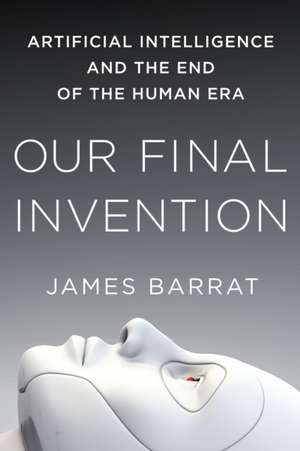
Our Final Invention: Artificial Intelligence and the End of the Human Era
Autor James Barraten Limba Engleză Paperback – 16 feb 2015
A "Huffington Post" Definitive Tech Book of 2013
In as little as a decade, artificial intelligence could match and then surpass human intelligence. Corporations and government agencies around the world are pouring billions into achieving AI's Holy Grail human-level intelligence. Once AI has attained it, scientists argue, it will have survival drives much like our own. We may be forced to compete with a rival more cunning, more powerful, and more alien than we can imagine.
Through profiles of tech visionaries, industry watchdogs, and groundbreaking AI systems, James Barrat's "Our Final Invention" explores the perils of the heedless pursuit of advanced AI. Until now, human intelligence has had no rival. Can we coexist with beings whose intelligence dwarfs our own? And will they allow us to?"
Preț: 87.67 lei
Preț vechi: 109.58 lei
-20%
Carte disponibilă
Livrare economică 27 octombrie-10 noiembrie
Specificații
ISBN-10: 1250058783
Pagini: 336
Dimensiuni: 137 x 208 x 28 mm
Greutate: 0.27 kg
Editura: St. Martin's Griffin
V-ar putea interesa
-
 The Age of the WarriorRobert FiskPreț: 116.59 lei
 -
 The Myth of the Strong LeaderArchie Brown-18%Preț: 75.99 lei92.91 lei
 -
 Fooled by RandomnessNassim Nicholas TalebPreț: 93.61 lei
 -
 Life 3.0Max Tegmark-30%Preț: 65.28 lei93.72 lei
 -
 Human CompatibleStuart Russell-44%Preț: 55.66 lei99.91 lei
 -
 Superintelligence: Paths, Dangers, StrategiesNick Bostrom-17%Preț: 79.19 lei95.58 lei
 -
 How To Think About AI: A Guide For The PerplexedRichard Susskind-35%Preț: 65.73 lei100.59 lei
 -
 -25%Preț: 83.09 lei110.16 lei
 -
 -20%Preț: 1361.81 lei1702.26 lei
 -
 IstanbulOrhan Pamuk-31%Preț: 64.81 lei93.44 lei
 -
 Preț: 179.92 lei
 -
 Magic Eye: A New Way of Looking at the WorldCheri Smith-18%Preț: 95.53 lei116.51 lei
 -
 Preț: 85.85 lei
 -
 Becoming Strategic with Robotic Process AutomationMary C. LacityPreț: 239.86 lei
 -
 -42%Preț: 56.60 lei97.70 lei
 -
 -20%Preț: 78.74 lei98.43 lei
 -
 Preț: 110.98 lei
 -
 -27%Preț: 100.33 lei136.63 lei
 -
 Artificial Intelligence BasicsTom Taulli-20%Preț: 211.36 lei264.19 lei
 -
 The Robotic Process Automation HandbookTom Taulli-20%Preț: 264.61 lei330.77 lei
 -
 The Singularity is NearerRay KurzweilPreț: 94.02 lei
 -
 -19%Preț: 74.59 lei92.24 lei
 -
 The Great War for CivilisationRobert FiskPreț: 169.26 lei
 -
 The Power of HabitCharles DuhiggPreț: 85.65 lei
 -
 Smarter Faster BetterCharles Duhigg-25%Preț: 64.12 lei85.33 lei
Descriere
'I wish it was science fiction, but I know it's not' Jaan Tallinn, co-founder of Skype
'If you read just one book that makes you confront scary high-tech realities that we'll soon have no choice but to address, make it this one' Washington Post
'The best book yet written on the most important problem of the twenty-first century' Luke Muehlhauser, Executive Director, Machine Intelligence Research Institute
'Science fiction has long explored the implications of humanlike machines, but Barrat's thoughtful treatment adds a dose of reality' Science News
Corporations and government agencies around the world have for years been pouring billions into achieving AI's Holy Grail - human-level intelligence.
Once AI has attained it, scientists argue, it will have survival drives much like our own. We may be forced to compete with a rival more cunning, more powerful, and more alien than we can imagine.
First published ten years ago, Our Final Invention predicted much of the artificial 'intelligence explosion' that is now ripping through our culture. Now with an urgent new preface, James Barrat's landmark work explores the ethics, history and future perils of the heedless pursuit of advanced AI.
Until now, human intelligence has had no rival. Can we coexist with beings whose intelligence dwarfs our own? And will they allow us to?
Recenzii
The compelling story of humanity's most critical challenge. A Silent Spring for the twenty-first century.
An important and disturbing book
Enthusiasts dominate observers of progress in artificial intelligence; the minority who disagree are alarmed, articulate and perhaps growing in numbers, and Barrat delivers a thoughtful account of their worries
This book makes an important case that without extraordinary care in our planning, powerful "thinking" machines present at least as many risks as benefits . . . Our Final Invention makes an excellent read for technophiles as well as readers wishing to get a glimpse of the near future as coloured by rapidly improving technological competence
A dark new book by James Barrat, Our Final Invention lays out a strong case for why we should be at least a little worried
You can skip coffee this week - Our Final Invention will keep you wide-awake
Science fiction has long explored the implications of humanlike machines (think of Asimov's I, Robot), but Barrat's thoughtful treatment adds a dose of reality
Barrat has talked to all the significant American players in the effort to create recursively self-improving artificial general intelligence in machines. He makes a strong case that AGI with human-level intelligence will be developed in the next couple of decades . . . His thoughtful case about the dangers of ASI gives even the most cheerful technological optimist much to think about.
Barrat's book is excellently written and deeply researched. It does a great job of communicating to general readers the danger of mistakes in AI design and implementation.