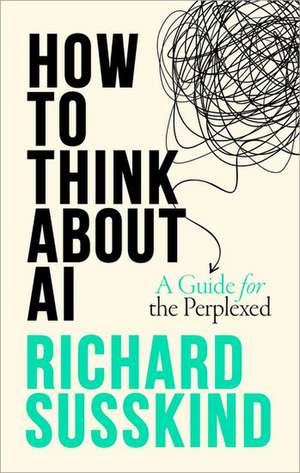
How To Think About AI: A Guide For The Perplexed
Autor Richard Susskinden Limba Engleză Hardback – 20 mar 2025
Preț: 53.01 lei
Preț vechi: 68.35 lei
-22% Nou
Puncte Express: 80
Preț estimativ în valută:
9.38€ • 11.01$ • 8.23£
9.38€ • 11.01$ • 8.23£
Carte disponibilă
Livrare economică 08-14 ianuarie 26
Livrare express 20-26 decembrie pentru 24.26 lei
Preluare comenzi: 021 569.72.76
Specificații
ISBN-13: 9780198941927
ISBN-10: 0198941927
Pagini: 224
Dimensiuni: 140 x 224 x 22 mm
Greutate: 0.33 kg
Editura: OUP OXFORD
Colecția OUP Oxford
Locul publicării:Oxford, United Kingdom
ISBN-10: 0198941927
Pagini: 224
Dimensiuni: 140 x 224 x 22 mm
Greutate: 0.33 kg
Editura: OUP OXFORD
Colecția OUP Oxford
Locul publicării:Oxford, United Kingdom
Recenzii
Richard Susskind's very readable How To Think about AI has a double appeal: to the expert who knows about AI and is worried about the consequences and to the lay reader, who needs to understand the scale of the change that is happening around us. It is a 'must-read' for anybody interested in the AI revolution.
This book is essential reading for those who wish to think about AI, explore its promise, and transform the world through AI.
This book cuts through the many misunderstandings about AI with wonderful clarity. It is vital reading in a fast-changing world.
A page turner of a book about AI from someone who really knows what he is talking about. This is a very refreshing and pragmatic look at AI to help the non-technical understand what it's all about. Highly recommended.
The name Susskind is virtually synonymous with the phrase 'AI and its impact'. There is no better guide through the still-unfolding maze of questions about this matter than this cogent, lucid, instructive, and deeply thought-provoking survey: it is an absolute must-read.
One of the most important and interesting voices on artificial intelligence - a must-read for anyone trying to understand the change through which we are living.
AI sage Richard Susskind boldly reframes the AI revolution by asking 'what if', steering us beyond the hype to eloquently reflect on the truly important, even existential choices we face.
Richard Susskind has written an elegant, easily-understood guide to the opportunities, challenges, risks and benefits of AI. It is essential reading for anyone who wants a clear introduction to the future.
In How To Think About AI, Richard Susskind explores the far-reaching impact artificial intelligence will have on us all. In this clear and accessible guide Susskind examines both the potential and challenges of AI, helping readers navigate its ethical, economic, and social implications. Essential for anyone curious about the future of technology, this book equips readers with a way of engaging with AI that forces a profound rethinking of the future and how to prepare for it.
Richard has always been at the forefront of thinking about technology and our professions. Our professions have long prided themselves on the quality, and quantity, of their written output. Now AI engulfs our professions beneath a tsunami of increasing quality. Richard's thoughtful book explores the challenges, not least that AI challenges us all to confront what it truly means to be human.
Richard Susskind is a master of clear exposition, and How To Think About AI is a salutatory wake-up call for urgent attention now to how humanity will co-exist with the undoubtedly vastly more capable artificial intelligence of tomorrow. This is an important and timely book, from a discerning thinker who has been involved with AI for decades. Whether or not you agree with the destinations in that landscape that Susskind arrives at, or how they are reached, this is an indispensable guide for how to think about AI.
A comprehensive and accessible review of the history, current, and possible future trajectories of AI, and how this will impact us all. Susskind invites us to consider the opportunities and challenges of AI as they relate to humankind and ultimately perhaps the wider cosmos.
In this cynical arena, Susskind's book stands out for its willingness to consider the issue from multiple angles. Governments, AI ethicists and, above all, tech CEOs are not spared his critique ... this book is a thorough and thoughtful resource for the curious.
Measured and insightful...[Susskind] writes with both humility and expertise, both theoretical and practical... [He] is ideally placed to step back in order to look forward.
A well-researched mix of historical analysis and personal reflection.
Thought-provoking
As someone who spends most of my waking hours exploring how emerging technologies transform business and society, I occasionally encounter perspectives that fundamentally shift how I view our technological future. My recent conversation with Richard Susskind, leading AI expert and author of How To Think About AI: A Guide for the Perplexed, provided exactly that kind of paradigm-shifting insight.
An indispensable guide to understanding what artificial intelligence can - or will - do to us, our societies, our nations, and the world.
Probably the most valuable single book to read in 2025.
May be [Susskind's] best book yet.
An excellent summary of what seems to be a vast literature and presents the major issues in a helpful and instructive manner that is certainly not patronising. The modest size is illusory, first, as it encompasses explanations of major and critical issues that are pressing now, and not theoretical matters.
Every professional needs to read this book now - before it's too late.
An invaluable, clear and rather terrifying account for lay readers of the history, development and possible future of artificial intelligence.
Susskind has a rare talent for synthesizing complex ideas and explaining them in a clear and engaging way...[this] may be Susskind's most timely and clarifying work yet.
[O]ne of the best [books on AI], filled with real insight and common sense, and refusing to engage in either fear-mongering or a casual dismissal of other, more opinionated takes...[Susskind's book] is frank about the confusion and mystery that any candid approach to artificial intelligence entails, and that is as good a record as exists right now.
How to Think About AI is a much-needed call to take a step back from the short-term hype about AI, while taking seriously its potential future significance and pushing the boundaries of what most people consider remotely possible. It is both informative and interesting, and it is written in a clear and lively style which will make it accessible to a wide audience.
This book is essential reading for those who wish to think about AI, explore its promise, and transform the world through AI.
This book cuts through the many misunderstandings about AI with wonderful clarity. It is vital reading in a fast-changing world.
A page turner of a book about AI from someone who really knows what he is talking about. This is a very refreshing and pragmatic look at AI to help the non-technical understand what it's all about. Highly recommended.
The name Susskind is virtually synonymous with the phrase 'AI and its impact'. There is no better guide through the still-unfolding maze of questions about this matter than this cogent, lucid, instructive, and deeply thought-provoking survey: it is an absolute must-read.
One of the most important and interesting voices on artificial intelligence - a must-read for anyone trying to understand the change through which we are living.
AI sage Richard Susskind boldly reframes the AI revolution by asking 'what if', steering us beyond the hype to eloquently reflect on the truly important, even existential choices we face.
Richard Susskind has written an elegant, easily-understood guide to the opportunities, challenges, risks and benefits of AI. It is essential reading for anyone who wants a clear introduction to the future.
In How To Think About AI, Richard Susskind explores the far-reaching impact artificial intelligence will have on us all. In this clear and accessible guide Susskind examines both the potential and challenges of AI, helping readers navigate its ethical, economic, and social implications. Essential for anyone curious about the future of technology, this book equips readers with a way of engaging with AI that forces a profound rethinking of the future and how to prepare for it.
Richard has always been at the forefront of thinking about technology and our professions. Our professions have long prided themselves on the quality, and quantity, of their written output. Now AI engulfs our professions beneath a tsunami of increasing quality. Richard's thoughtful book explores the challenges, not least that AI challenges us all to confront what it truly means to be human.
Richard Susskind is a master of clear exposition, and How To Think About AI is a salutatory wake-up call for urgent attention now to how humanity will co-exist with the undoubtedly vastly more capable artificial intelligence of tomorrow. This is an important and timely book, from a discerning thinker who has been involved with AI for decades. Whether or not you agree with the destinations in that landscape that Susskind arrives at, or how they are reached, this is an indispensable guide for how to think about AI.
A comprehensive and accessible review of the history, current, and possible future trajectories of AI, and how this will impact us all. Susskind invites us to consider the opportunities and challenges of AI as they relate to humankind and ultimately perhaps the wider cosmos.
In this cynical arena, Susskind's book stands out for its willingness to consider the issue from multiple angles. Governments, AI ethicists and, above all, tech CEOs are not spared his critique ... this book is a thorough and thoughtful resource for the curious.
Measured and insightful...[Susskind] writes with both humility and expertise, both theoretical and practical... [He] is ideally placed to step back in order to look forward.
A well-researched mix of historical analysis and personal reflection.
Thought-provoking
As someone who spends most of my waking hours exploring how emerging technologies transform business and society, I occasionally encounter perspectives that fundamentally shift how I view our technological future. My recent conversation with Richard Susskind, leading AI expert and author of How To Think About AI: A Guide for the Perplexed, provided exactly that kind of paradigm-shifting insight.
An indispensable guide to understanding what artificial intelligence can - or will - do to us, our societies, our nations, and the world.
Probably the most valuable single book to read in 2025.
May be [Susskind's] best book yet.
An excellent summary of what seems to be a vast literature and presents the major issues in a helpful and instructive manner that is certainly not patronising. The modest size is illusory, first, as it encompasses explanations of major and critical issues that are pressing now, and not theoretical matters.
Every professional needs to read this book now - before it's too late.
An invaluable, clear and rather terrifying account for lay readers of the history, development and possible future of artificial intelligence.
Susskind has a rare talent for synthesizing complex ideas and explaining them in a clear and engaging way...[this] may be Susskind's most timely and clarifying work yet.
[O]ne of the best [books on AI], filled with real insight and common sense, and refusing to engage in either fear-mongering or a casual dismissal of other, more opinionated takes...[Susskind's book] is frank about the confusion and mystery that any candid approach to artificial intelligence entails, and that is as good a record as exists right now.
How to Think About AI is a much-needed call to take a step back from the short-term hype about AI, while taking seriously its potential future significance and pushing the boundaries of what most people consider remotely possible. It is both informative and interesting, and it is written in a clear and lively style which will make it accessible to a wide audience.
Notă biografică
Professor Richard Susskind CBE KC is Special Envoy for Justice and AI to the Secretary-General of the Commonwealth. He is President of the Society for Computers and Law, and for 25 years, from 1998 to 2023, was Technology Adviser to the Lord Chief Justice of England and Wales. The author of 11 books, his work has been translated into 16 languages and he has been invited to speak in over 50 countries. He wrote his doctorate on AI and law at Balliol College Oxford in the mid-1980s. He is a Fellow of the British Computer Society and of the Royal Society of Edinburgh.