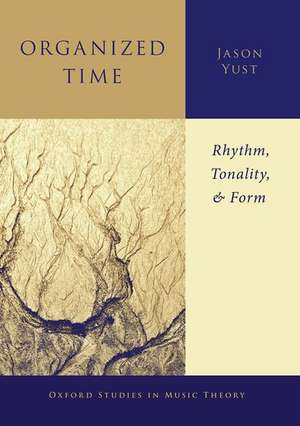
Organized Time: Rhythm, Tonality, and Form: Oxford Studies in Music Theory
Autor Jason Yusten Limba Engleză Paperback – 13 noi 2020
Din seria Oxford Studies in Music Theory
- 32%
 Preț: 684.19 lei
 - 14%
 Preț: 217.86 lei
 - 19%
 Preț: 150.77 lei
 - 30%
 Preț: 454.81 lei
 - 29%
 Preț: 432.23 lei
 - 29%
 Preț: 498.35 lei
 - 28%
 Preț: 450.53 lei
 - 29%
 Preț: 449.54 lei
 - 29%
 Preț: 545.65 lei
 - 19%
 Preț: 173.94 lei
 - 20%
 Preț: 375.32 lei
 - 18%
 Preț: 366.36 lei
 - 8%
 Preț: 291.15 lei
 - 28%
 Preț: 403.82 lei
 - 18%
 Preț: 389.13 lei
 - 19%
 Preț: 351.74 lei
 - 19%
 Preț: 352.76 lei
 - 27%
 Preț: 430.14 lei
 - 28%
 Preț: 424.25 lei
 - 31%
 Preț: 385.54 lei
 - 21%
 Preț: 368.33 lei
 - 14%
 Preț: 302.92 lei
 -
 Preț: 342.87 lei
 - 18%
 Preț: 395.93 lei
 -
 Preț: 268.20 lei
 - 16%
 Preț: 165.00 lei
 - 31%
 Preț: 550.35 lei
 - 18%
 Preț: 357.72 lei
 - 6%
 Preț: 529.48 lei
 - 30%
 Preț: 559.01 lei
 - 27%
 Preț: 447.77 lei
 - 28%
 Preț: 537.65 lei
 - 28%
 Preț: 458.54 lei
 - 26%
 Preț: 422.02 lei
 - nou
 Preț: 616.31 lei
Preț: 360.67 lei
Preț vechi: 426.00 lei
-15%
Puncte Express: 541
Carte tipărită la comandă
Livrare economică 04-15 decembrie
Livrare prin curier în România Termenul estimat este afișat lângă disponibilitate.
Transport gratuit de la 400.00 lei Plată online sau ramburs, în funcție de opțiunile comenzii.
Retur gratuit în 14 zile Comandă securizată și suport în română.
Specificații
ISBN-13: 9780197546420
ISBN-10: 0197546420
Pagini: 440
Ilustrații: 543 musical examples
Dimensiuni: 178 x 251 x 23 mm
Greutate: 0.77 kg
Editura: Oxford University Press
Colecția OUP USA
Seria Oxford Studies in Music Theory
Locul publicării:New York, United States
ISBN-10: 0197546420
Pagini: 440
Ilustrații: 543 musical examples
Dimensiuni: 178 x 251 x 23 mm
Greutate: 0.77 kg
Editura: Oxford University Press
Colecția OUP USA
Seria Oxford Studies in Music Theory
Locul publicării:New York, United States
Recenzii
Astonishing in both its ambition and its achievement. [Organized Time] offers a theory of tonal music that treats harmony, rhythm, and form as separate dimensions that might either reinforce or contradict each other, providing an appealing notation system that permits direct comparison of these dimensions. It profoundly rethinks aspects of tonal theory that we had thought pretty well settled. The theoretical framework is powerful and the analyses-of both familiar and unfamiliar tonal works-are deeply revealing.
Notă biografică
Jason Yust is Assistant Professor of Music Theory at Boston University. Born in St. Louis, Missouri, he received a BA in Music at Brown University and a PhD in Music Theory from the University of Washington. His research interests include mathematical theories of harmonic space; metrical, tonal, and formal structure in tonal music; and music perception and cognition.
Cuprins
- Contents
- Introduction
- Time and Landscape
- Dimension
- Chapter 1: Rhythmic Hierarchy and the Network Model
- 1.1 Metric and Rhythmic Structures as Temporal Hierarchies
- 1.2 Rhythmic Classes and Transformations
- 1.3 Inferring Rhythmic Hierarchies
- 1.4 Metricality
- Chapter 2: Tonal Structure
- 2.1 Melodic Structure
- 2.2 Backgrounds
- 2.3 Repetition
- 2.4 Keys
- 2.5 Tonal Models for Binary Forms
- Chapter 3: Formal Structure
- 3.1 Elements of Form: Repetition, Contrast, Fragmentation
- 3.2 Small Baroque Forms
- 3.3 Expositions and the Secondary Theme
- 3.4 Interactions of Form and Tonal Structure
- Chapter 4: Structural Networks and the Experience of Musical Time
- 4.1 Depth, Distance, and the Classification of Structural Shapes
- 4.2 A Phenomenology of Structure
- 4.3 Center, Skew, and Bias
- 4.4 Splitting and Disjunction
- Chapter 5: Timespan Intervals
- 5.1 Large-Scale Rhythmic Design in Bach's F Minor Fugue
- 5.2 Classification of Timespan Intervals
- 5.3 Hypermetric Hemiola in a Bach Prelude
- 5.4 Transformations of Rhythmic Structures
- Chapter 6: Hypermeter
- 6.1 Hypermeter in the Eye of the Beholder
- 6.2 Some Criteria for Hypermetric Analysis
- 6.3 Functions of Hypermetric Shift in Haydn's Symphonies
- 6.4 Indefinite Hypermeter and Hypermetric Reinterpretation
- Chapter 7: Hypermeter, Form, and Closure
- 7.1 Hypermetric Placement in Cadential Syntax
- 7.2 Mozart's Afterbeat Melodic Ideas
- 7.3 Main Theme Endings in Haydn's Symphonies
- 7.4 Elided Cadences and Expositional Closure
- 7.5 Beethoven's Open Expositions
- Chapter 8: Syncopation
- 8.1 Contrapuntal and Tonal versus Structural Syncopation
- 8.2 Contrapuntal Syncopation and Metrical Dissonance
- 8.3 Hypermetric Syncopation and Contrapuntal Displacement
- 8.4 Rhythmic Process as Formal Process in Beethoven
- Chapter 9: Counterpoint
- 9.1 Rhythmic Counterpoint
- 9.2 Brahms's Use of Rhythmic Irregularity and Rhythmic Counterpoint
- 9.3 Counterpoint of Tonal Structures
- 9.4 Formal Counterpoint
- Chapter 10: Harmony Simplified
- 10.1 Harmonic Syntax and Structure
- 10.2 Voice Leading on the Tonnetz
- 10.3 Enharmonicism
- Chapter 11: Reforming Formal Analysis
- 11.1 Tonal Disjunction and the Phrase
- 11.2 Ritornello Form in the Eighteenth-Century Symphony
- 11.3 Form(s) and Recipes
- 11.4 Outside the Frame
- Chapter 12: Tonal-Formal Disjunction
- 12.1 High-Level Tonal-Formal Disjunction in Sonata Form
- 12.2 Alternate Subordinate Keys
- 12.3 Disjunction in the Exposition: Modulating Subordinate Themes
- 12.4 Off-Tonic Recapitulations
- Chapter 13: Graph Theory for Temporal Structure
- 13.1 Planarity and Cycles
- 13.2 Direction and Confluence
- 13.3 Chords and Holes
- 13.4 Reduction Trees, Event Trees, and Spanning Trees over MOPs
- 13.5 Spanning Trees and the Cycle/Edge-Cut Algebras
- Chapter 14: A Geometry of Temporal Structure
- 14.1 Associahedra
- 14.2 Higher-Dimensional Associahedra and their Facets
- 14.3 Evenness
- Epilogue