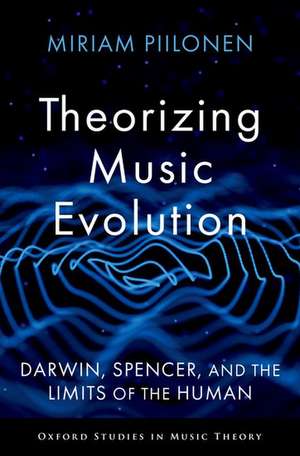
Theorizing Music Evolution: Darwin, Spencer, and the Limits of the Human: Oxford Studies in Music Theory
Autor Miriam Piilonenen Limba Engleză Hardback – 7 mar 2024
Din seria Oxford Studies in Music Theory
- 32%
 Preț: 684.19 lei
 - 14%
 Preț: 217.86 lei
 - 19%
 Preț: 150.77 lei
 - 29%
 Preț: 432.23 lei
 - 29%
 Preț: 498.35 lei
 - 28%
 Preț: 450.53 lei
 - 29%
 Preț: 449.54 lei
 - 29%
 Preț: 545.65 lei
 - 19%
 Preț: 173.94 lei
 - 20%
 Preț: 375.32 lei
 - 18%
 Preț: 366.36 lei
 - 8%
 Preț: 291.15 lei
 - 28%
 Preț: 403.82 lei
 - 18%
 Preț: 389.13 lei
 - 19%
 Preț: 351.74 lei
 - 19%
 Preț: 352.76 lei
 - 27%
 Preț: 430.14 lei
 - 28%
 Preț: 424.25 lei
 - 31%
 Preț: 385.54 lei
 - 21%
 Preț: 368.33 lei
 - 14%
 Preț: 302.92 lei
 - 15%
 Preț: 360.67 lei
 -
 Preț: 342.87 lei
 - 18%
 Preț: 395.93 lei
 -
 Preț: 268.20 lei
 - 16%
 Preț: 165.00 lei
 - 31%
 Preț: 550.35 lei
 - 18%
 Preț: 357.72 lei
 - 6%
 Preț: 529.48 lei
 - 30%
 Preț: 559.01 lei
 - 27%
 Preț: 447.77 lei
 - 28%
 Preț: 537.65 lei
 - 28%
 Preț: 458.54 lei
 - 26%
 Preț: 422.02 lei
 - nou
 Preț: 616.31 lei
Preț: 454.81 lei
Preț vechi: 646.33 lei
-30%
Puncte Express: 682
Carte disponibilă
Livrare economică 13-24 noiembrie
Livrare prin curier în România Termenul estimat este afișat lângă disponibilitate.
Transport gratuit pentru acest produs Plată online sau ramburs, în funcție de opțiunile comenzii.
Retur gratuit în 14 zile Comandă securizată și suport în română.
Specificații
ISBN-13: 9780197695289
ISBN-10: 0197695280
Pagini: 168
Ilustrații: 8 b/w figures
Dimensiuni: 226 x 163 x 28 mm
Greutate: 0.39 kg
Editura: Oxford University Press
Colecția OUP USA
Seria Oxford Studies in Music Theory
Locul publicării:New York, United States
ISBN-10: 0197695280
Pagini: 168
Ilustrații: 8 b/w figures
Dimensiuni: 226 x 163 x 28 mm
Greutate: 0.39 kg
Editura: Oxford University Press
Colecția OUP USA
Seria Oxford Studies in Music Theory
Locul publicării:New York, United States
Recenzii
In the resurgent field of evolutionary musicology, Miriam Piilonen's critical account of the views of Darwin, Spencer, and Edmund Gurney is a cogent, sometimes pessimistic, always welcome intervention. Highlighting the biases and limitations of nineteenth-century evolutionism and listening for their echoes today, she offers correctives for just-so stories told and retold: about music's adaptive benefits, its primordial anticipation of language, its gendered production and impact, and, most generally, its progress.
The pioneers of evolution, great Victorians like Herbert Spencer and Charles Darwin, thought long and hard about music. As an experience, it both puzzled and amazed them. Yet they strongly disagreed about its origins and purpose. The issues raised in their discussions have recently resurfaced, so Piilonen's new book, Theorizing Music Evolution, is both a welcome resource and a gentle caution lest we unknowingly resurrect the problematic presuppositions of our scientific ancestors.
Piilonen's book sheds light on the surprising similarities between the Victorian tendency to view music as a metonym for evolution and our modern tendencies to continue doing so. Such a robust intellectual history stands as a vital addition to the current fields of music theory, evolutionary musicology, and posthumanism.
In this brilliant, incisive book, Miriam Piilonen shows that nineteenth-century evolutionists such as Charles Darwin and Herbert Spencer remain relevant today. Their speculative, often biased theories reverberate in discussions of culture and biology, voice, emotion, embodiment, music-language relations, gender and sexuality, and ultimately, the very definitions of music and humanity. Theorizing Music Evolution will be thought-provoking reading for music scholars, psychologists, and anyone curious about the origins and functions of music.
Piilonen's book deepens our understanding of nineteenth-century thinking on music and evolution. She explores the nuances of Darwin's ideas on the topic and shows how his ideas are entwined with others such as Spencer and Gurney and enmeshed in English Victorian ideologies. Based on this analysis, Piilonen raises timely issues for contemporary research on the evolution of human musicality.
This is an incisive and stimulating book, and I learned much from it concerning the historical background of evolutionary theory of music, and its philosophical implications.
The pioneers of evolution, great Victorians like Herbert Spencer and Charles Darwin, thought long and hard about music. As an experience, it both puzzled and amazed them. Yet they strongly disagreed about its origins and purpose. The issues raised in their discussions have recently resurfaced, so Piilonen's new book, Theorizing Music Evolution, is both a welcome resource and a gentle caution lest we unknowingly resurrect the problematic presuppositions of our scientific ancestors.
Piilonen's book sheds light on the surprising similarities between the Victorian tendency to view music as a metonym for evolution and our modern tendencies to continue doing so. Such a robust intellectual history stands as a vital addition to the current fields of music theory, evolutionary musicology, and posthumanism.
In this brilliant, incisive book, Miriam Piilonen shows that nineteenth-century evolutionists such as Charles Darwin and Herbert Spencer remain relevant today. Their speculative, often biased theories reverberate in discussions of culture and biology, voice, emotion, embodiment, music-language relations, gender and sexuality, and ultimately, the very definitions of music and humanity. Theorizing Music Evolution will be thought-provoking reading for music scholars, psychologists, and anyone curious about the origins and functions of music.
Piilonen's book deepens our understanding of nineteenth-century thinking on music and evolution. She explores the nuances of Darwin's ideas on the topic and shows how his ideas are entwined with others such as Spencer and Gurney and enmeshed in English Victorian ideologies. Based on this analysis, Piilonen raises timely issues for contemporary research on the evolution of human musicality.
This is an incisive and stimulating book, and I learned much from it concerning the historical background of evolutionary theory of music, and its philosophical implications.
Notă biografică
Miriam Piilonen is Assistant Professor of Music Theory at the University of Massachusetts Amherst. Her research has appeared in Critical Inquiry and Empirical Musicology Review, and her chapter "Music Theory and Social Media" appears in The Oxford Handbook of Public Music Theory.