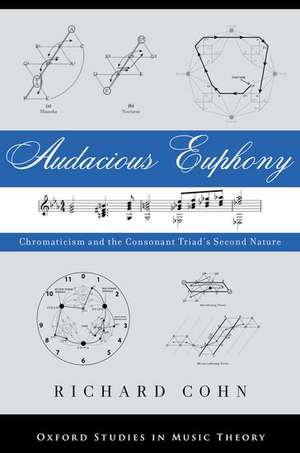
Audacious Euphony: Chromatic Harmony and the Triad's Second Nature: Oxford Studies in Music Theory
Autor Richard Cohnen Limba Engleză Hardback – 16 feb 2012
Din seria Oxford Studies in Music Theory
- 32%
 Preț: 684.19 lei
 - 14%
 Preț: 217.86 lei
 - 19%
 Preț: 150.77 lei
 - 30%
 Preț: 454.81 lei
 - 29%
 Preț: 432.23 lei
 - 29%
 Preț: 498.35 lei
 - 28%
 Preț: 450.53 lei
 - 29%
 Preț: 449.54 lei
 - 29%
 Preț: 545.65 lei
 - 19%
 Preț: 173.94 lei
 - 20%
 Preț: 375.32 lei
 - 18%
 Preț: 366.36 lei
 - 8%
 Preț: 291.15 lei
 - 18%
 Preț: 389.13 lei
 - 19%
 Preț: 351.74 lei
 - 19%
 Preț: 352.76 lei
 - 27%
 Preț: 430.14 lei
 - 28%
 Preț: 424.25 lei
 - 31%
 Preț: 385.54 lei
 - 21%
 Preț: 368.33 lei
 - 14%
 Preț: 302.92 lei
 - 15%
 Preț: 360.67 lei
 -
 Preț: 342.87 lei
 - 18%
 Preț: 395.93 lei
 -
 Preț: 268.20 lei
 - 16%
 Preț: 165.00 lei
 - 31%
 Preț: 550.35 lei
 - 18%
 Preț: 357.72 lei
 - 6%
 Preț: 529.48 lei
 - 30%
 Preț: 559.01 lei
 - 27%
 Preț: 447.77 lei
 - 28%
 Preț: 537.65 lei
 - 28%
 Preț: 458.54 lei
 - 26%
 Preț: 422.02 lei
 - nou
 Preț: 616.31 lei
Preț: 403.82 lei
Preț vechi: 558.42 lei
-28%
Puncte Express: 606
Carte tipărită la comandă
Livrare economică 04-15 decembrie
Livrare prin curier în România Termenul estimat este afișat lângă disponibilitate.
Transport gratuit pentru acest produs Plată online sau ramburs, în funcție de opțiunile comenzii.
Retur gratuit în 14 zile Comandă securizată și suport în română.
Specificații
ISBN-13: 9780199772698
ISBN-10: 019977269X
Pagini: 256
Dimensiuni: 236 x 163 x 23 mm
Greutate: 0.52 kg
Editura: Oxford University Press
Colecția OUP USA
Seria Oxford Studies in Music Theory
Locul publicării:New York, United States
ISBN-10: 019977269X
Pagini: 256
Dimensiuni: 236 x 163 x 23 mm
Greutate: 0.52 kg
Editura: Oxford University Press
Colecția OUP USA
Seria Oxford Studies in Music Theory
Locul publicării:New York, United States
V-ar putea interesa
-
 Performing Rites: On the Value of Popular MusicSimon Frith-20%Preț: 366.60 lei457.00 lei
 -
 -13%Preț: 282.88 lei324.01 lei
 -
 The Nibelungenlied: The Lay of the NibelungsCyril EdwardsPreț: 69.69 lei
 -
 The Music of James BondJon Burlingame-24%Preț: 167.45 lei220.61 lei
 -
 Elvis Presley: A Southern LifeJoel Williamson-21%Preț: 201.51 lei254.61 lei
 -
 The Music of James BondJon Burlingame-20%Preț: 323.34 lei402.12 lei
 -
 -5%Preț: 321.37 lei338.76 lei
 -
 Can't Buy Me LoveJonathan GouldPreț: 155.44 lei
 -
 The Cambridge Companion to the BeatlesKenneth WomackPreț: 257.61 lei
 -
 Paul WellerPaolo Hewitt-18%Preț: 76.57 lei93.34 lei
 -
 -15%Preț: 454.98 lei535.26 lei
Recenzii
This book is a major contribution to the field of music theory ... Cohn targets not only music theorists but also music historians, conductors, performers, and any interested music listener with a modest level of music-theory training. Avoiding excessive theoretical jargon ... he presents analyses ... that are illuminating regardless of one's theoretical background ... Highly recommended
Notă biografică
Richard Cohn is Battell Professor of Music Theory at Yale University. His work on chromatic harmony has been the topic of a series of summer seminars convened by the late John Clough, and has been developed in about a dozen doctoral dissertations, at Chicago, Indiana, Yale, Harvard, and SUNY-Buffalo. His articles have twice earned the Society for Music Theory's Outstanding Publication Award. Cohn edits the Oxford Studies in Music Theory series. In preparation is a general model of meter with applications for European, African, and African-diasporic music, and a co-edited collection on David Lewin's phenomenological writings.