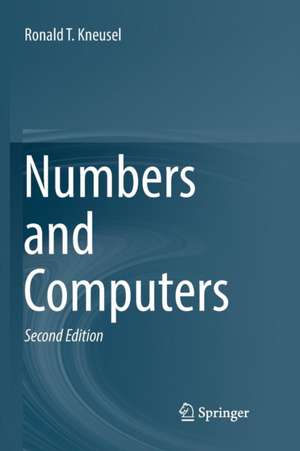
Numbers and Computers
Autor Ronald T. Kneuselen Limba Engleză Paperback – 13 iul 2018
Notăm cu interes apariția celei de-a treia ediții a lucrării Numbers and Computers, un text de referință pentru studenții în informatică, dezvoltatorii de software și cercetătorii care doresc să înțeleagă fundamentul matematic al mașinilor de calcul. Această ediție 2025 aduce o perspectivă actualizată asupra modului în care computerele gestionează datele numerice, punând un accent deosebit pe distincția dintre ceea ce poate fi reprezentat cu acuratețe și limitările inerente sistemelor de calcul. Descoperim aici o structură riguroasă, organizată în zece capitole care pornesc de la sistemele de numerație de bază și evoluează spre subiecte complexe precum aritmetica de interval și formatele de precizie arbitrară.
Remarcăm faptul că Ronald T. Kneusel extinde cadrul propus de Every Bit Counts prin integrarea unor date noi privind formatele de numere optimizate pentru inteligența artificială. Un element distinctiv al acestei ediții este capitolul dedicat unui experiment colaborativ cu GPT-4 pentru generarea de formate numerice inedite, reflectând preocupările actuale ale autorului vizibile și în How AI Works. Spre deosebire de abordarea pur teoretică din Handbook of Floating-Point Arithmetic, Kneusel menține un echilibru pragmatic, oferind fragmente de cod în Python și C pentru a ilustra conceptele discutate.
Evoluția de la edițiile anterioare este marcată de adăugarea formatelor posit și a soluțiilor pentru eficiența rețelelor neurale, teme care completează expertiza autorului începută în Practical Deep Learning, 2nd Edition. Textul nu se limitează la descrierea formatelor standard, ci analizează critic capcanele numerelor floating-point, oferind strategii concrete pentru evitarea erorilor de precizie în aplicațiile științifice și de inginerie.
Preț: 380.40 lei
Preț vechi: 475.49 lei
-20%
Carte tipărită la comandă
Livrare economică 28 iulie-11 august
Specificații
ISBN-10: 3319844156
Pagini: 360
Ilustrații: XIII, 346 p. 68 illus., 12 illus. in color.
Dimensiuni: 155 x 235 x 20 mm
Greutate: 0.55 kg
Ediția:Second Edition 2017
Editura: Springer
Locul publicării:Cham, Switzerland
V-ar putea interesa
-
 -20%Preț: 206.70 lei258.37 lei
 -
 Using Artificial Intelligence Absolute Beginner's GuideMichael Miller-20%Preț: 189.01 lei236.26 lei
 -
 CodeCharles Petzold-20%Preț: 185.98 lei232.48 lei
 -
 -11%Preț: 305.14 lei343.89 lei
 -
 Numbers: A Very Short IntroductionPeter M. Higgins-21%Preț: 55.06 lei70.00 lei
 -
 Concrete MathematicsRonald Graham-20%Preț: 535.38 lei669.22 lei
 -
 The Art of Computer ProgrammingDonald Knuth-20%Preț: 475.96 lei594.95 lei
 -
 Hacker's DelightHenry Warren-20%Preț: 333.89 lei417.36 lei
 -
 Computer Architecture: A Quantitative ApproachJohn L. Hennessy-41%Preț: 517.65 lei870.83 lei
 -
 How to Calculate QuicklyHenry StickerPreț: 56.09 lei
 -
 Agentic AI For DummiesPam Baker-20%Preț: 143.73 lei179.66 lei
 -
 The Essential Book of AIAnne Rooney-20%Preț: 71.24 lei89.04 lei
 -
 The Book of NumbersTim Glynne-JonesPreț: 92.39 lei
 -
 Preț: 80.87 lei
 -
 Maths All Around You: MeasurementsRob Colson-38%Preț: 50.75 lei81.26 lei
 -
 Click, Connect, Compute: Computer Science EssentialsDr Dharini Balasubramaniam-38%Preț: 48.72 lei78.90 lei
 -
 Math for ProgrammingRonald T. Kneusel-36%Preț: 235.53 lei367.50 lei
 -
 Why Machines LearnAnil AnanthaswamyPreț: 157.93 lei
 -
 A Year in NumbersKyle D. EvansPreț: 79.07 lei
 -
 Statistics for ScientistsUmberto Michelucci-20%Preț: 275.88 lei344.84 lei
De ce să citești această carte
Această carte se adresează programatorilor și studenților care vor să treacă dincolo de utilizarea abstractă a variabilelor și să înțeleagă cum sunt stocate numerele la nivel de bit. Cititorul câștigă o înțelegere profundă a erorilor de rotunjire și a noilor formate numerice utilizate în AI. Este o resursă esențială pentru scrierea unui cod mai robust și eficient, oferind un fundament matematic aplicat, indispensabil în contextul actual al dezvoltării sistemelor de calcul performante.
Despre autor
Ronald T. Kneusel este un autor și cercetător cu o vastă experiență în domeniul informaticii și al inteligenței artificiale. Lucrările sale, publicate adesea în colecții de prestigiu precum Texts in Computer Science de la Springer, se concentrează pe intersecția dintre matematică și programare. Printre titlurile sale notabile se numără Math for Programming și The Art of Randomness, volume apreciate pentru claritatea cu care explică subiecte tehnice complexe. Expertiza sa în deep learning și sisteme numerice îl poziționează ca o autoritate în explicarea modului în care arhitecturile moderne de calcul pot fi optimizate prin înțelegerea riguroasă a datelor.
Descriere scurtă
Divided into two parts, the first deals with standard representations of integers and floating point numbers, while the second examines several other number representations. Details are explained thoroughly, with clarity and specificity. Each chapter ends with a summary, recommendations, carefully selected references, and exercises to review the key points. Topics covered include interval arithmetic, fixed-point numbers, big integers and rational arithmetic. This new edition has three new chapters: Pitfalls of Floating-Point Numbers (and How to Avoid Them), Arbitrary Precision Floating Point, and Other Number Systems.
This book is for anyone who develops software including software engineers, scientists, computer science students, engineering students and anyone who programs for fun.
Cuprins
Recenzii
Notă biografică
Caracteristici
Textul de pe ultima copertă
The revised and updated third edition of this unique textbook/reference details the variety of number formats used by computers, thereby helping to ground readers in what can and cannot be represented accurately, especially by floating-point numbers.
The book's first part details standard representations of integers and floating-point numbers. The second explores other number representations, including the wide variety recently developed to support artificial intelligence (AI) and its demand for efficiency in representation to accommodate the ever-expanding scope of neural network models. Chapters describe each format, with examples in code (Python and C) and exercises. This new edition includes three new chapters on posits, AI number formats, and a collaborative experiment with an AI to generate novel number formats.
Topics and features:
- Explores how computers use numbers to complete operations
- Adds new chapters on posits and AI number formats
- Includes exercises and examples that are code snippets in C or Python
- Implements and tests new AI-designed number formats (as designed by GPT-4)
- Provides thorough grounding on what can and cannot be represented accurately
Dr. Ronald T. Kneusel, a senior data scientist with L3Harris (Melbourne, FL, USA), is also the author of the Springer book, Random Numbers and Computers.