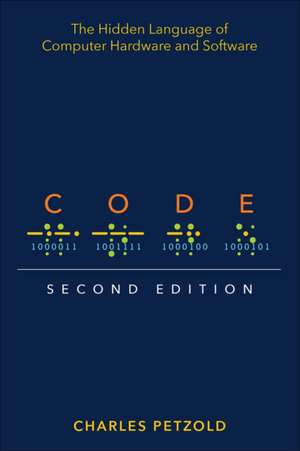
Code
Autor Charles Petzolden Limba Engleză Paperback – 28 iul 2022
Pentru a parcurge Code, cititorul nu are nevoie de cunoștințe prealabile de inginerie sau programare, însă este necesară o curiozitate tehnică riguroasă pentru a înțelege cum logica pură se transformă în hardware funcțional. Remarcăm că această a doua ediție, publicată de Microsoft Press, extinde modelul teoretic original prin capitole noi care detaliază construcția „inimii” oricărui dispozitiv inteligent: unitatea centrală de procesare. Suntem de părere că forța acestui volum rezidă în structura sa stratificată. Charles Petzold nu începe cu microcipuri complexe, ci cu bazele comunicării umane. Pe linia practică a volumului The Elements of Computing Systems, dar cu un focus pronunțat pe evoluția istorică și conceptuală a componentelor, Code explică modul în care releele și comutatoarele devin porți logice, care la rândul lor formează sumatoare și unități aritmetice (ALU). Progresia este logică și granulară: de la sistemul binar și codul ASCII, până la mecanismele complexe de „Jumps, Loops, and Calls” introduse în noile capitole. Spre deosebire de Principles of Computer Hardware, care adoptă un ton academic de manual universitar, Code utilizează o abordare narativă și vizuală. Includerea diagramelor și a referințelor către site-ul dedicat cu simulări interactive permite vizualizarea fluxului de date prin registre și magistrale (busses). Este o explorare tehnică a „limbajului ascuns” din spatele siliciului, transformând conceptele abstracte de Systems Thinking în specificații concrete de construcție a unui sistem de calcul.
Preț: 185.98 lei
Preț vechi: 232.48 lei
-20%
Carte disponibilă
Livrare economică 06-20 iulie
Livrare express 19-25 iunie pentru 38.62 lei
Specificații
ISBN-10: 0137909101
Pagini: 480
Ilustrații: facsimiles, portraits
Dimensiuni: 156 x 234 x 26 mm
Greutate: 0.69 kg
Ediția:2nd edition
Editura: Microsoft Press
V-ar putea interesa
-
 -20%Preț: 355.84 lei444.80 lei
 -
 Clean Code: A Handbook of Agile Software CraftsmanshipRobert Martin-20%Preț: 361.33 lei451.66 lei
 -
 -20%Preț: 300.52 lei375.66 lei
 -
 Principles of Computer HardwareAlan Clements-30%Preț: 587.38 lei836.70 lei
 -
 How to Stay Safe OnlineSeyi Akiwowo-21%Preț: 61.34 lei77.47 lei
 -
 Hacker's DelightHenry Warren-20%Preț: 333.89 lei417.36 lei
 -
 Computer Architecture: A Quantitative ApproachJohn L. Hennessy-41%Preț: 517.65 lei870.83 lei
 -
 The Design of Everyday ThingsDon NormanPreț: 108.32 lei
 -
 Computer Systems: A Programmer's Perspective, Global EditionRandal E. Bryant-20%Preț: 642.42 lei803.03 lei
 -
 Coding For Dummies, All New EditionPaul McFedries-20%Preț: 115.67 lei144.59 lei
 -
 Science Stories: Coding and ComputersLisa ReganPreț: 72.05 lei
 -
 Lift-the-Flap Computers and CodingRosie DickinsPreț: 89.26 lei
 -
 -34%Preț: 69.56 lei105.74 lei
 -
 Click, Connect, Compute: Computer Science EssentialsDr Dharini Balasubramaniam-38%Preț: 48.72 lei78.90 lei
 -
 Dive Into Systems: A Gentle Introduction to Computer SystemsSuzanne J Matthews-36%Preț: 393.13 lei615.65 lei
 -
 Introduction to Computer Organization: ARM EditionRobert G. Plantz-36%Preț: 292.96 lei460.84 lei
 -
 Computer ArchitectureCharles Fox-37%Preț: 292.12 lei460.22 lei
 -
 -36%Preț: 233.97 lei366.31 lei
 -
 Quantum Computing: From Concepts to CodeAndrew Glassner-36%Preț: 232.99 lei365.58 lei
 -
 Glucose Revolution: The life-changing power of balancing your bloodJessie Inchauspé-28%Preț: 96.31 lei134.00 lei
 -
 Digital ElectronicsGareth MonkmanPreț: 364.65 lei
De ce să citești această carte
Recomandăm această carte oricui dorește să înțeleagă fundamentul tehnologiei moderne, dincolo de interfața grafică. Cititorul câștigă o perspectivă clară asupra modului în care funcționează un procesor la nivel de poartă logică. Este ideală pentru programatori, studenți la politehnică sau entuziaști care vor să demistifice „magia” din spatele codului, oferind o bază solidă de arhitectură a sistemelor de calcul.
Despre autor
Charles Petzold este o figură legendară în literatura tehnică, fiind autorul celebrului manual Programming Windows, aflat la a cincea ediție. În 1994, a primit prestigiosul premiu Windows Pioneer din partea lui Bill Gates, recunoaștere a contribuției sale fundamentale la ecosistemul de dezvoltare software. Cu o experiență care începe de la versiunile beta ale Windows 1.0 în 1985, Petzold are capacitatea rară de a explica sisteme complexe prin analogii simple, fiind considerat unul dintre cei mai buni educatori în domeniul arhitecturii de calcul și al programării la nivel de sistem.
Cuprins
Chapter One: Best Friends
Chapter Two: Codes and Combinations
Chapter Three: Braille and Binary Codes
Chapter Four: Anatomy of a Flashlight
Chapter Five: Communicating Around Corners
Chapter Six: Logic with Switches
Chapter Seven: Telegraphs and Relays
Chapter Eight: Relays and Gates
Chapter Nine: Our Ten Digits
Chapter Ten: Alternative 10s
Chapter Eleven: Bit by Bit by Bit
Chapter Twelve: Bytes and Hexadecimal
Chapter Thirteen: From ASCII to Unicode
Chapter Fourteen: Adding with Logic Gates
Chapter Fifteen: Is This for Real?
Chapter Sixteen: But What About Subtraction?
Chapter Seventeen: Feedback and Flip-Flops
Chapter Eighteen: Lets Build a Clock!
Chapter Nineteen: An Assemblage of Memory
Chapter Twenty: Automating Arithmetic
Chapter Twenty-One: The Arithmetic Logic Unit
Chapter Twenty-Two: Registers and Busses
Chapter Twenty-Three: CPU Control Signals
Chapter Twenty-Four: Loops, Jumps, and Calls
Chapter Twenty-Five: Peripherals
Chapter Twenty-Six: The Operating System
Chapter Twenty-Seven: Coding
Chapter Twenty-Eight: The World Brain
Descriere scurtă
"For me, Code was a revelation. It was the first book about programming that spoke to me. It started with a story, and it built up, layer by layer, analogy by analogy, until I understood not just the Code, but the System. Code is a book that is as much about Systems Thinking and abstractions as it is about code and programming. Code teaches us how many unseen layers there are between the computer systems that we as users look at every day and the magical silicon rocks that we infused with lightning and taught to think."
- Scott Hanselman, Partner Program Director, Microsoft, and host of Hanselminutes
Computers are everywhere, most obviously in our laptops and smartphones, but also our cars, televisions, microwave ovens, alarm clocks, robot vacuum cleaners, and other smart appliances. Have you ever wondered what goes on inside these devices to make our lives easier but occasionally more infuriating?
For more than 20 years, readers have delighted in Charles Petzold's illuminating story of the secret inner life of computers, and now he has revised it for this new age of computing. Cleverly illustrated and easy to understand, this is the book that cracks the mystery. You'll discover what flashlights, black cats, seesaws, and the ride of Paul Revere can teach you about computing, and how human ingenuity and our compulsion to communicate have shaped every electronic device we use.
This new expanded edition explores more deeply the bit-by-bit and gate-by-gate construction of the heart of every smart device, the central processing unit that combines the simplest of basic operations to perform the most complex of feats. Petzolds companion website, CodeHiddenLanguage.com, uses animated graphics of key circuits in the book to make computers even easier to comprehend.
In addition to substantially revised and updated content, new chapters include:
- Chapter 18: Lets Build a Clock!
- Chapter 21: The Arithmetic Logic Unit
- Chapter 22: Registers and Busses
- Chapter 23: CPU Control Signals
- Chapter 24: Jumps, Loops, and Calls
- Chapter 28: The World Brain