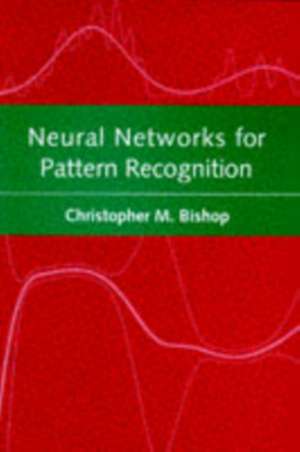
Neural Networks for Pattern Recognition
Christopher M. Bishop Autor Geoffrey Hintonen Limba Engleză Paperback – 23 noi 1995
Preț: 597.81 lei
Preț vechi: 864.42 lei
-31%
Puncte Express: 897
Carte tipărită la comandă
Livrare economică 26 noiembrie-02 decembrie
Livrare prin curier în România Termenul estimat este afișat lângă disponibilitate.
Transport gratuit pentru acest produs Plată online sau ramburs, în funcție de opțiunile comenzii.
Retur gratuit în 14 zile Comandă securizată și suport în română.
Specificații
ISBN-13: 9780198538646
ISBN-10: 0198538642
Pagini: 504
Ilustrații: line figures
Dimensiuni: 156 x 234 x 28 mm
Greutate: 0.75 kg
Editura: Clarendon Press
Colecția Clarendon Press
Locul publicării:Oxford, United Kingdom
ISBN-10: 0198538642
Pagini: 504
Ilustrații: line figures
Dimensiuni: 156 x 234 x 28 mm
Greutate: 0.75 kg
Editura: Clarendon Press
Colecția Clarendon Press
Locul publicării:Oxford, United Kingdom
V-ar putea interesa
-
 Using Artificial Intelligence Absolute Beginner's GuideMichael Miller-20%Preț: 194.58 lei243.22 lei
 -
 Machine LearningKevin P. Murphy-20%Preț: 731.22 lei918.37 lei
 -
 Deep LearningIan Goodfellow-20%Preț: 626.02 lei782.53 lei
 -
 Understanding Deep LearningSimon J. D. Prince-21%Preț: 687.48 lei867.24 lei
 -
 Gaussian Processes for Machine LearningCarl Edward Rasmussen-27%Preț: 348.38 lei476.65 lei
 -
 Theoretical NeuroscienceLaurence F. Abbott-16%Preț: 546.97 lei651.46 lei
 -
 -20%Preț: 655.10 lei818.88 lei
 -
 Pattern Recognition and Machine LearningChristopher M Bishop-20%Preț: 646.10 lei807.62 lei
 -
 The Elements of Statistical LearningJerome Friedman-20%Preț: 546.54 lei683.17 lei
 -
 -39%Preț: 394.79 lei646.62 lei
 -
 -40%Preț: 622.22 lei1028.93 lei
 -
 -31%Preț: 607.05 lei885.58 lei
 -
 Pattern ClassificationRichard O Duda-23%Preț: 1040.07 lei1350.74 lei
 -
 Pattern RecognitionM Narasimha Murty-20%Preț: 255.90 lei319.87 lei
 -
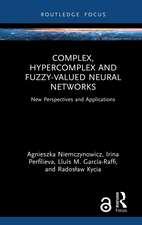 Complex, Hypercomplex and Fuzzy-Valued Neural Networks: New Perspectives and ApplicationsAgnieszka Niemczynowicz-20%Preț: 404.86 lei506.08 lei
 -
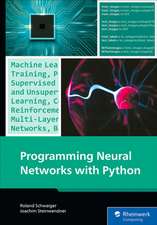 Programming Neural Networks with PythonJoachim Steinwendner-20%Preț: 301.14 lei376.42 lei
 -
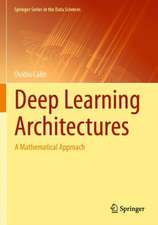 Deep Learning ArchitecturesOvidiu Calin-15%Preț: 498.66 lei586.66 lei
 -
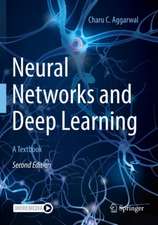 Neural Networks and Deep LearningCharu C. AggarwalPreț: 440.74 lei
 -
 Materials Data ScienceStefan Sandfeld-15%Preț: 591.20 lei695.53 lei
 -
 Statistics for ScientistsUmberto Michelucci-20%Preț: 275.88 lei344.84 lei
Recenzii
excellent... Bishop is able to achieve a level of depth on these topics which is unparalleled in other neural-net texts.... clear and concise mathematical analysis. Bishop's text [] picks up where Duda and Hart left off, and, luckily does so with the same level of clarity and elegance. Neural Networks for Pattern Recognition is an excellent read, and represents a real contribution to the neural-net community. IEEE Transactions on Neural Networks, May 1997
this is an excellent book in the specialised area of statistical pattern recognition with statistical neural nets ... a good starting point for new students in those laboratories where research into statistico-neural pattern recognition is being done ... The examples for the reader at the end of this and every chapter are well chosen and will ensure sales as a course textbook ... this is a first-class book for the researcher in statistical pattern recognition.
Bishop leads the way through a forest of mathematical minutiae. Readers will emerge with a rigorous statistical grounding in the theory of how to construct and train neural networks in pattern recognition. New Scientist
[Bishop] has written a textbook, introducing techniques, relating them to the theory, and explaining their pitfalls. Moreover, a large set of exercises makes it attractive for the teacher to use the book.... should be warmly welcomed by the neural network and pattern recognition communities. Bishop can be recommended to students and engineers in computer science. The Computer Journal, Volume 39, No. 6, 1996
Its sequential organization and end-of chapter exercises make it an ideal mental gymnasium. The author has eschewed biological metaphor and sweeping statements in favour of welcome mathematical rigour. Scientific Computing World
a neural network introduction placed in a pattern recognition context. ...He has written a textbook, introducing techniques, relating them to the theory and explaining their pitfalls. Moreover, a large set of exercises makes it attractive for the teacher to use the book ... should be warmly welcomed by the neural network and pattern recognition communities.
This outstanding book contributes remarkably to a better statistical understanding of artificial neural networks. The superior quality of this book is that it presents a comprehensive self-contained survey of feed-forward networks from the point of view of statistical pattern recognition.
this is an excellent book in the specialised area of statistical pattern recognition with statistical neural nets ... a good starting point for new students in those laboratories where research into statistico-neural pattern recognition is being done ... The examples for the reader at the end of this and every chapter are well chosen and will ensure sales as a course textbook ... this is a first-class book for the researcher in statistical pattern recognition.
Bishop leads the way through a forest of mathematical minutiae. Readers will emerge with a rigorous statistical grounding in the theory of how to construct and train neural networks in pattern recognition. New Scientist
[Bishop] has written a textbook, introducing techniques, relating them to the theory, and explaining their pitfalls. Moreover, a large set of exercises makes it attractive for the teacher to use the book.... should be warmly welcomed by the neural network and pattern recognition communities. Bishop can be recommended to students and engineers in computer science. The Computer Journal, Volume 39, No. 6, 1996
Its sequential organization and end-of chapter exercises make it an ideal mental gymnasium. The author has eschewed biological metaphor and sweeping statements in favour of welcome mathematical rigour. Scientific Computing World
a neural network introduction placed in a pattern recognition context. ...He has written a textbook, introducing techniques, relating them to the theory and explaining their pitfalls. Moreover, a large set of exercises makes it attractive for the teacher to use the book ... should be warmly welcomed by the neural network and pattern recognition communities.
This outstanding book contributes remarkably to a better statistical understanding of artificial neural networks. The superior quality of this book is that it presents a comprehensive self-contained survey of feed-forward networks from the point of view of statistical pattern recognition.