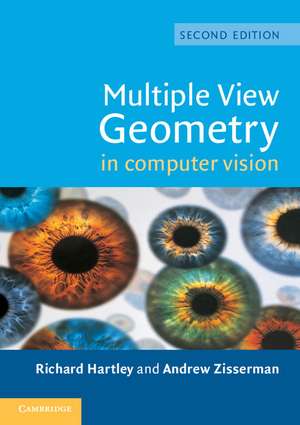
Multiple View Geom Comp Vision 2ed
Autor Richard Hartley, Andrew Zissermanen Limba Engleză Paperback – 12 feb 2019
Descoperim în această lucrare de referință o abordare practică riguroasă a viziunii artificiale, unde raportul dintre fundamentul teoretic și aplicabilitatea algoritmilor este echilibrat prin cele 124 de exerciții incluse. Putem afirma că volumul transformă concepte complexe de geometrie proiectivă în instrumente de lucru concrete, oferind cititorului posibilitatea de a implementa algoritmi de estimare direct din text. Autorii, Richard Hartley și Andrew Zisserman, structurează materialul astfel încât principiile geometrice să fie traduse în reprezentări algebrice precise, precum matricile de proiecție ale camerei și tensorul trifocal. Merită menționat că, dacă An Invitation to 3-D Vision v-a oferit cadrul teoretic necesar înțelegerii spațiului tridimensional, Multiple View Geometry in Computer Vision oferă instrumentele practice și metodele de calcul esențiale pentru reconstrucția scenelor din imagini multiple. Această ediție a doua aduce rezultate semnificative apărute recent în domeniu și anexe actualizate, consolidând poziția cărții ca standard în literatura tehnică. În contextul operei lui Richard Hartley, această carte reprezintă pilonul tehnic și specializat, spre deosebire de lucrările sale colective precum Computer Vision, care explorează perspective de cercetare mai largi. Abordarea de aici este una aplicată, transformând fotogrammetria și geometria într-un ghid de implementare pentru profesioniști și cercetători, facilitând trecerea de la imaginea bidimensională la structura reală a scenei.
Preț: 766.84 lei
Preț vechi: 891.67 lei
-14%
Carte tipărită la comandă
Livrare economică 28 noiembrie-12 decembrie
Specificații
ISBN-10: 0521540518
Pagini: 672
Ilustrații: 36 colour illus. 35 tables 124 exercises
Dimensiuni: 170 x 244 x 36 mm
Greutate: 1.32 kg
Ediția:Revizuită
Editura: Cambridge University Press
Locul publicării:Cambridge, United Kingdom
V-ar putea interesa
-
 -39%Preț: 402.67 lei660.61 lei
 -
 Deep LearningIan Goodfellow-21%Preț: 684.46 lei865.01 lei
 -
 Probabilistic Machine LearningKevin P. Murphy-21%Preț: 854.63 lei1080.57 lei
 -
 Image Processing and Acquisition using PythonRavishankar Chityala-18%Preț: 1034.06 lei1261.06 lei
 -
 -20%Preț: 418.89 lei523.61 lei
 -
 Numerical Geometry of Non-Rigid ShapesAlexander M. Bronstein-20%Preț: 515.64 lei644.54 lei
 -
 The Elements of Statistical LearningTrevor Hastie-20%Preț: 546.54 lei683.17 lei
 -
 -20%Preț: 1266.67 lei1583.33 lei
 -
 The Cyber Risk HandbookDomenic Antonucci-8%Preț: 516.27 lei561.16 lei
 -
 Database SystemsRamez Elmasri-20%Preț: 552.09 lei690.12 lei
 -
 Digital Image Processing, Global EditionRafael Gonzalez-11%Preț: 663.18 lei745.14 lei
 -
 Geometric Methods and ApplicationsJean Gallier-15%Preț: 726.41 lei854.59 lei
 -
 Guide to Computational Geometry ProcessingJ. Andreas Bærentzen-15%Preț: 555.00 lei652.95 lei
 -
 Programming Robots with ROSMorgan Quigley-20%Preț: 260.82 lei326.02 lei
 -
 Bridging Relational and NoSQL DatabasesDrazena Gaspar-20%Preț: 1091.20 lei1364.00 lei
 -
 Docker in ActionBret Fisher-20%Preț: 302.80 lei378.50 lei
 -
 -20%Preț: 285.05 lei356.31 lei
 -
 Robot Operating System CookbookPackt Publishing-20%Preț: 274.91 lei343.64 lei
 -
 Mastering ROS for Robotics Programming - Second EditionLentin Joseph-19%Preț: 477.95 lei590.06 lei
 -
 Hands-On Computer Vision with TensorFlow 2Benjamin Planche-20%Preț: 214.62 lei268.28 lei
 -
 -20%Preț: 297.64 lei372.04 lei
 -
 Python Image Processing CookbookSandipan Dey-20%Preț: 269.83 lei337.28 lei
 -
 Computer Graphics and Geometric ModellingMax K. Agoston-20%Preț: 396.47 lei495.59 lei
 -
 Mathematical Image ProcessingKristian Bredies-15%Preț: 563.05 lei662.41 lei
 -
 Principles of Distributed Database SystemsM. Tamer Özsu-20%Preț: 637.99 lei797.49 lei
 -
 Robot Operating System (ROS)Anis Koubâa-18%Preț: 1160.23 lei1414.92 lei
 -
 Foundations of Computer VisionJames F. Peters-20%Preț: 687.07 lei858.83 lei
 -
 SQL & NoSQL DatabasesAndreas Meier-20%Preț: 321.18 lei401.48 lei
 -
 Geometry of Deep LearningJong Chul Ye-15%Preț: 449.02 lei528.26 lei
De ce să citești această carte
Această carte este indispensabilă inginerilor și cercetătorilor din robotică sau viziune artificială care doresc să stăpânească geometria din spatele reconstrucției 3D. Cititorul câștigă o înțelegere profundă a algoritmilor de estimare și a matricilor de proiecție, beneficiind de un suport practic solid pentru implementarea sistemelor complexe de navigare și recunoaștere spațială.
Despre autor
Richard Hartley este o figură centrală în comunitatea de viziune computerizată, recunoscut pentru contribuțiile sale fundamentale în geometria vederii artificiale. Alături de Andrew Zisserman, a definit standardele moderne în interpretarea geometrică a imaginilor. Deși interesele sale pot părea diverse, incluzând contribuții în volume colective de cercetare precum Computer Vision, expertiza sa principală rămâne ancorată în aplicarea riguroasă a matematicii în inginerie. Colaborarea lor a transformat Multiple View Geometry in Computer Vision într-o lucrare citată la nivel global în mediul academic și industrial.
Descriere scurtă
Cuprins
Recenzii
'… a book which is timely, extremely thorough and commendably clear … Overall, the approach is masterly … The authors have managed to present the very essence of the subject in a way which the most subtle ideas seem natural and straightforward. I have never seen such a clear exploration of the geometry of vision. I would wholeheartedly recommend this book. It deserves to be in the library of every serious researcher in the field of computer vision.' Journal of Robotica
'The new edition features an extended introduction covering the key ideas in the book (which itself have been updated with additional examples and appendices) and significant new results which have appeared since the first edition. Comprehensive background material is provided, so readers familiar with linear algebra and basic numerical methods can understand the projective geometry and estimation algorithms presented, and implement the algorithms directly from the book.' Zentralblatt MATH