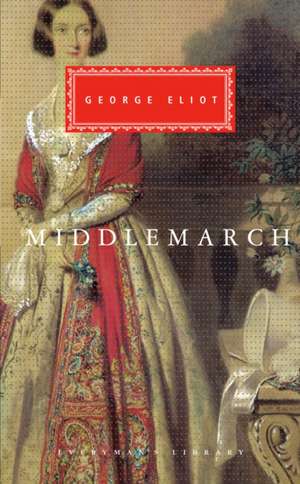
Middlemarch
Autor George Elioten Limba Engleză Hardback – 15 oct 1991
Ca și The Mill on the Floss, această lucrare explorează tensiunea dintre aspirațiile individuale și rigorile unei comunități provinciale, dar dintr-o perspectivă mult mai matură și panoramică, abandonând nostalgia în favoarea unei analize sociale chirurgicale. Observăm în Middlemarch nu doar un roman, ci un efort enciclopedic de a cartografia „istoria omului” prin prisma unor vieți aparent mărunte. Premisa este așezată sub semnul Sfintei Tereza: ce se întâmplă cu sufletele arzătoare care nu găsesc un canal epic pentru idealismul lor? Dorothea Brooke devine astfel simbolul unei grandori spirituale neadaptate la „micimea oportunităților” dintr-un oraș de provincie englezesc. În contextul operei sale, dacă Silas Marner sau Adam Bede păstrează un ton mai degrabă pastoral, Middlemarch reprezintă apogeul realismului psihologic al lui George Eliot. Structura cărții, subintitulată „A Study of Provincial Life”, este una de o complexitate remarcabilă, împletind destinele Dorotheei și ale medicului Lydgate cu o precizie care justifică faimoasa apreciere a Virginiei Woolf: este un roman pentru oameni maturi. Ritmul lecturii este dictat de o proză densă, meditativă, unde acțiunea exterioară este subordonată mișcărilor interioare ale conștiinței. Ediția de față, publicată de OUP OXFORD, îmbogățește experiența prin includerea unor anexe valoroase: eseuri ale autoarei despre moralitate și literatură, precum și recenzii de epocă, oferind cititorului coordonatele intelectuale necesare pentru a înțelege profunzimea acestui „monument” al literaturii victoriene.
Preț: 217.26 lei
Carte disponibilă
Livrare economică 14-28 august
Specificații
ISBN-10: 0679405674
Pagini: 936
Dimensiuni: 135 x 212 x 43 mm
Greutate: 0.82 kg
Editura: Knopf Doubleday Publishing Group
V-ar putea interesa
-
 XWUTHERING HEIGHTS_CLASSICS PBEmily BrontëPreț: 24.60 lei
 -
 Tess of the D'UrbervillesThomas HardyPreț: 24.60 lei
 -
 Song of SolomonToni Morrison-18%Preț: 59.51 lei72.33 lei
 -
 PossessionA. S. Byatt-16%Preț: 67.71 lei80.81 lei
 -
 UlyssesJames Joyce-39%Preț: 67.82 lei111.62 lei
 -
 Vanity FairWilliam Makepeace Thackeray-20%Preț: 66.43 lei83.19 lei
 -
 Sense and SensibilityJane Austen-26%Preț: 48.45 lei65.11 lei
 -
 AntigoneSophocles-40%Preț: 16.87 lei28.02 lei
 -
 The Worm at the CoreSheldon Solomon-19%Preț: 62.76 lei77.83 lei
 -
 Tyger, TygerWilliam Blake-40%Preț: 16.82 lei28.02 lei
 -
 One DayDavid NichollsPreț: 91.09 lei
 -
 You Are HomeCatana Chetwynd-19%Preț: 69.82 lei85.85 lei
 -
 Sea PrayerKhaled Hosseini-36%Preț: 59.36 lei92.95 lei
 -
 -25%Preț: 216.08 lei288.11 lei
 -
 Invisible Women: Exposing Data Bias in a World Designed for MenCaroline Criado Perez-19%Preț: 75.16 lei92.59 lei
 -
 Tools of TitansTimothy Ferriss-23%Preț: 148.74 lei192.92 lei
 -
 The Denial of DeathErnest Becker-20%Preț: 68.28 lei85.01 lei
 -
 The Woman in WhiteWilkie CollinsPreț: 38.41 lei
 -
 -18%Preț: 118.19 lei144.01 lei
 -
 Man's Search For MeaningViktor E. Frankl-20%Preț: 72.37 lei90.92 lei
 -
 Vanity FairWilliam Makepeace ThackerayPreț: 39.98 lei
 -
 Bleak HouseCharles DickensPreț: 40.65 lei
 -
 The Mayor of CasterbridgeThomas HardyPreț: 24.60 lei
 -
 Our Castle by the SeaLucy StrangePreț: 57.79 lei
 -
 Le Petit Prince: Antoine de Saint-ExupéryAntoine de Saint-ExupèryPreț: 35.78 lei
De ce să citești această carte
Recomandăm Middlemarch cititorului care caută o experiență de lectură profundă, capabilă să oglindească complexitatea relațiilor umane și a compromisurilor sociale. Câștigați acces la o analiză psihologică fără egal în literatura secolului al XIX-lea și la un context critic de excepție oferit de Oxford World's Classics. Este o lectură esențială pentru a înțelege evoluția romanului modern și luptele interioare ale individului împotriva convențiilor.
Despre autor
George Eliot, pseudonimul literar al lui Mary Anne Evans (1819–1880), a fost una dintre cele mai influente voci ale epocii victoriene. Într-o perioadă în care literatura feminină era adesea redusă la romane de moravuri ușoare, ea a adoptat un nume masculin pentru a se asigura că scrierile sale sunt tratate cu seriozitate intelectuală. Erudiția sa vastă, influențată de cultura germană și de studiile filozofice, se reflectă în realismul psihologic dens și în compasiunea față de eșecurile umane. Prin operele sale, George Eliot a transformat romanul într-un instrument de analiză socială și etică, rămânând până astăzi un reper al literaturii universale.
Notă biografică
With Lewes’s encouragement, Mary Ann Evans wrote her first fictional work, “The Sad Fortunes of the Reverend Amos Barton,” for Blackwood’s Magazine in 1857; it was followed by two more stories published under the pseudonym George Elliot–“George” because it was Lewes’s name and “Eliot” because, she said, it was good mouth-filling, easily pronounced word.” At the age of thirty-nine she used her memories of Warwickshire to write her first long novel, Adam Bede (1859), a book that established her as the foremost woman novelist in her day. Then came The Mill on the Floss (1860), Silas Marner (1861), and Romola (1863). Her masterpiece and one of the greatest English novels, Middlemarch, was published in 1871-72. Her last work was Daniel Deronda (1876). After Lewes’s death George Eliot married John Walter Cross. He was forty; she was sixty-one. Before her death on December 22, 1880, she had been recognized by her contemporaries as the greatest living writer of English fiction.
From the Paperback edition.
Extras
That Spanish woman who lived three hundred years ago was certainly not the last of her kind. Many Theresas have been born who found for themselves no epic life wherein there was a constant unfolding of far - resonant action; perhaps only a life of mistakes, the offspring of a certain spiritual grandeur ill - matched with the meanness of opportunity; perhaps a tragic failure which found no sacred poet and sank unwept into oblivion. With dim lights and tangled circumstance they tried to shape their thought and deed in noble agreement; but after all, to common eyes their struggles seemed mere inconsistency and formlessness; for these later - born Theresas were helped by no coherent social faith and order which could perform the function of knowledge for the ardently willing soul. Their ardour alternated between a vague ideal and the common yearning of womanhood; so that the one was disapproved as extravagance, and the other condemned as a lapse.
Some have felt that these blundering lives are due to the inconvenient indefiniteness with which the Supreme Power has fashioned the natures of women: if there were one level of feminine incompetence as strict as the ability to count three and no more, the social lot of women might be treated with scientific certitude. Meanwhile the indefiniteness remains, and the limits of variation are really much wider than any one would imagine from the sameness of women's coiffure and the favourite love - stories in prose and verse. Here and there a cygnet is reared uneasily among the ducklings in the brown pond, and never finds the living stream in fellowship with its own oary-footed kind. Here and there is born a Saint Theresa, foundress of nothing, whose loving heart -beats and sobs after an unattained goodness tremble off and are dispersed among hindrances, instead of centering in some long recognisable deed.
From the Trade Paperback edition.
Recenzii
--V. S. Pritchett
From the Trade Paperback edition.
Descriere scurtă
Introduction by E. S. Shaffer
(Book Jacket Status: Not Jacketed)
Descriere
Textul de pe ultima copertă
In a panoramic sweep of the years leading up to the First Reform Bill of 1832, George Eliot explores nearly every subject of concern to modern life: art, religion, science, politics, self, society, human relationships. Among her characters are some of the most remarkable portraits in English literature: Dorothea Brooke, the heroine, idealistic but naive; Rosamund Vincy, beautiful and egoistic; Edward Casaubon, the dry-as-dust scholar; Tertius Lydgate, the brilliant but morally flawed physician; the passionate artist, Will Ladislaw; and Fred Vincy and Mary Garth, childhood sweethearts whose charming courtship is one of the many humorous elements in the novel's comic vein.