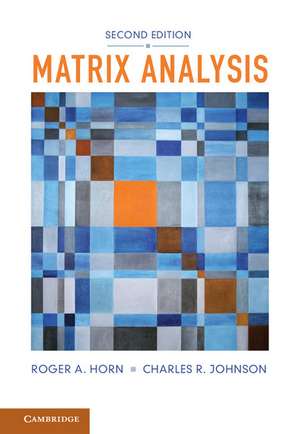
Matrix Analysis
Autor Roger A. Horn, Charles R. Johnsonen Limba Engleză Hardback – oct 2012
Problema centrală pe care o rezolvă Matrix Analysis este tranziția dificilă de la algebra liniară elementară la analiza matricială avansată, necesară în cercetarea modernă din econometrie și științele fizice. Adesea, studenții și cercetătorii stăpânesc operațiile de bază, dar le lipsește rigoarea necesară pentru a utiliza structurile matriciale în aplicații complexe. Ne-a atras atenția modul în care Roger A. Horn și Charles R. Johnson folosesc formele canonice ca fir conductor, oferind o unitate structurală unei materii care altfel ar putea părea fragmentată. Ca și Stephan Ramon Garcia în Matrix Mathematics, autorii distilează experiența academică vastă în principii acționabile, însă Matrix Analysis se distinge prin volumul impresionant de peste 1100 de exerciții, transformând textul dintr-o simplă expunere teoretică într-un instrument de lucru intensiv. Structura cărții este construită progresiv: începe cu valorile proprii și similaritatea, trece prin analiza normelor vectoriale și a matricelor Hermitiene, culminând cu studiul matricelor pozitive și nenegative. Reținem faptul că această a doua ediție extinde considerabil tratamentul problemelor inverse și al matricelor bloc, incluzând în premieră forma canonică Weyr. În contextul operei autorului, lucrarea de față reprezintă fundamentul teoretic necesar înainte de a aborda Topics in Matrix Analysis, volumul complementar care explorează aplicații specializate. Credem că abordarea riguroasă a celor opt capitole, susținută de apendice matematice esențiale (de la numere complexe la teoreme de compactitate), face din acest titlu standardul de aur pentru oricine dorește să stăpânească mecanica profundă a matricelor.
Preț: 1080.41 lei
Preț vechi: 1403.13 lei
-23%
Carte tipărită la comandă
Livrare economică 28 noiembrie-12 decembrie
Specificații
ISBN-10: 0521839408
Pagini: 662
Ilustrații: 1175 exercises
Dimensiuni: 183 x 260 x 40 mm
Greutate: 1.38 kg
Ediția:Revizuită
Editura: Cambridge University Press
Locul publicării:New York, United States
V-ar putea interesa
-
 Fundamental Methods of Mathematical EconomicsAlpha Chiang-26%Preț: 419.52 lei569.17 lei
 -
 Mathematical Methods for Physicists: A Comprehensive GuideGeorge B. Arfken-31%Preț: 668.40 lei969.76 lei
 -
 Linear AlgebraGeorgi E Shilov-18%Preț: 124.20 lei151.89 lei
 -
 Matrices and Linear AlgebraHans SchneiderPreț: 148.62 lei
 -
 Linear AlgebraSterling K. BerberianPreț: 151.74 lei
 -
 Coding the MatrixPhilip N. KleinPreț: 271.20 lei
 -
 Differential Equations and Linear AlgebraGilbert Strang-8%Preț: 489.48 lei532.05 lei
 -
 Linear Algebra with ApplicationsOtto Bretscher-13%Preț: 640.84 lei736.60 lei
 -
 Linear Algebra with Applications, Global EditionSteven Leon-9%Preț: 619.29 lei680.54 lei
 -
 Matrix ComputationsGene H. Golub-15%Preț: 494.62 lei581.91 lei
 -
 -42%Preț: 585.79 lei1018.55 lei
 -
 Introduction to Linear AlgebraGilbert Strang-5%Preț: 627.35 lei660.37 lei
 -
 Further Linear AlgebraT. S. BlythPreț: 265.98 lei
 -
 Loewner's Theorem on Monotone Matrix FunctionsBarry Simon-24%Preț: 675.77 lei889.17 lei
 -
 Advanced Linear and Matrix AlgebraNathaniel JohnstonPreț: 439.03 lei
 -
 Preț: 453.69 lei
 -
 Advanced Techniques with Block Matrices of OperatorsMohammad Sal MoslehianPreț: 421.26 lei
 -
 Linear AlgebraJörg LiesenPreț: 366.50 lei
 -
 Numerical Linear Algebra: Theory and ApplicationsLarisa Beilina-15%Preț: 620.49 lei729.99 lei
De ce să citești această carte
Această carte este indispensabilă studenților de la masterat și doctorat în econometrie, fizică sau matematică aplicată. Cititorul câștigă o înțelegere profundă a structurilor matriciale prin prisma formelor canonice, beneficiind de un set masiv de exerciții pentru autoevaluare. Este resursa definitivă pentru a trece de la calculul matricial de bază la analiza matematică riguroasă utilizată în cercetare.
Despre autor
Roger A. Horn este profesor de cercetare în cadrul Departamentului de Matematică de la Universitatea din Utah. Cu o carieră dedicată excelenței academice, Horn a devenit o autoritate recunoscută în domeniul algebrei liniare. Este co-autor, alături de Charles R. Johnson, al lucrării Topics in Matrix Analysis, publicată tot la Cambridge University Press. Expertiza sa se reflectă în claritatea expunerii și în structura pedagogică a textelor sale, care au devenit bibliografie obligatorie în universitățile de prestigiu din întreaga lume.
Descriere scurtă
Cuprins
Recenzii
Review of the first edition: 'The reviewer strongly recommends that those working in either pure or applied linear algebra have this book on their desks.' SIAM Review
Review of the first edition: 'There seems little doubt that the book will become a standard reference for research workers in numerical mathematics.' Computing Reviews
Review of the first edition: 'The authors have done an excellent job of supplying linear algebraists and applied mathematicians with a well-organized comprehensive survey, which can serve both as a text and as a reference.' Linear Algebra and its Applications
'The book is well organized, completely readable, and very enlightening. For researchers in matrix analysis, matrix computations, applied linear algebra, or computational science, this second edition is a valuable book.' Jesse L. Barlow, Computing Reviews
'With the additional material and exceedingly clear exposition, this book will remain the go-to book for graduate students and researchers alike in the area of linear algebra and matrix theory. I suspect there are few readers who will go through this book and not learn many new things. It is an invaluable reference for anyone working in this area.' Anne Greenbaum, SIAM Review
'The new edition is clearly a must-have for anyone seriously interested in matrix analysis.' Nick Higham, Applied Mathematics, Software and Workflow blog