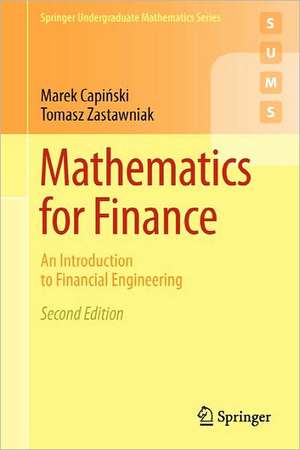
Mathematics for Finance
Autor Capi&, Tomasz Zastawniaken Limba Engleză Paperback – 25 noi 2010
Ne-a atras atenția modul în care Mathematics for Finance transformă rigoarea matematică într-un set de instrumente de lucru pentru ingineria financiară. Apreciem în special includerea studiilor de caz la deschiderea fiecărui capitol, o metodă care ancorează teoria în scenarii de piață reale, oferind cititorului un cadru de analiză aplicat. Remarcăm progresia logică a materialului: se începe cu activele fără risc și managementul portofoliului, trecând prin contracte forward și futures, până la complexitatea modelelor în timp continuu. Ca și Robert J. Elliott în Mathematics of Financial Markets, autorii distilează experiența reală în principii acționabile, însă Mathematics for Finance se distinge printr-o abordare mai accesibilă pentru cei care nu au încă un fundament solid în teoria măsurii. În timp ce lucrarea anterioară a autorilor, Numerical Methods in Finance with C++, se concentra pe execuția algoritmică, acest titlu prioritizează înțelegerea mecanismelor de evaluare a opțiunilor bazate pe principiul non-arbitrajului și pe optimizarea portofoliilor Markowitz. Structura ediției a doua extinde aria de acoperire prin capitole dedicate modelelor în timp discret și continuu, oferind o viziune unitară asupra ratelor dobânzii. Cuprinsul indică o trecere atentă de la modelul binomial la modelele matematice generale, asigurând o curbă de învățare echilibrată. Este o resursă care nu se rezumă la formule, ci explică motivația financiară din spatele fiecărui model matematic utilizat în bănci și instituții de investiții.
Preț: 285.57 lei
Carte tipărită la comandă
Livrare economică 07-21 decembrie
Specificații
ISBN-10: 0857290819
Pagini: 336
Ilustrații: XIII, 336 p. 66 illus.
Dimensiuni: 156 x 238 x 20 mm
Greutate: 0.54 kg
Ediția:2nd 2011 edition
Editura: SPRINGER LONDON
Locul publicării:London, United Kingdom
V-ar putea interesa
-
 The Complete Guide to Option Pricing FormulasEspen Gaarder Haug-14%Preț: 337.03 lei392.07 lei
 -
 Mathematical Finance: A Very Short IntroductionMark H. A. Davis-19%Preț: 57.51 lei70.98 lei
 -
 An Introduction to Quantitative FinanceStephen Blyth-11%Preț: 375.51 lei420.27 lei
 -
 Mastering Financial CalculationsBob Steiner-15%Preț: 490.15 lei576.66 lei
 -
 Intermediate Financial TheoryJean-Pierre Danthine-33%Preț: 444.06 lei666.40 lei
 -
 Paul Wilmott on Quantitative Finance 2e +CD 3V SetPaul Wilmott-23%Preț: 1407.02 lei1827.30 lei
 -
 Numerical Methods in Finance with C++Maciej J. Capi¿skiPreț: 329.19 lei
 -
 Mathematics for Economics and Finance: Methods and ModellingMartin Anthony-8%Preț: 349.41 lei379.04 lei
 -
 Quantitative Methods for FinanJohn TeallPreț: 550.93 lei
 -
 Financial Mathematics: A Comprehensive Treatment in Discrete TimeGiuseppe Campolieti-8%Preț: 513.76 lei558.44 lei
 -
 Introduction to Stochastic Finance with Market ExamplesNicolas Privault-9%Preț: 984.40 lei1081.76 lei
 -
 Introduction to Stochastic Calculus Applied to FinanceDamien LambertonPreț: 455.29 lei
 -
 The Mathematics of Financial ModelsKannoo Ravindran-8%Preț: 488.94 lei531.46 lei
 -
 Foundations of the Pricing of Financial DerivativesRobert E Brooks-8%Preț: 526.42 lei572.19 lei
 -
 An Introduction to Mathematical Finance with ApplicationsArlie O. Petters-19%Preț: 527.08 lei650.72 lei
 -
 Mathematical Finance: Theory Review and ExercisesEmanuela Rosazza GianinPreț: 357.66 lei
 -
 Financial MathematicsAndrea PascucciPreț: 458.33 lei
Public țintă
Upper undergraduateDe ce să citești această carte
Recomandăm această carte studenților la economie sau matematică și profesioniștilor care doresc să stăpânească fundamentele ingineriei financiare. Veți învăța să evaluați instrumente derivate și să optimizați portofolii de investiții folosind modele consacrate (CAPM, Black-Scholes). Câștigul major este capacitatea de a aplica teoria probabilităților în decizii financiare concrete, susținută de studii de caz care clarifică aplicabilitatea practică a fiecărui model prezentat.
Despre autor
Tomasz Zastawniak și colegii săi sunt recunoscuți pentru capacitatea de a preda concepte cantitative complexe într-o manieră structurată. Cu o experiență vastă în domeniul matematicii financiare, Zastawniak a contribuit semnificativ la literatura de specialitate prin lucrări care îmbină teoria pură cu programarea și metodele numerice. Expertiza sa se reflectă în claritatea expunerii din Mathematics for Finance, unde reușește să pună bazele teoretice necesare pentru dezvoltarea ulterioară a algoritmilor financiari, o temă centrală și în cealaltă lucrare a sa de referință, Numerical Methods in Finance with C++.
Cuprins
Recenzii
“This second edition … is to start each chapter with the presentation of a case study and to end each chapter with a thorough discussion of that study. The authors also added new material on time-continuous models, along with the essentials of the mathematical arguments. … The current book is more substantial … . Summing Up: Recommended. Upper-division undergraduates and graduate students.” (D. Robbins, Choice, Vol. 48 (10), June, 2011)
“Throughout the text, the authors invite active reader participation. One way is by opening and closing each chapter with a case study. … authors have embedded all of the exercises in the discussion. … Solutions to all exercises appear in an appendix. This makes the book excellent for self-study. … this book provides an excellent introduction to financial engineering. … authors display impressive dexterity in ushering the reader from basics to an understanding of some of the deepest and most far-reaching ideas in the discipline.” (David A. Huckaby, The Mathematical Association of America, February, 2011)
“This second edition consists of standard topics for undergraduate level financial mathematics courses, plus an introduction to materials from an advanced level course. … Each chapter starts with a case study and ends with a discussion on it using the material taught in the chapter. In general this book provides many examples and exercises, which is very useful for helping readers to understand the materials covered. Overall this is a great book for upper level undergraduate students and those who want to self-study financial engineering.” (Youngna Choi, Mathematical Reviews, Issue 2012 e)
“This textbook presents … three major areas of mathematical finance at a level suitable for second or third year undergraduate students in mathematics, business management, finance or economics. … The text is interspersed with a multitude of elaborated examples and exercises, complete with solutions, providing ample material for tutorials as well as making the book good for self-study.” (Yuliya S. Mishura, Zentralblatt MATH, Vol. 1207, 2011)
Notă biografică
Textul de pe ultima copertă
In this second edition, the material has been thoroughly revised and rearranged. New features include:
• A case study to begin each chapter – a real-life situation motivating the development of theoretical tools;
• A detailed discussion of the case study at the end of each chapter;
• A new chapter on time-continuous models with intuitive outlines of the mathematical arguments and constructions;
• Complete proofs of the two fundamental theorems of mathematical finance in discrete setting.
From the reviews of the first edition:
”This text is an excellent introduction to Mathematical Finance. Armed with a knowledge of basic calculus and probability a student can use this book to learn about derivatives, interest rates and their term structure and portfolio management.”(Zentralblatt MATH)
”Given these basic tools, it is surprising how high a level of sophistication the authors achieve, covering such topics as arbitrage-free valuation, binomial trees, and risk-neutral valuation.” (www.riskbook.com)
”The reviewer can only congratulate the authors with successful completion of a difficult task of writing a useful textbook on a traditionally hard topic.” (K. Borovkov, The Australian Mathematical Society Gazette, Vol. 31 (4), 2004)