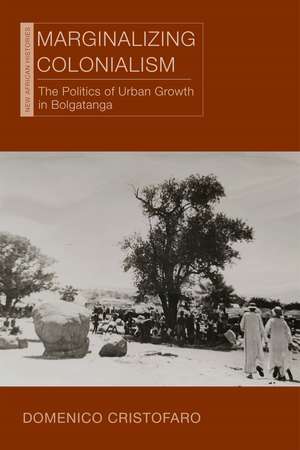
Marginalizing Colonialism: The Politics of Urban Growth in Bolgatanga: New African Histories
Autor Domenico Cristofaroen Limba Engleză Paperback – 8 sep 2026
Marginalizing Colonialism offers a social, political, and spatial history of Bolgatanga, a northern Ghanaian town whose colonial-era urban development has been largely overlooked in African historiography. Covering the late nineteenth century through the 1940s, the book traces how this settlement—long characterized as a remote hinterland of the British Empire—emerged as a commercial and political center in the region. Rather than depicting urbanization as an imperial project, it reveals how African actors actively shaped Bolgatanga’s growth and repeatedly marginalized, redirected, and evaded colonial authority.
The narrative follows Bolgatanga’s transformation from a dispersed settlement organized around kinship, ritual geographies, and earth shrines into a dynamic urban hub integrated into regional trade networks. Central to this shift were new land tenure systems, commercial expansion, and changing spatial practices. By the 1930s and 1940s, trade in kola, groundnuts, livestock, and other goods surged, stimulated by new roads and increased mobility. Population growth converted farmland into leased plots, permanent buildings replaced older compounds, and areas around the market became focal points of economic and social life.
These changes were driven not by the colonial state but rather by local negotiations and strategic adaptations. Chiefs, earth priests, merchants, and migrant traders mediated and reshaped colonial policies, while missionaries and settlers concluded land agreements beyond official oversight. Roads and marketplaces, planned through negotiations between colonial officials and local chiefs and built largely through African labor, became central infrastructures of local economic life. Even as colonial administrators sought to codify land tenure and regulate commerce, their influence remained largely nominal—a background presence in a story propelled by African initiative.
Drawing on archival documents, oral histories, and unpublished manuscripts by local intellectuals, Marginalizing Colonialism provides the first comprehensive urban history of Bolgatanga. It challenges dominant narratives in African colonial and urban historiography by exposing the silences of the colonial archive and highlighting the significance of medium-sized towns as arenas of negotiation and creativity. Ultimately, the book argues that Bolgatanga’s urbanization was a locally driven process that redefined power, space, and governance—leaving a legacy that continues to shape the city’s identity and regional role today.
The narrative follows Bolgatanga’s transformation from a dispersed settlement organized around kinship, ritual geographies, and earth shrines into a dynamic urban hub integrated into regional trade networks. Central to this shift were new land tenure systems, commercial expansion, and changing spatial practices. By the 1930s and 1940s, trade in kola, groundnuts, livestock, and other goods surged, stimulated by new roads and increased mobility. Population growth converted farmland into leased plots, permanent buildings replaced older compounds, and areas around the market became focal points of economic and social life.
These changes were driven not by the colonial state but rather by local negotiations and strategic adaptations. Chiefs, earth priests, merchants, and migrant traders mediated and reshaped colonial policies, while missionaries and settlers concluded land agreements beyond official oversight. Roads and marketplaces, planned through negotiations between colonial officials and local chiefs and built largely through African labor, became central infrastructures of local economic life. Even as colonial administrators sought to codify land tenure and regulate commerce, their influence remained largely nominal—a background presence in a story propelled by African initiative.
Drawing on archival documents, oral histories, and unpublished manuscripts by local intellectuals, Marginalizing Colonialism provides the first comprehensive urban history of Bolgatanga. It challenges dominant narratives in African colonial and urban historiography by exposing the silences of the colonial archive and highlighting the significance of medium-sized towns as arenas of negotiation and creativity. Ultimately, the book argues that Bolgatanga’s urbanization was a locally driven process that redefined power, space, and governance—leaving a legacy that continues to shape the city’s identity and regional role today.
Din seria New African Histories
-
 Preț: 247.57 lei
 -
 Preț: 253.31 lei
 - 23%
 Preț: 677.80 lei
 -
 Preț: 258.31 lei
 -
 Preț: 232.59 lei
 -
 Preț: 266.39 lei
 -
 Preț: 251.03 lei
 -
 Preț: 281.16 lei
 -
 Preț: 281.54 lei
 - 19%
 Preț: 479.40 lei
 -
 Preț: 250.25 lei
 -
 Preț: 239.59 lei
 -
 Preț: 256.01 lei
 -
 Preț: 249.08 lei
 -
 Preț: 258.31 lei
 -
 Preț: 241.03 lei
 -
 Preț: 282.69 lei
 -
 Preț: 256.01 lei
 -
 Preț: 241.03 lei
 -
 Preț: 243.00 lei
 -
 Preț: 238.77 lei
 -
 Preț: 275.57 lei
 -
 Preț: 281.54 lei
 -
 Preț: 232.59 lei
 -
 Preț: 280.72 lei
 -
 Preț: 259.43 lei
 -
 Preț: 282.86 lei
 -
 Preț: 280.42 lei
 -
 Preț: 267.38 lei
 -
 Preț: 259.82 lei
 - 23%
 Preț: 459.61 lei
 -
 Preț: 271.64 lei
 -
 Preț: 276.72 lei
 -
 Preț: 264.04 lei
 -
 Preț: 289.28 lei
 - 23%
 Preț: 477.76 lei
 -
 Preț: 260.77 lei
 - 23%
 Preț: 478.63 lei
 - 23%
 Preț: 476.87 lei
 -
 Preț: 275.57 lei
Preț: 266.39 lei
Precomandă
Puncte Express: 400
Carte nepublicată încă
Livrare prin curier în România Precomanda se expediază când titlul devine disponibil.
Transport gratuit de la 400.00 lei Plată online sau ramburs, în funcție de opțiunile comenzii.
Retur gratuit în 14 zile Comandă securizată și suport în română.
Doresc să fiu notificat când acest titlu va fi disponibil:
Se trimite...
Specificații
ISBN-13: 9780821427101
ISBN-10: 0821427105
Pagini: 264
Ilustrații: 8 figures; 7 maps
Greutate: 0.37 kg
Editura: Ohio University Press
Colecția Ohio University Press
Seria New African Histories
ISBN-10: 0821427105
Pagini: 264
Ilustrații: 8 figures; 7 maps
Greutate: 0.37 kg
Editura: Ohio University Press
Colecția Ohio University Press
Seria New African Histories
Notă biografică
Domenico Cristofaro is a research fellow and adjunct lecturer at the University of Bologna. A historian of Africa with an anthropological background, he researches and writes about planning, political change, economic history, gender, and labor history. He has published in journals such as The Journal of African History and AfricanEconomicHistory.
Cuprins
List of Illustrations ix
Acknowledgments xi
Note on Ethnonyms xv
Introduction A Peripheral Town?
Marginalizing Colonial Rule in Bolgatanga 1
Chapter 1 A Town with No Center
Trade Networks and the Politics of Dwelling 31
Chapter 2 Defiance, Conflict, and Negotiation
Accommodating the Colonial Army in Bolgatanga 57
Chapter 3 Integrating the Colonial State
Currencies, Mobility, and Trade Growth, 1899–1919 83
Chapter 4 Rising to Paramountcy
Centralization and the Negotiation of Boundaries, 1911–1920 107
Chapter 5 Reconfiguring a Town
Land Leasing and Commercial Growth, 1920–1950 133
Epilogue 164
Notes 169
Bibliography 229
Index 244
Acknowledgments xi
Note on Ethnonyms xv
Introduction A Peripheral Town?
Marginalizing Colonial Rule in Bolgatanga 1
Chapter 1 A Town with No Center
Trade Networks and the Politics of Dwelling 31
Chapter 2 Defiance, Conflict, and Negotiation
Accommodating the Colonial Army in Bolgatanga 57
Chapter 3 Integrating the Colonial State
Currencies, Mobility, and Trade Growth, 1899–1919 83
Chapter 4 Rising to Paramountcy
Centralization and the Negotiation of Boundaries, 1911–1920 107
Chapter 5 Reconfiguring a Town
Land Leasing and Commercial Growth, 1920–1950 133
Epilogue 164
Notes 169
Bibliography 229
Index 244
Descriere
Marginalizing Colonialism uncovers how Bolgatanga, a northern Ghanaian town, transformed from a dispersed settlement into a regional hub between the 1890s and 1940s—not through colonial planning but instead through African agency, land negotiations, and trade networks that redefined power and space.