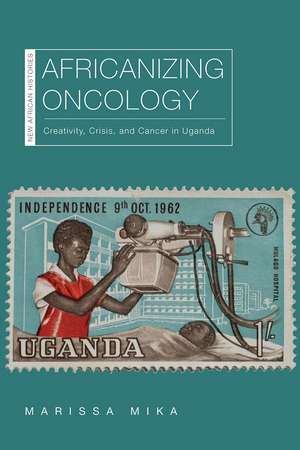
Africanizing Oncology: Creativity, Crisis, and Cancer in Uganda: New African Histories
Autor Marissa Mikaen Limba Engleză Paperback – 18 oct 2022
An innovative contemporary history that blends insights from a variety of disciplines to highlight how a storied African cancer institute has shaped lives and identities in postcolonial Uganda. Over the past decade, an increasingly visible crisis of cancer in Uganda has made local and international headlines. Based on transcontinental research and public engagement with the Uganda Cancer Institute that began in 2010, Africanizing Oncology frames the cancer hospital as a microcosm of the Ugandan state, as a space where one can trace the lived experiences of Ugandans in the twentieth century. Ongoing ethnographic fieldwork, patient records, oral histories, private papers from US oncologists, American National Cancer Institute records, British colonial office reports, and even the architecture of the institute itself show how Ugandans understood and continue to shape ideas about national identity, political violence, epidemics, and economic life. Africanizing Oncology describes the political, social, technological, and biomedical dimensions of how Ugandans created, sustained, and transformed this institute over the past half century. With insights from science and technology studies and contemporary African history, Marissa Mika’s work joins a new wave of contemporary histories of the political, technological, moral, and intellectual aspirations and actions of Africans after independence. It contributes to a growing body of work on chronic disease and situates the contemporary urgency of the mounting cancer crisis on the continent in a longer history of global cancer research and care. With its creative integration of African studies, science and technology studies, and medical anthropology, Africanizing Oncology speaks to multiple scholarly communities.
Din seria New African Histories
-
 Preț: 251.51 lei
 -
 Preț: 252.85 lei
 - 23%
 Preț: 687.50 lei
 -
 Preț: 232.16 lei
 -
 Preț: 270.62 lei
 -
 Preț: 263.55 lei
 -
 Preț: 281.16 lei
 -
 Preț: 281.04 lei
 - 19%
 Preț: 479.40 lei
 -
 Preț: 249.79 lei
 -
 Preț: 251.51 lei
 -
 Preț: 256.01 lei
 -
 Preț: 249.08 lei
 -
 Preț: 258.31 lei
 -
 Preț: 241.01 lei
 -
 Preț: 282.21 lei
 -
 Preț: 260.07 lei
 -
 Preț: 241.60 lei
 -
 Preț: 246.04 lei
 -
 Preț: 238.77 lei
 -
 Preț: 286.44 lei
 -
 Preț: 285.51 lei
 -
 Preț: 232.16 lei
 -
 Preț: 290.36 lei
 -
 Preț: 268.31 lei
 -
 Preț: 303.80 lei
 -
 Preț: 290.05 lei
 -
 Preț: 267.38 lei
 -
 Preț: 259.82 lei
 - 23%
 Preț: 459.61 lei
 -
 Preț: 285.04 lei
 -
 Preț: 286.21 lei
 -
 Preț: 264.04 lei
 -
 Preț: 303.56 lei
 - 23%
 Preț: 494.01 lei
 -
 Preț: 269.73 lei
 - 23%
 Preț: 478.63 lei
 - 23%
 Preț: 493.11 lei
 -
 Preț: 285.04 lei
Preț: 258.31 lei
Puncte Express: 387
Carte disponibilă
Livrare economică 09-23 noiembrie
Livrare express 24-30 octombrie pentru 29.60 lei
Livrare prin curier în România Termenul estimat este afișat lângă disponibilitate.
Transport gratuit de la 400.00 lei Plată online sau ramburs, în funcție de opțiunile comenzii.
Retur gratuit în 14 zile Comandă securizată și suport în română.
Specificații
ISBN-13: 9780821425091
ISBN-10: 0821425099
Pagini: 284
Ilustrații: 9
Dimensiuni: 152 x 229 x 20 mm
Greutate: 0.4 kg
Editura: Ohio University Press
Colecția Ohio University Press
Seria New African Histories
ISBN-10: 0821425099
Pagini: 284
Ilustrații: 9
Dimensiuni: 152 x 229 x 20 mm
Greutate: 0.4 kg
Editura: Ohio University Press
Colecția Ohio University Press
Seria New African Histories
V-ar putea interesa
-
 Reforming the UnreformableNgozi Okonjo-IwealaPreț: 169.33 lei
 -
 Economic GangstersRay FismanPreț: 154.33 lei
 -
 MozambiqueUnited States Agency for International D.Preț: 93.28 lei
 -
 RwandaUnited States Agency for International D.Preț: 89.92 lei
 -
 SenegalUnited States Agency for International D.Preț: 93.67 lei
 -
 UgandaUnited States Agency for International D.Preț: 94.47 lei
 -
 ZambiaUnited States Agency for International D.Preț: 93.91 lei
 -
 ZimbabweUnited States Agency for International D.Preț: 94.85 lei
 -
 Legal Responses to Health EmergenciesThe Law Library of CongressPreț: 141.17 lei
 -
 Health for 21st Century PlusDr Tom Okeyo Mboya-23%Preț: 942.98 lei1224.64 lei
 -
 La BorracheraMarco GaspariPreț: 117.16 lei
 -
 LiberiaUnited States Agency for International D.Preț: 93.67 lei
 -
 MaliUnited States Agency for International D.Preț: 93.51 lei
 -
 Universal RecognitionAzurePreț: 56.59 lei
 -
 Preț: 477.94 lei
 -
 Preț: 279.22 lei
 -
 The Essential Groupworker: Teaching and Learning Creative GroupworkCatherine SawdonPreț: 299.62 lei
 -
 State of the Nation: Essays for Robert ManneGwenda TavanPreț: 206.34 lei
 -
 Malaysian Ethnic Festival FoodsRosmaliza Muhammad-8%Preț: 398.33 lei432.97 lei
Recenzii
“Mika’s lively history shows how Ugandan physician-scientists used cancer research to build oncology care and infrastructure over five decades of labile national politics, pervasive scarcity, and often ephemeral international partnerships. This engaging account illuminates struggles that shaped both global oncology knowledge and the fates of hundreds of thousands of Ugandans facing cancer diagnoses.”—Claire L. Wendland, author of A Heart for the Work: Journeys through an African Medical School
“Based on rich historical and ethnographic research, Africanizing Oncology provides an intimate, and at times harrowing view of the day-to-day activities of care, research, and healing that permitted physicians, researchers, nurses, and patients to survive civil war, structural adjustment, and massive global disparities in health resources to build and sustain an African cancer research institute. The book is a remarkable achievement.”—Randall M. Packard, author or A History of Global Health: Interventions into the Lives of Other Peoples
“In this historically and ethnographically rich book, Marissa Mika shows how African doctors and nurses practice oncology by creating, adapting, and transforming medical infrastructures. Tracing the life of the Uganda Cancer Institute through historical periods of independence, dictatorship, war, structural adjustment, and the HIV pandemic, this powerful book reveals the challenges and opportunities of Africanizing oncology. This is a landmark study on the history—and future—of global oncology.”—Carlo Caduff, author of The Pandemic Perhaps: Dramatic Events in a Public Culture of Danger
“In recounting half a century of research and care at the Uganda Cancer Institute, Marissa Mika tells an unforgettable story of the power of connections and the consequences of their loss. Ugandan physician/researchers and their staff proved the value of therapies because they had made friendships that motivated families to return to Kampala for follow-up, but that knowledge became useless when funders’ priorities changed and international partnerships ended. Mika’s story of UCI shows horrifying wounds—and the possibility of healing—in postindependence Uganda, in global health, and in the way we think about the world.”—Holly Hanson, author of To Speak and Be Heard: Seeking Good Government in Uganda, ca. 1500–2015
Notă biografică
Marissa Mika is a visiting scholar at the Center for Science, Technology, Medicine & Society at the University of California, Berkeley.
Cuprins
List of Illustrations xi
Acknowledgments xiii
Abbreviations xxi
Prelude A Week in the Life of the Uganda Cancer Institute 1
Introduction 7
Chapter 1 The African Lymphoma 25
Chapter 2 A Hospital Built from Scratch 42
Chapter 3 Africanizing Oncology in Idi Amin’s Uganda 61
Chapter 4 Rocket Launchers and Toxic Drugs 93
Chapter 5 When Radiotherapy Travels 115
Chapter 6 “Research Is Our Resource” 131
Epilogue In Memoriam 153
Notes 169
Bibliography 205
Index 250
Acknowledgments xiii
Abbreviations xxi
Prelude A Week in the Life of the Uganda Cancer Institute 1
Introduction 7
Chapter 1 The African Lymphoma 25
Chapter 2 A Hospital Built from Scratch 42
Chapter 3 Africanizing Oncology in Idi Amin’s Uganda 61
Chapter 4 Rocket Launchers and Toxic Drugs 93
Chapter 5 When Radiotherapy Travels 115
Chapter 6 “Research Is Our Resource” 131
Epilogue In Memoriam 153
Notes 169
Bibliography 205
Index 250
Descriere
Combining methods from African studies, science and technology studies, and medical anthropology, Marissa Mika considers the Uganda Cancer Institute as a microcosm of the Ugandan state and as a lens through which to trace the political, technological, moral, and intellectual aspirations and actions of health care providers and patients.