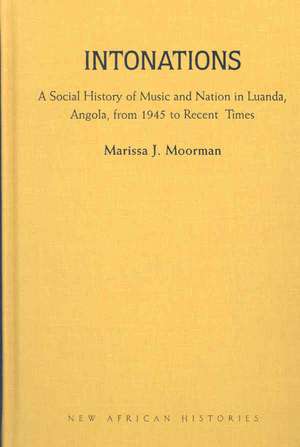
Intonations: A Social History of Music and Nation in Luanda, Angola, from 1945 to Recent Times: New African Histories
Autor Marissa J. Moormanen Limba Engleză Mixed media product – 15 oct 2008
Descoperim în Intonations o analiză riguroasă a modului în care cartierele sărace din Luanda, cunoscute sub numele de musseques, au devenit epicentrul unei rezistențe culturale prin muzică. Notăm cu interes felul în care Marissa J. Moorman demonstrează că identitatea națională angoleză nu a fost doar rezultatul luptelor politice de gherilă, ci a fost modelată activ în baruri, centre comunitare și cinematografe, cu mult înainte de independența din 1975. Cartea se concentrează pe perioada 1945–1974, investigând cum sunetele urbane au oferit o platformă de comunicare împotriva opresiunii coloniale portugheze.
Abordarea autoarei este una interdisciplinară, îmbinând istoria socială cu etnomuzicologia. Putem afirma că elementul distinctiv al acestei lucrări este utilizarea istoriei orale; interviurile cu artiștii vremii și cu publicul lor oferă o perspectivă intimă asupra speranțelor și așteptărilor unei națiuni în devenire. Volumul acoperă o arie tematică similară cu Popular Music and the Postcolonial de Oliver Lovesey, însă Intonations se diferențiază printr-o focalizare geografică și temporală mult mai specifică, oferind în plus o dimensiune senzorială prin includerea unui CD cu înregistrări de epocă.
În contextul operei autoarei, această lucrare stabilește bazele teoretice pe care Marissa J. Moorman le va dezvolta ulterior în Powerful Frequencies. Dacă în volumul de față accentul cade pe producția muzicală ca act de cetățenie, în lucrarea ulterioară ea extinde cercetarea către rolul tehnologiei radio ca instrument de stat. Intonations rămâne o resursă esențială pentru înțelegerea modului în care cultura populară poate precede și structura mișcările de eliberare națională, oferind un studiu de caz detaliat despre relația dintre sunet, spațiu urban și politică în Africa de Sud-Vest.
Din seria New African Histories
-
 Preț: 285.51 lei
 -
 Preț: 252.85 lei
 - 19%
 Preț: 479.40 lei
 -
 Preț: 263.55 lei
 -
 Preț: 251.51 lei
 -
 Preț: 286.44 lei
 -
 Preț: 246.04 lei
 -
 Preț: 245.30 lei
 -
 Preț: 249.79 lei
 -
 Preț: 260.07 lei
 -
 Preț: 285.92 lei
 -
 Preț: 242.56 lei
 -
 Preț: 241.60 lei
 -
 Preț: 262.43 lei
 -
 Preț: 258.31 lei
 -
 Preț: 270.62 lei
 - 23%
 Preț: 533.83 lei
 -
 Preț: 232.16 lei
 -
 Preț: 303.80 lei
 -
 Preț: 290.05 lei
 -
 Preț: 267.38 lei
 - 23%
 Preț: 459.61 lei
 -
 Preț: 264.04 lei
 -
 Preț: 303.56 lei
 -
 Preț: 259.82 lei
 -
 Preț: 290.36 lei
 -
 Preț: 268.31 lei
 -
 Preț: 285.04 lei
 -
 Preț: 286.21 lei
 - 23%
 Preț: 494.01 lei
 -
 Preț: 269.73 lei
 -
 Preț: 284.46 lei
 -
 Preț: 285.04 lei
 - 23%
 Preț: 491.10 lei
 - 23%
 Preț: 494.01 lei
 -
 Preț: 268.31 lei
 -
 Preț: 276.72 lei
 - 23%
 Preț: 493.11 lei
 - 23%
 Preț: 489.24 lei
Preț: 478.63 lei
Preț vechi: 621.60 lei
-23%
Carte tipărită la comandă
Livrare economică 07-21 decembrie
Specificații
ISBN-10: 0821418238
Pagini: 320
Dimensiuni: 152 x 229 x 25 mm
Greutate: 0.57 kg
Ediția:1
Editura: Ohio University Press
Colecția Ohio University Press
Seria New African Histories
V-ar putea interesa
-
 EU and AfricaAdekeye AdebajoPreț: 453.44 lei
 -
 -8%Preț: 550.76 lei598.66 lei
 -
 Rhodesia-Beginning to EndRon MorkelPreț: 132.48 lei
 -
 A History of the Asians in East Africa, CA. 1886 to 1945: The QuiltJagjit Singh MangatPreț: 100.46 lei
 -
 The PlantRobert Coe BluestonePreț: 184.29 lei
 -
 Slave NarrativesJanice R. SwintonPreț: 67.53 lei
 -
 The Legendary Uli Women of NigeriaAmbassador (Dr. Robin Renee SandersPreț: 422.99 lei
 -
 The Sadat-Mubarak DeceptionNevin GussackPreț: 61.33 lei
 -
 Monkeys in My GardenValerie PixleyPreț: 129.83 lei
 -
 A Travers l'AlgérieL -M ReussPreț: 139.07 lei
 -
 Documents Arabes Relatifs À l'Histoire Du Soudan (Éd.1898)Abd Al-Rah M Sa?diPreț: 262.69 lei
 -
 Preț: 231.08 lei
 -
 Preț: 278.88 lei
 -
 Preț: 278.88 lei
 -
 Le Maroc, Géographie, Organisation, Politique, (Éd.1895)René-Jules FrischPreț: 207.38 lei
 -
 Preț: 199.25 lei
 -
 Preț: 175.60 lei
 -
 L'Islam Algérien En l'An 1900 (Éd.1900)Edmond DouttéPreț: 127.99 lei
 -
 Races Berbères, Kabylie Du Jurjura (Éd.1892)Jules LiorelPreț: 255.40 lei
 -
 Preț: 238.31 lei
 -
 Alger, Étude (Éd.1862)Ernest FeydeauPreț: 162.28 lei
 -
 Preț: 82.68 lei
 -
 Preț: 394.83 lei
 -
 Preț: 390.92 lei
 -
 African Cinema and EuropeTeresa Hoefert de TureganoPreț: 225.30 lei
De ce să citești această carte
Recomandăm această carte cercetătorilor și studenților interesați de istoria Africii și de sociologia muzicii. Cititorul câștigă o înțelegere profundă a modului în care arta devine un instrument politic de emancipare. Este o lectură esențială deoarece nu oferă doar teorie, ci și dovezi concrete — inclusiv audio — despre cum o populație marginalizată și-a articulat dorința de libertate prin ritmuri de semba și rumbă africană.
Despre autor
Marissa J. Moorman este o cercetătoare recunoscută în domeniul istoriei africane, cu un interes deosebit pentru relația dintre tehnologie, cultură și politică în Angola. Este autoarea unor lucrări fundamentale care explorează spațiul public și media în context colonial și postcolonial. Prin volume precum Intonations și Powerful Frequencies, ambele publicate în prestigioasa serie New African Histories, Moorman s-a impus ca o voce autoritară în studiul modului în care sunetul și radiofonia au contribuit la construcția identităților naționale în Africa lusofonă.
Descriere scurtă
Marissa J. Moorman presents a social and cultural history of the relationship between Angolan culture and politics. She argues that it was in and through popular urban music, produced mainly in the musseques (urban shantytowns) of the capital city, Luanda, that Angolans forged the nation and developed expectations about nationalism. Through careful archival work and extensive interviews with musicians and those who attended performances in bars, community centers, and cinemas, Moorman explores the ways in which the urban poor imagined the nation.
The spread of radio technology and the establishment of a recording industry in the early 1970s reterritorialized an urban-produced sound and cultural ethos by transporting music throughout the country. When the formerly exiled independent movements returned to Angola in 1975, they found a population receptive to their nationalist message but with different expectations about the promises of independence. In producing and consuming music, Angolans formed a new image of independence and nationalist politics.
Recenzii
— Anne Pitcher, author of Transforming Mozambique: The Politics of Privatization, 1975–2000
— Oral History Review
— Africa: Journal of the IAI