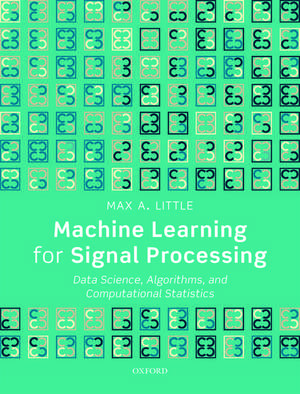
Machine Learning for Signal Processing: Data Science, Algorithms, and Computational Statistics
Autor Max A. Littleen Limba Engleză Hardback – 13 aug 2019
Preț: 560.61 lei
Preț vechi: 789.25 lei
-29%
Puncte Express: 841
Carte tipărită la comandă
Livrare economică 04-09 decembrie
Livrare prin curier în România Termenul estimat este afișat lângă disponibilitate.
Transport gratuit pentru acest produs Plată online sau ramburs, în funcție de opțiunile comenzii.
Retur gratuit în 14 zile Comandă securizată și suport în română.
Specificații
ISBN-13: 9780198714934
ISBN-10: 0198714939
Pagini: 384
Ilustrații: 77 grayscale and 52 color line figures, 1 color halftone
Dimensiuni: 194 x 250 x 25 mm
Greutate: 0.98 kg
Editura: OUP OXFORD
Colecția OUP Oxford
Locul publicării:Oxford, United Kingdom
ISBN-10: 0198714939
Pagini: 384
Ilustrații: 77 grayscale and 52 color line figures, 1 color halftone
Dimensiuni: 194 x 250 x 25 mm
Greutate: 0.98 kg
Editura: OUP OXFORD
Colecția OUP Oxford
Locul publicării:Oxford, United Kingdom
V-ar putea interesa
-
 Just Enough Data Science and Machine LearningMark LevenePreț: 352.28 lei
 -
 -9%Preț: 324.84 lei357.76 lei
 -
 Digital Signal ProcessingEmmanuel Ifeachor-20%Preț: 572.74 lei715.93 lei
 -
 Signal Processing and Machine Learning TheoryPaulo S.R. Diniz-34%Preț: 790.16 lei1188.32 lei
 -
 Pattern Recognition and Machine LearningChristopher M Bishop-20%Preț: 646.10 lei807.62 lei
 -
 The Elements of Statistical LearningTrevor Hastie-20%Preț: 547.10 lei683.87 lei
 -
 Signals and Systems Using MATLAB®Aydin Akan-32%Preț: 669.76 lei981.55 lei
 -
 -39%Preț: 394.79 lei646.62 lei
 -
 -39%Preț: 622.57 lei1028.93 lei
 -
 -31%Preț: 607.05 lei885.58 lei
 -
 -24%Preț: 146.65 lei192.05 lei
 -
 Machine Learning For DummiesLuca Massaron-20%Preț: 149.88 lei187.36 lei
 -
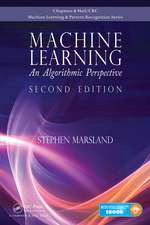 Machine Learning: An Algorithmic Perspective, Second EditionStephen Marsland-20%Preț: 625.22 lei781.53 lei
 -
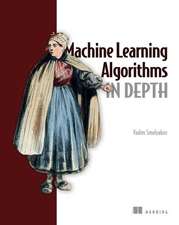 Machine Learning Algorithms in DepthVadim Smolyakov-20%Preț: 445.58 lei556.96 lei
 -
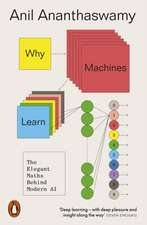 Why Machines LearnAnil AnanthaswamyPreț: 160.44 lei
 -
 Fundamentals of Music ProcessingMeinard Müller-20%Preț: 379.20 lei474.00 lei
 -
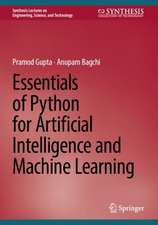 Preț: 462.84 lei
 -
 Materials Data ScienceStefan Sandfeld-15%Preț: 601.09 lei707.16 lei
 -
 Statistics for ScientistsUmberto Michelucci-20%Preț: 279.62 lei349.53 lei
 -
 -20%Preț: 458.54 lei573.18 lei
Recenzii
This book provides an excellent pathway for gaining first-class expertise in machine learning. It provides both the technical background that explains why certain approaches, but not others, are best practice in real world problems, and a framework for how to think about and approach new problems. I highly recommend it for people with a signal processing background who are seeking to become an expert in machine learning.
Over the past decade in signal processing, machine learning has gone from a disparate research field known only to people working on topics such as speech and image processing, to permeating all aspects of it. With this book, Prof. Little has taken an important step in unifying machine learning and signal processing. As a whole, this book covers many topics, new and old, that are important in their own right and equips the reader with a broader perspective than traditional signal processing textbooks. In particular, I would highlight the combination of statistical modeling, convex optimization, and graphs as particularly potent. Machine learning and signal processing are no longer separate, and there is no doubt in my mind that this is the way to teach signal processing in the future.
This book gives a solid mathematical foundation to, and details the key concepts and algorithmsin, this important topic.
Over the past decade in signal processing, machine learning has gone from a disparate research field known only to people working on topics such as speech and image processing, to permeating all aspects of it. With this book, Prof. Little has taken an important step in unifying machine learning and signal processing. As a whole, this book covers many topics, new and old, that are important in their own right and equips the reader with a broader perspective than traditional signal processing textbooks. In particular, I would highlight the combination of statistical modeling, convex optimization, and graphs as particularly potent. Machine learning and signal processing are no longer separate, and there is no doubt in my mind that this is the way to teach signal processing in the future.
This book gives a solid mathematical foundation to, and details the key concepts and algorithmsin, this important topic.
Notă biografică
Max A. Little is Professor of Mathematics at Aston University, UK, and a world-leading expert in signal processing and machine learning. His research in machine learning for digital health is highly influential and is the basis of advances in basic and applied research into quantifying neurological disorders such as Parkinson disease. He has published over 60 articles in the scientific literature on the topic, two patents, and a textbook. He is an advisor to government and leading international corporations in topics such as machine learning for health.
Cuprins
- 1: Mathematical Foundations
- 2: Optimization
- 3: Random Sampling
- 4: Statistical Modelling and Inference
- 5: Probabalistic Graphical Models
- 6: Statistical Machine Learning
- 7: Linear-Gaussian Systems and Signal Processing
- 8: Discrete Signals: Sampling, Quantization and Coding
- 9: Nonlinear and Non-Gaussian Signal Processing
- 10: Nonparametric Bayesian Machine Learning and Signal Processing