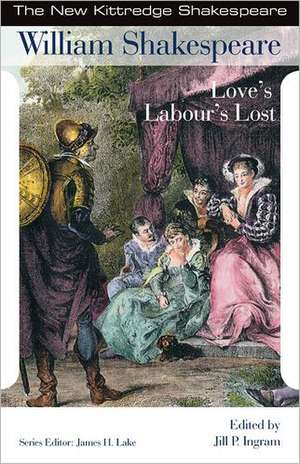
Love's Labour's Lost
Autor William Shakespeare Editat de Jill P. Ingram, James H. Lakeen Limba Engleză Paperback – aug 2011
George Lyman Kittredge’s insightful editions of Shakespeare have endured in part because of his eclecticism, his diversity of interests, and his wide-ranging accomplishments, all of which are reflected in the valuable notes in each volume.
These new editions have specific emphasis on the performance histories of the plays (on stage and screen).
Features of each edition include:
Features of each edition include:
- The original introduction to the Kittredge Edition
- Editor’s Introduction to the Focus Edition. An overview on major themes of the plays, and sections on the play’s performance history on stage and screen.
- Explanatory Notes. The explanatory notes either expand on Kittredge’s superb glosses, or, in the case of plays for which he did not write notes, give the needed explanations for Shakespeare’s sometimes demanding language.
- Performance notes. These appear separately and immediately below the textual footnotes and include discussions of noteworthy stagings of the plays, issues of interpretation, and film and stage choices.
- How to read the play as Performance Section. A discussion of the written play vs. the play as performed and the various ways in which Shakespeare’s words allow the reader to envision the work "off the page."
- Comprehensive Timeline. Covering major historical events (with brief annotations) as well as relevant details from Shakespeare’s life. Some include time chronologies within the plays.
- Topics for Discussion and Further Study. Critical Issues: Dealing with the text in a larger context and considerations of character, genre, language, and interpretative problems. Performance Issues: Problems and intricacies of staging the play connected to chief issues discussed in the Focus Editions’ Introduction.
- Select Bibliography & Filmography
Preț: 67.12 lei
Preț vechi: 81.12 lei
-17%
Puncte Express: 101
Carte disponibilă
Livrare economică 07-21 noiembrie
Livrare prin curier în România Termenul estimat este afișat lângă disponibilitate.
Transport gratuit de la 400.00 lei Plată online sau ramburs, în funcție de opțiunile comenzii.
Retur gratuit în 14 zile Comandă securizată și suport în română.
Specificații
ISBN-13: 9781585103010
ISBN-10: 1585103012
Pagini: 130
Ilustrații: Photos from major productions
Dimensiuni: 140 x 216 x 10 mm
Greutate: 0.17 kg
Ediția:First Edition
Editura: Hackett Publishing Company,Inc
Colecția Focus
Locul publicării:United States
ISBN-10: 1585103012
Pagini: 130
Ilustrații: Photos from major productions
Dimensiuni: 140 x 216 x 10 mm
Greutate: 0.17 kg
Ediția:First Edition
Editura: Hackett Publishing Company,Inc
Colecția Focus
Locul publicării:United States
V-ar putea interesa
-
 HamletCollins GcsePreț: 28.01 lei
 -
 A Midsummer Night's DreamWilliam ShakespearePreț: 28.01 lei
 -
 XSONNETS_CLASSICS PBWilliam ShakespearePreț: 29.15 lei
 -
 Love's Labor's Lost: The Pelican ShakespeareWilliam Shakespeare-20%Preț: 50.48 lei63.04 lei
 -
 Oxford School Shakespeare: Midsummer Night's DreamWilliam ShakespearePreț: 48.55 lei
 -
 Oxford School Shakespeare: Oxford School Shakespeare: Julius CaesarWilliam ShakespearePreț: 49.05 lei
 -
 The Complete Sonnets and Poems: The Oxford ShakespeareWilliam Shakespeare-9%Preț: 65.79 lei72.49 lei
 -
 The New Oxford Shakespeare: Modern Critical Edition: The Complete WorksWilliam Shakespeare-16%Preț: 413.39 lei489.84 lei
 -
 Love's Labour's LostProf. Eric Rasmussen-19%Preț: 67.48 lei82.87 lei
 -
 The Merry Wives Of WindsorWilliam ShakespearePreț: 29.30 lei
 -
 The Comedy of ErrorsWilliam ShakespearePreț: 28.68 lei
 -
 The PoemsWilliam ShakespearePreț: 58.34 lei
 -
 The Merchant of VeniceWilliam ShakespearePreț: 37.28 lei
 -
 All's Well That Ends WellWilliam ShakespearePreț: 38.47 lei
 -
 King JohnWilliam ShakespearePreț: 37.70 lei
 -
 Antony and CleopatraWilliam ShakespearePreț: 28.01 lei
 -
 Taming of the ShrewWilliam ShakespearePreț: 30.05 lei
 -
 Much Ado About NothingWilliam ShakespearePreț: 28.01 lei
Recenzii
This student-friendly edition of a difficult play includes a clear, helpful introduction and notes elucidating the complicated imagery and wordplay. Notes and illustrations refer the reader to various staging options enabling him or her to imagine Love’s Labour’s Lost in performance.
—Katharine E. Maus, James Branch Cabell Professor of English Literature, University of Virginia
—Katharine E. Maus, James Branch Cabell Professor of English Literature, University of Virginia
Even as the New Kittredge Shakespeare series glances back to George Lyman Kittredge's student editions of the plays, it is very much of our current moment: the slim editions are targeted largely at high school and first-year college students who are more versed in visual than in print culture. Not only are the texts of the plays accompanied by photographs or stills from various stage and cinema performances: the editorial contributions are performance-oriented, offering surveys of contemporary film interpretations, essays on the plays as performance pieces, and an annotated filmography. Traditional editorial issues (competing versions of the text, cruxes, editorial emendation history) are for the most part excluded; the editions focus instead on clarifying the text with an eye to performing it. There is no disputing the pedagogic usefulness of the New Kittredge Shakespeare's performance-oriented approach. At times, however, it can run the risk of treating textual issues as impediments, rather than partners, to issues of performance. This is particularly the case with a textually vexed play such as Pericles: Prince of Tyre. In the introduction to the latter, Jeffrey Kahan notes the frequent unintelligibility of the play as originally published: "the chances of a reconstructed text matching what Shakespeare actually wrote are about 'nil'" (p. xiii) But his solution — to use a "traditional text" rather than one corrected as are the Oxford and Norton Pericles — obscures how this "traditional text," including its act and scene division, is itself a palimpsest produced through three centuries of editorial intervention. Nevertheless, the series does a service to its target audience with its emphasis on performance and dramaturgy. Kahan's own essay about his experiences as dramaturge for a college production of Pericles is very good indeed, particularly on the play's inability to purge the trace of incestuous desire that Pericles first encounters in Antioch. Other plays' cinematic histories: Annalisa Castaldo's edition of Henry V contrasts Laurence Oliver's and Branagh's film productions; Samuel Crowl's and James Wells's edition of (respectively) I and 2 Henry IV concentrate on Welle's Chimes at Midnight and Gus Van Sant's My Own Private Idaho; Patricia Lennox's edition of As You Like It offers an overview of four Hollywood and British film adaptations; and John R. Ford's edition of A Midsummer Night's Dream provides a spirited survey of the play's rich film history.
The differences between, and comparative merits of, various editorial series are suggested by the three editions of The Taming of the Shrew published this year. Laury Magnus's New Kittredge Shakespeare edition is, like the other New Kittredge volumes, a workable text for high school and first year college students interested in film and theater. The introduction elaborates on one theme — Elizabethan constructions of gender — and offers a very broad performance history, focusing on Sam Taylor's and Zeffirelli's film versions as well as adaptations such as Kiss Me Kate and Ten Things I Hate About You (accompanied by a still of ten hearthtrobs Heath Ledger and Julia Stiles). The volume is determined to eradicate any confusion that a first time reader of the play might experience: the dramatis personae page explains that "Bianca Minola" is "younger daughter to Baptista, wooed by Lucentio-in-disguise (as Cambio) and then wife to him, also wooed by the elderly Gremio and Hortensio-in-disguise (as Licio)" (p.1). Other editorial notes, based on Kittredge's own, are confined mostly to explaining individual words and phrases: additional footnotes discuss interpretive choices made by film and stage productions. Throughout, the editorial emphasis is on the play less as text than as performance piece, culminating in fifteen largely performance-oriented "study questions" on topics such as disguise, misogyny, and violence.
Studies in English Literature, Tudor and Stuart Drama, Volume 51, Spring 2011, Number 2, pages 497-499.
The differences between, and comparative merits of, various editorial series are suggested by the three editions of The Taming of the Shrew published this year. Laury Magnus's New Kittredge Shakespeare edition is, like the other New Kittredge volumes, a workable text for high school and first year college students interested in film and theater. The introduction elaborates on one theme — Elizabethan constructions of gender — and offers a very broad performance history, focusing on Sam Taylor's and Zeffirelli's film versions as well as adaptations such as Kiss Me Kate and Ten Things I Hate About You (accompanied by a still of ten hearthtrobs Heath Ledger and Julia Stiles). The volume is determined to eradicate any confusion that a first time reader of the play might experience: the dramatis personae page explains that "Bianca Minola" is "younger daughter to Baptista, wooed by Lucentio-in-disguise (as Cambio) and then wife to him, also wooed by the elderly Gremio and Hortensio-in-disguise (as Licio)" (p.1). Other editorial notes, based on Kittredge's own, are confined mostly to explaining individual words and phrases: additional footnotes discuss interpretive choices made by film and stage productions. Throughout, the editorial emphasis is on the play less as text than as performance piece, culminating in fifteen largely performance-oriented "study questions" on topics such as disguise, misogyny, and violence.
Studies in English Literature, Tudor and Stuart Drama, Volume 51, Spring 2011, Number 2, pages 497-499.
This student-friendly edition of a difficult play includes a clear, helpful introduction and notes elucidating the complicated imagery and wordplay. Notes and illustrations refer the reader to various staging options enabling him or her to imagine Love’s Labour’s Lost in performance.
—Katharine E. Maus, James Branch Cabell Professor of English Literature, University of Virginia
Jill P. Ingram is Assistant Professor of Shakespeare and Renaissance Literature at Ohio University. She received her Ph.D. in English from the University of Virginia, and is the author of the book, Idioms of Self-Interest: Credit, Identity and Property in English Renaissance Literature (Routledge, 2006). She has also published many articles on English Renaissance culture and literature.
—Katharine E. Maus, James Branch Cabell Professor of English Literature, University of Virginia
Jill P. Ingram is Assistant Professor of Shakespeare and Renaissance Literature at Ohio University. She received her Ph.D. in English from the University of Virginia, and is the author of the book, Idioms of Self-Interest: Credit, Identity and Property in English Renaissance Literature (Routledge, 2006). She has also published many articles on English Renaissance culture and literature.
Notă biografică
JONATHAN BATE is Professor of Shakespeare and Renaissance Literature, University of Warwick, UK, and the editor of The RSC Shakespeare: The Complete Works. He has held visiting posts at Harvard, Yale and UCLA and is a Fellow of the Royal Society of Literature, a Fellow of the British Academy, an Honorary Fellow of St Catherine's College, Cambridge, and a Governor and Board member of the Royal Shakespeare Company. A prominent critic, award-winning biographer and broadcaster, he is the author of several books on Shakespeare, including The Genius of Shakespeare (Picador), which was praised by Sir Peter Hall, founder of the RSC, as "the best modern book on Shakespeare." In June 2006 he was awarded a CBE by HM The Queen 'for services to Higher Education'.
ERIC RASMUSSEN is Professor of English at the University of Nevada, USA, and the Textual Editor of The RSC Shakespeare: The Complete Works. He is co-editor of the Norton Anthology of English Renaissance Drama and has edited volumes in both the Arden Shakespeare and Oxford World's Classics series. He is the General Textual Editor of the Internet Shakespeare Editions project - one of the most visited Shakespeare websites in the world. For over nine years he has written the annual review of editions and textual studies for the Shakespeare Survey.
ERIC RASMUSSEN is Professor of English at the University of Nevada, USA, and the Textual Editor of The RSC Shakespeare: The Complete Works. He is co-editor of the Norton Anthology of English Renaissance Drama and has edited volumes in both the Arden Shakespeare and Oxford World's Classics series. He is the General Textual Editor of the Internet Shakespeare Editions project - one of the most visited Shakespeare websites in the world. For over nine years he has written the annual review of editions and textual studies for the Shakespeare Survey.
Cuprins
Introduction to the Play
Introduction to the Text
Key Facts
Love's Labour's Lost
Textual Notes
Scene-by-scene Analysis
Love's Labour's Lost in Performance: The RSC and Beyond
Four Centuries of Love's Labour's: An Overview
At the Royal Shakespeare Company
The Director's Cut: Interviews with Terry Hands and Liz Shipman
Approaching Love's Labour's: Reflections by Gregory Doran
Shakespeare's Career in the Theatre
Shakespeare's Works: A Chronology
Further Reading and Viewing
Acknowledgements and Picture Credits
Introduction to the Text
Key Facts
Love's Labour's Lost
Textual Notes
Scene-by-scene Analysis
Love's Labour's Lost in Performance: The RSC and Beyond
Four Centuries of Love's Labour's: An Overview
At the Royal Shakespeare Company
The Director's Cut: Interviews with Terry Hands and Liz Shipman
Approaching Love's Labour's: Reflections by Gregory Doran
Shakespeare's Career in the Theatre
Shakespeare's Works: A Chronology
Further Reading and Viewing
Acknowledgements and Picture Credits
Extras
list of parts
Ferdinand KING of Navarre
BEROWNE
LONGAVILLE
DUMAINE
Don Adriano de ARMADO, a Spanish braggart
MOTH, a boy, his page
COSTARD, a clown
JAQUENETTA, a dairymaid
Anthony DULL, a constable
Sir NATHANIEL, a curate
HOLOFERNES, a pedantic schoolmaster
The PRINCESS of France
ROSALINE
MARIA
KATHERINE
BOYET, a lord attending on the princess
Monsieur MARCADÉ, a messenger from the King of France
A FORESTER
Lords, Ladies, Attendants
Act 1 [Scene 1] running scene 1
Enter Ferdinand King of Navarre, Berowne, Longaville and Dumaine
KING Let fame, that all hunt after in their lives,
Live registered upon our brazen tombs,
And then grace us in the disgrace of death
When, spite of cormorant devouring time,
Th'endeavour of this present breath may buy
That honour which shall bate his scythe's keen edge
And make us heirs of all eternity.
Therefore, brave conquerors - for so you are,
That war against your own affections
And the huge army of the world's desires -
Our late edict shall strongly stand in force.
Navarre shall be the wonder of the world,
Our court shall be a little academe,
Still and contemplative in living art.
You three, Berowne, Dumaine and Longaville,
Have sworn for three years' term to live with me,
My fellow-scholars, and to keep those statutes
That are recorded in this schedule here. [Shows a paper]
Your oaths are passed, and now subscribe your names,
That his own hand may strike his honour down
That violates the smallest branch herein.
If you are armed to do as sworn to do,
Subscribe to your deep oaths, and keep it too.
LONGAVILLE I am resolved: 'tis but a three years' fast.
The mind shall banquet though the body pine.
Fat paunches have lean pates, and dainty bits
Make rich the ribs, but bankrupt quite the wits.
DUMAINE My loving lord, Dumaine is mortified.
The grosser manner of these world's delights
He throws upon the gross world's baser slaves.
To love, to wealth, to pomp, I pine and die,
With all these living in philosophy.
BEROWNE I can but say their protestation over.
So much, dear liege, I have already sworn,
That is, to live and study here three years.
But there are other strict observances,
As not to see a woman in that term,
Which I hope well is not enrollèd there.
And one day in a week to touch no food,
And but one meal on every day beside,
The which I hope is not enrollèd there.
And then to sleep but three hours in the night,
And not be seen to wink of all the day -
When I was wont to think no harm all night
And make a dark night too of half the day -
Which I hope well is not enrollèd there.
O, these are barren tasks, too hard to keep:
Not to see ladies, study, fast, not sleep.
KING Your oath is passed to pass away from these.
BEROWNE Let me say no, my liege, an if you please.
I only swore to study with your grace
And stay here in your court for three years' space.
LONGAVILLE You swore to that, Berowne, and to the rest.
BEROWNE By yea and nay, sir, then I swore in jest.
What is the end of study, let me know?
KING Why, that to know which else we should not know.
BEROWNE Things hid and barred, you mean, from common
sense?
KING Ay, that is study's godlike recompense.
BEROWNE Come on then, I will swear to study so,
To know the thing I am forbid to know:
As thus, to study where I well may dine,
When I to feast expressly am forbid.
Or study where to meet some mistress fine,
When mistresses from common sense are hid.
Or, having sworn too hard-a-keeping oath,
Study to break it and not break my troth.
If study's gain be thus and this be so,
Study knows that which yet it doth not know.
Swear me to this, and I will ne'er say no.
KING These be the stops that hinder study quite
And train our intellects to vain delight.
BEROWNE Why, all delights are vain, and that most vain,
Which with pain purchased doth inherit pain:
As painfully to pore upon a book
To seek the light of truth, while truth the while
Doth falsely blind the eyesight of his look.
Light seeking light doth light of light beguile:
So, ere you find where light in darkness lies,
Your light grows dark by losing of your eyes.
Study me how to please the eye indeed
By fixing it upon a fairer eye,
Who dazzling so, that eye shall be his heed
And give him light that it was blinded by.
Study is like the heaven's glorious sun
That will not be deep-searched with saucy looks:
Small have continual plodders ever won
Save base authority from others' books.
These earthly godfathers of heaven's lights,
That give a name to every fixèd star,
Have no more profit of their shining nights
Than those that walk and wot not what they are.
Too much to know is to know nought but fame,
And every godfather can give a name.
KING How well he's read, to reason against reading.
DUMAINE Proceeded well, to stop all good proceeding.
LONGAVILLE He weeds the corn, and still lets grow the
weeding.
BEROWNE The spring is near when green geese are
a-breeding.
DUMAINE How follows that?
BEROWNE Fit in his place and time.
DUMAINE In reason nothing.
BEROWNE Something then in rhyme.
KING Berowne is like an envious sneaping frost
That bites the first-born infants of the spring.
BEROWNE Well, say I am. Why should proud summer
boast
Before the birds have any cause to sing?
Why should I joy in any abortive birth?
At Christmas I no more desire a rose
Than wish a snow in May's new-fangled shows,
But like of each thing that in season grows.
So your to study now it is too late,
That were to climb o'er the house to unlock the gate.
KING Well, sit you out. Go home, Berowne, adieu.
BEROWNE No, my good lord, I have sworn to stay with
you.
And though I have for barbarism spoke more
Than for that angel knowledge you can say,
Yet confident I'll keep what I have sworn
And bide the penance of each three years' day.
Give me the paper, let me read the same,
And to the strict'st decrees I'll write my name. [Takes the paper]
KING How well this yielding rescues thee from shame.
BEROWNE 'Item, That no woman shall come within
a mile of my court.' Hath this been proclaimed?
LONGAVILLE Four days ago.
BEROWNE Let's see the penalty: 'On pain of losing her tongue.' Who devised this penalty?
LONGAVILLE Marry, that did I.
BEROWNE Sweet lord, and why?
LONGAVILLE To fright them hence with that dread
penalty.
BEROWNE A dangerous law against gentility!
'Item, If any man be seen to talk with a woman within
the term of three years, he shall endure such public shame as the rest of the court shall possibly devise.'
This article, my liege, yourself must break,
For well you know here comes in embassy
The French king's daughter with yourself to speak -
A maid of grace and complete majesty -
About surrender up of Aquitaine
To her decrepit, sick and bedrid father:
Therefore this article is made in vain,
Or vainly comes th'admirèd princess hither.
KING What say you, lords? Why, this was quite forgot.
BEROWNE So study evermore is overshot.
While it doth study to have what it would,
It doth forget to do the thing it should:
And when it hath the thing it hunteth most,
'Tis won as towns with fire, so won, so lost.
KING We must of force dispense with this decree.
She must lie here on mere necessity.
BEROWNE Necessity will make us all forsworn
Three thousand times within this three years' space,
For every man with his affects is born,
Not by might mastered but by special grace.
If I break faith, this word shall speak for me:
I am forsworn 'on mere necessity'.
So to the laws at large I write my name,
And he that breaks them in the least degree
Stands in attainder of eternal shame.
Suggestions are to others as to me:
But I believe, although I seem so loath,
I am the last that will last keep his oath.
But is there no quick recreation granted?
KING Ay, that there is. Our court, you know, is haunted
With a refinèd traveller of Spain,
A man in all the world's new fashion planted,
That hath a mint of phrases in his brain,
One who the music of his own vain tongue
Doth ravish like enchanting harmony,
A man of compliments, whom right and wrong
Have chose as umpire of their mutiny.
This child of fancy, that Armado hight,
For interim to our studies shall relate
In high-born words the worth of many a knight
From tawny Spain lost in the world's debate.
How you delight, my lords, I know not, I,
But I protest I love to hear him lie,
And I will use him for my minstrelsy.
BEROWNE Armado is a most illustrious wight,
A man of fire-new words, fashion's own knight.
LONGAVILLE Costard the swain and he shall be our sport,
And so to study three years is but short.
Enter a constable [Dull] with a letter, with Costard
DULL Which is the duke's own person?
BEROWNE This, fellow. What wouldst?
DULL I myself reprehend his own person, for I am his grace's tharborough. But I would see his own person in flesh and blood.
BEROWNE This is he.
DULL Signior Arme . . . Arme . . . commends you. There's villainy abroad. This letter will tell you more. [Shows a letter]
COSTARD Sir, the contempts thereof are as touching me.
KING A letter from the magnificent Armado.
BEROWNE How low soever the matter, I hope in God for high words.
LONGAVILLE A high hope for a low heaven. God grant us patience.
BEROWNE To hear, or forbear hearing?
LONGAVILLE To hear meekly, sir, and to laugh moderately, or to forbear both.
BEROWNE Well, sir, be it as the style shall give us cause to climb in the merriness.
COSTARD The matter is to me, sir, as concerning Jaquenetta. The manner of it is, I was taken with the manner.
BEROWNE In what manner?
COSTARD In manner and form following, sir, all those three. I was seen with her in the manor-house, sitting with her upon the form, and taken following her into the park, which, put together, is 'in manner and form following'. Now, sir, for the manner: it is the manner of a man to speak to a woman. For the form: in some form.
BEROWNE For the 'following', sir?
COSTARD As it shall follow in my correction, and God defend the right!
KING Will you hear this letter with attention?
BEROWNE As we would hear an oracle.
COSTARD Such is the simplicity of man to hearken after the flesh.
KING 'Great deputy, the welkin's vicegerent and sole dominator of Navarre, my soul's earth's god, and body's fostering patron'-
COSTARD Not a word of Costard yet.
KING 'So it is'-
COSTARD It may be so: but if he say it is so, he is, in telling true, but so.
KING Peace!
COSTARD Be to me and every man that dares not fight.
KING No words!
COSTARD Of other men's secrets, I beseech you.
KING 'So it is, besieged with sable-coloured
melancholy, I did commend the black oppressing humour to the most wholesome physic of thy health-giving air, and, as I am a gentleman, betook myself to walk. The time, when? About the sixth hour, when beasts most graze, birds best peck, and men sit down to that nourishment which is called supper: so much for the time when. Now for the ground, which? Which, I mean, I walked upon. It is ycleped thy park. Then for the place, where? Where, I mean, I did encounter that obscene and most preposterous event that draweth from my snow- white pen the ebon-coloured ink, which here thou viewest, beholdest, surveyest, or seest. But to the place, where? It standeth north-north- east and by east from the west corner of thy curious-knotted garden; there did I see that low-spirited swain, that base minnow of thy mirth'-
COSTARD Me?
KING 'That unlettered small-knowing soul'-
COSTARD Me?
KING 'That shallow vassal'-
COSTARD Still me?
KING 'Which, as I remember, hight Costard'-
COSTARD O, me!
KING 'Sorted and consorted, contrary to thy established proclaimed edict and continent canon, which with - O, with - but with this I passion to say wherewith'-
COSTARD With a wench.
KING 'With a child of our grandmother Eve, a female, or, for thy more sweet understanding, a woman. Him I (as my ever-esteemed duty pricks me on) have sent to thee, to receive the meed of punishment, by thy sweet grace's officer, Anthony Dull, a man of good repute, carriage, bearing, and estimation.'
DULL Me, an't shall please you. I am Anthony Dull.
KING 'For Jaquenetta - so is the weaker vessel called which I apprehended with the aforesaid swain - I keep her as a vessel of the law's fury, and shall, at the least of thy sweet notice, bring her to trial. Thine, in all compliments of devoted and heart-burning heat of duty. Don Adriano de Armado.'
BEROWNE This is not so well as I looked for, but the best that ever I heard.
KING Ay, the best for the worst. But, sirrah, what say you to this?
COSTARD Sir, I confess the wench.
KING Did you hear the proclamation?
COSTARD I do confess much of the hearing it but little of the marking of it.
KING It was proclaimed a year's imprisonment to be taken with a wench.
COSTARD I was taken with none, sir: I was taken with a damsel.
KING Well, it was proclaimed damsel.
COSTARD This was no damsel, neither, sir: she was a virgin.
KING It is so varied too, for it was proclaimed virgin.
COSTARD If it were, I deny her virginity: I was taken with a maid.
KING This maid will not serve your turn, sir.
COSTARD This maid will serve my turn, sir.
KING Sir, I will pronounce your sentence: you shall fast a week with bran and water.
COSTARD I had rather pray a month with mutton and porridge.
KING And Don Armado shall be your keeper.
My Lord Berowne, see him delivered o'er:
And go we, lords, to put in practice that
Which each to other hath so strongly sworn.
[Exeunt King, Longaville and Dumaine]
BEROWNE I'll lay my head to any goodman's hat,
These oaths and laws will prove an idle scorn.
Sirrah, come on.
COSTARD I suffer for the truth, sir, for true it is, I was taken with Jaquenetta, and Jaquenetta is a true girl. And therefore welcome the sour cup of prosperity! Affliction may one day smile again, and until then, sit down, sorrow! Exeunt
[Act 1 Scene 2] running scene 1 continues
Enter Armado and Moth, his page
ARMADO Boy, what sign is it when a man of great spirit grows melancholy?
MOTH A great sign, sir, that he will look sad.
ARMADO Why, sadness is one and the self-same thing, dear imp.
MOTH No, no, O lord, sir, no.
Ferdinand KING of Navarre
BEROWNE
LONGAVILLE
DUMAINE
Don Adriano de ARMADO, a Spanish braggart
MOTH, a boy, his page
COSTARD, a clown
JAQUENETTA, a dairymaid
Anthony DULL, a constable
Sir NATHANIEL, a curate
HOLOFERNES, a pedantic schoolmaster
The PRINCESS of France
ROSALINE
MARIA
KATHERINE
BOYET, a lord attending on the princess
Monsieur MARCADÉ, a messenger from the King of France
A FORESTER
Lords, Ladies, Attendants
Act 1 [Scene 1] running scene 1
Enter Ferdinand King of Navarre, Berowne, Longaville and Dumaine
KING Let fame, that all hunt after in their lives,
Live registered upon our brazen tombs,
And then grace us in the disgrace of death
When, spite of cormorant devouring time,
Th'endeavour of this present breath may buy
That honour which shall bate his scythe's keen edge
And make us heirs of all eternity.
Therefore, brave conquerors - for so you are,
That war against your own affections
And the huge army of the world's desires -
Our late edict shall strongly stand in force.
Navarre shall be the wonder of the world,
Our court shall be a little academe,
Still and contemplative in living art.
You three, Berowne, Dumaine and Longaville,
Have sworn for three years' term to live with me,
My fellow-scholars, and to keep those statutes
That are recorded in this schedule here. [Shows a paper]
Your oaths are passed, and now subscribe your names,
That his own hand may strike his honour down
That violates the smallest branch herein.
If you are armed to do as sworn to do,
Subscribe to your deep oaths, and keep it too.
LONGAVILLE I am resolved: 'tis but a three years' fast.
The mind shall banquet though the body pine.
Fat paunches have lean pates, and dainty bits
Make rich the ribs, but bankrupt quite the wits.
DUMAINE My loving lord, Dumaine is mortified.
The grosser manner of these world's delights
He throws upon the gross world's baser slaves.
To love, to wealth, to pomp, I pine and die,
With all these living in philosophy.
BEROWNE I can but say their protestation over.
So much, dear liege, I have already sworn,
That is, to live and study here three years.
But there are other strict observances,
As not to see a woman in that term,
Which I hope well is not enrollèd there.
And one day in a week to touch no food,
And but one meal on every day beside,
The which I hope is not enrollèd there.
And then to sleep but three hours in the night,
And not be seen to wink of all the day -
When I was wont to think no harm all night
And make a dark night too of half the day -
Which I hope well is not enrollèd there.
O, these are barren tasks, too hard to keep:
Not to see ladies, study, fast, not sleep.
KING Your oath is passed to pass away from these.
BEROWNE Let me say no, my liege, an if you please.
I only swore to study with your grace
And stay here in your court for three years' space.
LONGAVILLE You swore to that, Berowne, and to the rest.
BEROWNE By yea and nay, sir, then I swore in jest.
What is the end of study, let me know?
KING Why, that to know which else we should not know.
BEROWNE Things hid and barred, you mean, from common
sense?
KING Ay, that is study's godlike recompense.
BEROWNE Come on then, I will swear to study so,
To know the thing I am forbid to know:
As thus, to study where I well may dine,
When I to feast expressly am forbid.
Or study where to meet some mistress fine,
When mistresses from common sense are hid.
Or, having sworn too hard-a-keeping oath,
Study to break it and not break my troth.
If study's gain be thus and this be so,
Study knows that which yet it doth not know.
Swear me to this, and I will ne'er say no.
KING These be the stops that hinder study quite
And train our intellects to vain delight.
BEROWNE Why, all delights are vain, and that most vain,
Which with pain purchased doth inherit pain:
As painfully to pore upon a book
To seek the light of truth, while truth the while
Doth falsely blind the eyesight of his look.
Light seeking light doth light of light beguile:
So, ere you find where light in darkness lies,
Your light grows dark by losing of your eyes.
Study me how to please the eye indeed
By fixing it upon a fairer eye,
Who dazzling so, that eye shall be his heed
And give him light that it was blinded by.
Study is like the heaven's glorious sun
That will not be deep-searched with saucy looks:
Small have continual plodders ever won
Save base authority from others' books.
These earthly godfathers of heaven's lights,
That give a name to every fixèd star,
Have no more profit of their shining nights
Than those that walk and wot not what they are.
Too much to know is to know nought but fame,
And every godfather can give a name.
KING How well he's read, to reason against reading.
DUMAINE Proceeded well, to stop all good proceeding.
LONGAVILLE He weeds the corn, and still lets grow the
weeding.
BEROWNE The spring is near when green geese are
a-breeding.
DUMAINE How follows that?
BEROWNE Fit in his place and time.
DUMAINE In reason nothing.
BEROWNE Something then in rhyme.
KING Berowne is like an envious sneaping frost
That bites the first-born infants of the spring.
BEROWNE Well, say I am. Why should proud summer
boast
Before the birds have any cause to sing?
Why should I joy in any abortive birth?
At Christmas I no more desire a rose
Than wish a snow in May's new-fangled shows,
But like of each thing that in season grows.
So your to study now it is too late,
That were to climb o'er the house to unlock the gate.
KING Well, sit you out. Go home, Berowne, adieu.
BEROWNE No, my good lord, I have sworn to stay with
you.
And though I have for barbarism spoke more
Than for that angel knowledge you can say,
Yet confident I'll keep what I have sworn
And bide the penance of each three years' day.
Give me the paper, let me read the same,
And to the strict'st decrees I'll write my name. [Takes the paper]
KING How well this yielding rescues thee from shame.
BEROWNE 'Item, That no woman shall come within
a mile of my court.' Hath this been proclaimed?
LONGAVILLE Four days ago.
BEROWNE Let's see the penalty: 'On pain of losing her tongue.' Who devised this penalty?
LONGAVILLE Marry, that did I.
BEROWNE Sweet lord, and why?
LONGAVILLE To fright them hence with that dread
penalty.
BEROWNE A dangerous law against gentility!
'Item, If any man be seen to talk with a woman within
the term of three years, he shall endure such public shame as the rest of the court shall possibly devise.'
This article, my liege, yourself must break,
For well you know here comes in embassy
The French king's daughter with yourself to speak -
A maid of grace and complete majesty -
About surrender up of Aquitaine
To her decrepit, sick and bedrid father:
Therefore this article is made in vain,
Or vainly comes th'admirèd princess hither.
KING What say you, lords? Why, this was quite forgot.
BEROWNE So study evermore is overshot.
While it doth study to have what it would,
It doth forget to do the thing it should:
And when it hath the thing it hunteth most,
'Tis won as towns with fire, so won, so lost.
KING We must of force dispense with this decree.
She must lie here on mere necessity.
BEROWNE Necessity will make us all forsworn
Three thousand times within this three years' space,
For every man with his affects is born,
Not by might mastered but by special grace.
If I break faith, this word shall speak for me:
I am forsworn 'on mere necessity'.
So to the laws at large I write my name,
And he that breaks them in the least degree
Stands in attainder of eternal shame.
Suggestions are to others as to me:
But I believe, although I seem so loath,
I am the last that will last keep his oath.
But is there no quick recreation granted?
KING Ay, that there is. Our court, you know, is haunted
With a refinèd traveller of Spain,
A man in all the world's new fashion planted,
That hath a mint of phrases in his brain,
One who the music of his own vain tongue
Doth ravish like enchanting harmony,
A man of compliments, whom right and wrong
Have chose as umpire of their mutiny.
This child of fancy, that Armado hight,
For interim to our studies shall relate
In high-born words the worth of many a knight
From tawny Spain lost in the world's debate.
How you delight, my lords, I know not, I,
But I protest I love to hear him lie,
And I will use him for my minstrelsy.
BEROWNE Armado is a most illustrious wight,
A man of fire-new words, fashion's own knight.
LONGAVILLE Costard the swain and he shall be our sport,
And so to study three years is but short.
Enter a constable [Dull] with a letter, with Costard
DULL Which is the duke's own person?
BEROWNE This, fellow. What wouldst?
DULL I myself reprehend his own person, for I am his grace's tharborough. But I would see his own person in flesh and blood.
BEROWNE This is he.
DULL Signior Arme . . . Arme . . . commends you. There's villainy abroad. This letter will tell you more. [Shows a letter]
COSTARD Sir, the contempts thereof are as touching me.
KING A letter from the magnificent Armado.
BEROWNE How low soever the matter, I hope in God for high words.
LONGAVILLE A high hope for a low heaven. God grant us patience.
BEROWNE To hear, or forbear hearing?
LONGAVILLE To hear meekly, sir, and to laugh moderately, or to forbear both.
BEROWNE Well, sir, be it as the style shall give us cause to climb in the merriness.
COSTARD The matter is to me, sir, as concerning Jaquenetta. The manner of it is, I was taken with the manner.
BEROWNE In what manner?
COSTARD In manner and form following, sir, all those three. I was seen with her in the manor-house, sitting with her upon the form, and taken following her into the park, which, put together, is 'in manner and form following'. Now, sir, for the manner: it is the manner of a man to speak to a woman. For the form: in some form.
BEROWNE For the 'following', sir?
COSTARD As it shall follow in my correction, and God defend the right!
KING Will you hear this letter with attention?
BEROWNE As we would hear an oracle.
COSTARD Such is the simplicity of man to hearken after the flesh.
KING 'Great deputy, the welkin's vicegerent and sole dominator of Navarre, my soul's earth's god, and body's fostering patron'-
COSTARD Not a word of Costard yet.
KING 'So it is'-
COSTARD It may be so: but if he say it is so, he is, in telling true, but so.
KING Peace!
COSTARD Be to me and every man that dares not fight.
KING No words!
COSTARD Of other men's secrets, I beseech you.
KING 'So it is, besieged with sable-coloured
melancholy, I did commend the black oppressing humour to the most wholesome physic of thy health-giving air, and, as I am a gentleman, betook myself to walk. The time, when? About the sixth hour, when beasts most graze, birds best peck, and men sit down to that nourishment which is called supper: so much for the time when. Now for the ground, which? Which, I mean, I walked upon. It is ycleped thy park. Then for the place, where? Where, I mean, I did encounter that obscene and most preposterous event that draweth from my snow- white pen the ebon-coloured ink, which here thou viewest, beholdest, surveyest, or seest. But to the place, where? It standeth north-north- east and by east from the west corner of thy curious-knotted garden; there did I see that low-spirited swain, that base minnow of thy mirth'-
COSTARD Me?
KING 'That unlettered small-knowing soul'-
COSTARD Me?
KING 'That shallow vassal'-
COSTARD Still me?
KING 'Which, as I remember, hight Costard'-
COSTARD O, me!
KING 'Sorted and consorted, contrary to thy established proclaimed edict and continent canon, which with - O, with - but with this I passion to say wherewith'-
COSTARD With a wench.
KING 'With a child of our grandmother Eve, a female, or, for thy more sweet understanding, a woman. Him I (as my ever-esteemed duty pricks me on) have sent to thee, to receive the meed of punishment, by thy sweet grace's officer, Anthony Dull, a man of good repute, carriage, bearing, and estimation.'
DULL Me, an't shall please you. I am Anthony Dull.
KING 'For Jaquenetta - so is the weaker vessel called which I apprehended with the aforesaid swain - I keep her as a vessel of the law's fury, and shall, at the least of thy sweet notice, bring her to trial. Thine, in all compliments of devoted and heart-burning heat of duty. Don Adriano de Armado.'
BEROWNE This is not so well as I looked for, but the best that ever I heard.
KING Ay, the best for the worst. But, sirrah, what say you to this?
COSTARD Sir, I confess the wench.
KING Did you hear the proclamation?
COSTARD I do confess much of the hearing it but little of the marking of it.
KING It was proclaimed a year's imprisonment to be taken with a wench.
COSTARD I was taken with none, sir: I was taken with a damsel.
KING Well, it was proclaimed damsel.
COSTARD This was no damsel, neither, sir: she was a virgin.
KING It is so varied too, for it was proclaimed virgin.
COSTARD If it were, I deny her virginity: I was taken with a maid.
KING This maid will not serve your turn, sir.
COSTARD This maid will serve my turn, sir.
KING Sir, I will pronounce your sentence: you shall fast a week with bran and water.
COSTARD I had rather pray a month with mutton and porridge.
KING And Don Armado shall be your keeper.
My Lord Berowne, see him delivered o'er:
And go we, lords, to put in practice that
Which each to other hath so strongly sworn.
[Exeunt King, Longaville and Dumaine]
BEROWNE I'll lay my head to any goodman's hat,
These oaths and laws will prove an idle scorn.
Sirrah, come on.
COSTARD I suffer for the truth, sir, for true it is, I was taken with Jaquenetta, and Jaquenetta is a true girl. And therefore welcome the sour cup of prosperity! Affliction may one day smile again, and until then, sit down, sorrow! Exeunt
[Act 1 Scene 2] running scene 1 continues
Enter Armado and Moth, his page
ARMADO Boy, what sign is it when a man of great spirit grows melancholy?
MOTH A great sign, sir, that he will look sad.
ARMADO Why, sadness is one and the self-same thing, dear imp.
MOTH No, no, O lord, sir, no.
Textul de pe ultima copertă
The Sparkling repartee between the fair visitors from France and their host in Navarre, whose vow to study out of sight of woman is quickly broken, makes Love's Labour's Lost one of the most delightful and stageworthy of Shakespear's comedies.
Caracteristici
This is the first edition of Love's Labours Lost to be developed by and for the RSC, the world's leading Shakespeare theatre company and it includes unique material to help the reader understand and enjoy Shakespeare on the stage as well as on the page
Illustrated with photographs of classic and unusual performances
Outstanding on-page notes which explain words and phrases unfamiliar to a modern audience, including the slang, political references and bawdy humour often ignored or censored in competing editions
Includes scene-by-scene summary, offering an easily understandable way into the play
Completely new introduction by Jonathan Bate, exploring the text and critical debates around it
Summary of the play's performance history at the RSC and elsewhere
Interviews with important Shakespearean directors Terry Hands, Liz Shipman and Greg Doran, discussing key productions at the RSC
Illustrated with photographs of classic and unusual performances
Outstanding on-page notes which explain words and phrases unfamiliar to a modern audience, including the slang, political references and bawdy humour often ignored or censored in competing editions
Includes scene-by-scene summary, offering an easily understandable way into the play
Completely new introduction by Jonathan Bate, exploring the text and critical debates around it
Summary of the play's performance history at the RSC and elsewhere
Interviews with important Shakespearean directors Terry Hands, Liz Shipman and Greg Doran, discussing key productions at the RSC