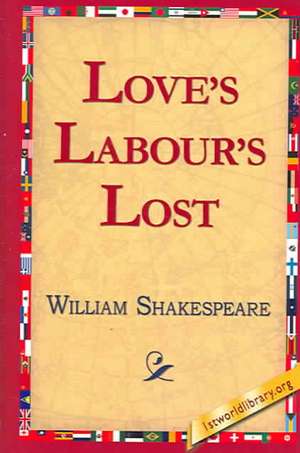
Love's Labour's Lost
Autor William Shakespeare Editat de 1stworld Library, Library 1stworld Libraryen Limba Engleză Hardback – 31 oct 2005
Preț: 158.25 lei
Puncte Express: 237
Carte tipărită la comandă
Livrare economică 03-17 iulie
Specificații
ISBN-13: 9781421813189
ISBN-10: 1421813181
Pagini: 108
Dimensiuni: 140 x 216 x 10 mm
Greutate: 0.27 kg
Editura: 1st World Publishing
Locul publicării:United States
ISBN-10: 1421813181
Pagini: 108
Dimensiuni: 140 x 216 x 10 mm
Greutate: 0.27 kg
Editura: 1st World Publishing
Locul publicării:United States
V-ar putea interesa
-
 HamletCollins GcsePreț: 28.08 lei
 -
 A Midsummer Night's DreamWilliam ShakespearePreț: 28.94 lei
 -
 The SonnetsWilliam ShakespearePreț: 28.69 lei
 -
 Love's Labor's Lost: The Pelican ShakespeareWilliam Shakespeare-21%Preț: 48.34 lei61.13 lei
 -
 Oxford School Shakespeare: Midsummer Night's DreamWilliam Shakespeare-5%Preț: 54.40 lei57.21 lei
 -
 Oxford School Shakespeare: Oxford School Shakespeare: Julius CaesarWilliam ShakespearePreț: 55.33 lei
 -
 The Complete Sonnets and Poems: The Oxford ShakespeareWilliam Shakespeare-11%Preț: 63.39 lei71.37 lei
 -
 The New Oxford Shakespeare: Modern Critical Edition: The Complete WorksWilliam Shakespeare-17%Preț: 382.04 lei460.43 lei
 -
 Love's Labour's LostProf. Eric Rasmussen-25%Preț: 63.57 lei84.53 lei
 -
 The Merry Wives Of WindsorWilliam ShakespearePreț: 27.89 lei
 -
 The Comedy of ErrorsWilliam ShakespearePreț: 28.68 lei
 -
 The PoemsWilliam ShakespearePreț: 56.40 lei
 -
 The Merchant of VeniceWilliam ShakespearePreț: 37.28 lei
 -
 All's Well That Ends WellWilliam ShakespearePreț: 38.47 lei
 -
 King JohnWilliam ShakespearePreț: 37.70 lei
 -
 Antony and CleopatraWilliam ShakespearePreț: 35.48 lei
 -
 The Taming of the ShrewWilliam ShakespearePreț: 35.34 lei
 -
 Much Ado About NothingWilliam ShakespearePreț: 24.60 lei
Descriere
This newly revised edition of one of the Bard's earliest comedies contains an extensive overview of Shakespeare's life, world, and theater; a special introduction to the play; dramatic criticism from the past and present; and a comprehensive stage history of the play. Reissue.
Cuprins
Introduction to the Play
Introduction to the Text
Key Facts
Love's Labour's Lost
Textual Notes
Scene-by-scene Analysis
Love's Labour's Lost in Performance: The RSC and Beyond
Four Centuries of Love's Labour's: An Overview
At the Royal Shakespeare Company
The Director's Cut: Interviews with Terry Hands and Liz Shipman
Approaching Love's Labour's: Reflections by Gregory Doran
Shakespeare's Career in the Theatre
Shakespeare's Works: A Chronology
Further Reading and Viewing
Acknowledgements and Picture Credits
Introduction to the Text
Key Facts
Love's Labour's Lost
Textual Notes
Scene-by-scene Analysis
Love's Labour's Lost in Performance: The RSC and Beyond
Four Centuries of Love's Labour's: An Overview
At the Royal Shakespeare Company
The Director's Cut: Interviews with Terry Hands and Liz Shipman
Approaching Love's Labour's: Reflections by Gregory Doran
Shakespeare's Career in the Theatre
Shakespeare's Works: A Chronology
Further Reading and Viewing
Acknowledgements and Picture Credits
Recenzii
`Hibbard lucidly expounds the intricately patterned structure of his play ... and he dispatches the largely distracting question of its 'topicality' with heartening promptness.'English Studies, Volume 72, Number 6, December 1991
`This Oxford text of Love's Labour's Lost is lucidly informative, scrupulous but concise,. and in general a model of restrained and level-headed editing.'Cedric Watts, University of Sussex, Review of English Studies, Vol. 43, 8/92
'Stanley Wells' OUP Complete Works of Shakespeare is now eight years old and has spawned a new Oxford Shakespeare which appears now in splendidly affordable volumes in that nonpareil of libraries of good reading The World's Classics.'The Oxford Times
`This Oxford text of Love's Labour's Lost is lucidly informative, scrupulous but concise,. and in general a model of restrained and level-headed editing.'Cedric Watts, University of Sussex, Review of English Studies, Vol. 43, 8/92
'Stanley Wells' OUP Complete Works of Shakespeare is now eight years old and has spawned a new Oxford Shakespeare which appears now in splendidly affordable volumes in that nonpareil of libraries of good reading The World's Classics.'The Oxford Times
Caracteristici
This is the first edition of Love's Labours Lost to be developed by and for the RSC, the world's leading Shakespeare theatre company and it includes unique material to help the reader understand and enjoy Shakespeare on the stage as well as on the page
Illustrated with photographs of classic and unusual performances
Outstanding on-page notes which explain words and phrases unfamiliar to a modern audience, including the slang, political references and bawdy humour often ignored or censored in competing editions
Includes scene-by-scene summary, offering an easily understandable way into the play
Completely new introduction by Jonathan Bate, exploring the text and critical debates around it
Summary of the play's performance history at the RSC and elsewhere
Interviews with important Shakespearean directors Terry Hands, Liz Shipman and Greg Doran, discussing key productions at the RSC
Illustrated with photographs of classic and unusual performances
Outstanding on-page notes which explain words and phrases unfamiliar to a modern audience, including the slang, political references and bawdy humour often ignored or censored in competing editions
Includes scene-by-scene summary, offering an easily understandable way into the play
Completely new introduction by Jonathan Bate, exploring the text and critical debates around it
Summary of the play's performance history at the RSC and elsewhere
Interviews with important Shakespearean directors Terry Hands, Liz Shipman and Greg Doran, discussing key productions at the RSC