
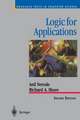
Logic for Applications: Texts in Computer Science
Autor Anil Nerode, Richard A. Shoreen Limba Engleză Hardback – 17 ian 1997
Din seria Texts in Computer Science
- 20%
 Preț: 330.09 lei
 - 17%
 Preț: 396.70 lei
 - 20%
 Preț: 560.04 lei
 - 20%
 Preț: 496.15 lei
 - 13%
 Preț: 435.53 lei
 - 20%
 Preț: 412.81 lei
 - 20%
 Preț: 494.73 lei
 - 15%
 Preț: 703.88 lei
 - 20%
 Preț: 484.25 lei
 - 23%
 Preț: 758.41 lei
 - 20%
 Preț: 665.88 lei
 - 24%
 Preț: 310.97 lei
 - 20%
 Preț: 571.17 lei
 - 20%
 Preț: 592.76 lei
 - 20%
 Preț: 589.70 lei
 - 20%
 Preț: 377.44 lei
 - 20%
 Preț: 362.96 lei
 - 20%
 Preț: 492.01 lei
 - 20%
 Preț: 332.62 lei
 - 20%
 Preț: 636.67 lei
 - 20%
 Preț: 671.21 lei
 - 29%
 Preț: 389.24 lei
 - 20%
 Preț: 514.49 lei
 - 20%
 Preț: 546.95 lei
 - 20%
 Preț: 335.61 lei
 - 20%
 Preț: 380.49 lei
 - 20%
 Preț: 344.40 lei
 - 20%
 Preț: 621.20 lei
 - 20%
 Preț: 400.45 lei
 -
 Preț: 491.23 lei
 - 20%
 Preț: 338.01 lei
 - 15%
 Preț: 756.39 lei
 - 20%
 Preț: 583.46 lei
 - 20%
 Preț: 310.74 lei
 -
 Preț: 401.78 lei
 - 20%
 Preț: 346.44 lei
 - 20%
 Preț: 750.96 lei
 - 20%
 Preț: 359.75 lei
 - 20%
 Preț: 320.19 lei
Preț: 949.56 lei
Preț vechi: 1186.96 lei
-20%
Puncte Express: 1424
Carte disponibilă
Livrare economică 26 octombrie-09 noiembrie
Livrare prin curier în România Termenul estimat este afișat lângă disponibilitate.
Transport gratuit pentru acest produs Plată online sau ramburs, în funcție de opțiunile comenzii.
Retur gratuit în 14 zile Comandă securizată și suport în română.
Specificații
ISBN-13: 9780387948935
ISBN-10: 0387948937
Pagini: 476
Ilustrații: XIII, 456 p.
Dimensiuni: 160 x 241 x 30 mm
Greutate: 0.88 kg
Ediția:Second Edition 1997
Editura: Springer
Colecția Texts in Computer Science
Seria Texts in Computer Science
Locul publicării:New York, NY, United States
ISBN-10: 0387948937
Pagini: 476
Ilustrații: XIII, 456 p.
Dimensiuni: 160 x 241 x 30 mm
Greutate: 0.88 kg
Ediția:Second Edition 1997
Editura: Springer
Colecția Texts in Computer Science
Seria Texts in Computer Science
Locul publicării:New York, NY, United States
V-ar putea interesa
-
 -31%Preț: 523.99 lei760.28 lei
 -
 A Student's Guide to Data and Error AnalysisHerman J. C. BerendsenPreț: 242.57 lei
 -
 The Logic of Quantum MechanicsEnrico G. Beltrametti-11%Preț: 451.60 lei507.41 lei
 -
 -19%Preț: 653.25 lei806.48 lei
 -
 Modeling and Simulation in Scilab/Scicos with Scicoslab 4.4Stephen L. CampbellPreț: 410.70 lei
 -
 Fractal Geometry, Complex Dimensions and Zeta FunctionsMichel L. Lapidus-18%Preț: 909.25 lei1108.83 lei
 -
 Alfred TarskiAndrew Mcfarland-18%Preț: 638.69 lei778.90 lei
 -
 Universal Logic: An AnthologyJean-Yves BéziauPreț: 402.13 lei
 -
 The Mathematics of Coordinated Inference: A Study of Generalized Hat ProblemsChristopher S. HardinPreț: 370.84 lei
 -
 Categories and SheavesMasaki Kashiwara-15%Preț: 717.25 lei843.82 lei
 -
 -18%Preț: 1401.61 lei1709.28 lei
 -
 Algebraic OperadsJean-Louis Loday-18%Preț: 803.32 lei979.65 lei
Public țintă
Professional/practitionerCuprins
I Propositional Logic.- 1 Orders and Trees.- 2 Propositions, Connectives and Truth Tables.- 3 Truth Assignments and Valuations.- 4 Tableau Proofs in Propositional Calculus.- 5 Soundness and Completeness of Tableau Proofs.- 6 Deductions from Premises and Compactness.- 7 An Axiomatic Approach*.- 8 Resolution.- 9 Refining Resolution.- 10 Linear Resolution, Horn Clauses and PROLOG.- II Predicate Logic.- 1 Predicates and Quantifiers.- 2 The Language: Terms and Formulas.- 3 Formation Trees, Structures and Lists.- 4 Semantics: Meaning and Truth.- 5 Interpretations of PROLOG Programs.- 6 Proofs: Complete Systematic Tableaux.- 7 Soundness and Completeness of Tableau Proofs.- 8 An Axiomatic Approach*.- 9 Prenex Normal Form and Skolemization.- 10 Herbrand’s Theorem.- 11 Unification.- 12 The Unification Algorithm.- 13 Resolution.- 14 Refining Resolution: Linear Resolution.- III PROLOG.- 1 SLD-Resolution.- 2 Implementations: Searching and Backtracking.- 3 Controlling the Implementation: Cut.- 4 Termination Conditions for PROLOG Programs.- 5 Equality.- 6 Negation as Failure.- 7 Negation and Nonmonotonic Logic.- 8 Computability and Undecidability.- IV Modal Logic.- 1 Possibility and Necessity; Knowledge or Belief.- 2 Frames and Forcing.- 3 Modal Tableaux.- 4 Soundness and Completeness.- 5 Modal Axioms and Special Accessibility Relations.- 6 An Axiomatic Approach*.- V Intuitionistic Logic.- 1 Intuitionism and Constructivism.- 2 Frames and Forcing.- 3 Intuitionistic Tableaux.- 4 Soundness and Completeness.- 5 Decidability and Undecidability.- 6 A Comparative Guide.- VI Elements of Set Theory.- 1 Some Basic Axioms of Set Theory.- 2 Boole’s Algebra of Sets.- 3 Relations, Functions and the Power Set Axiom.- 4 The Natural Numbers, Arithmetic and Infinity.- 5 Replacement, Choice andFoundation.- 6 Zermelo-Fraenkel Set Theory in Predicate Logic.- 7 Cardinality: Finite and Countable.- 8 Ordinal Numbers.- 9 Ordinal Arithmetic and Transfinite Induction.- 10 Transfinite Recursion, Choice and the Ranked Universe.- 11 Cardinals and Cardinal Arithmetic.- Appendix A: An Historical Overview.- 1 Calculus.- 2 Logic.- 3 Leibniz’s Dream.- 4 Nineteenth Century Logic.- 5 Nineteenth Century Foundations of Mathematics.- 6 Twentieth Century Foundations of Mathematics.- 7 Early Twentieth Century Logic.- 8 Deduction and Computation.- 9 Recent Automation of Logic and PROLOG.- 10 The Future.- Appendix B: A Genealogical Database.- Index of Symbols.- Index of Terms.
Recenzii
From reviews of the first edition: "... must surely rank as one of the most fruitful textbooks introduced into computer science ... We strongly suggest it as a textbook ..." SIGACT News
From the reviews of the second edition:
"…the book achieves its goal of being a unified introduction into classical logic, logic programming and certain non-classical logics. …the book succeeded in presenting a uniform framework for describing different logics. The author’s thorough approach to describing logic programming, via introduction of resolution-based refutations and subsequent study of different kinds of resolutions allows the reader to gradually switch from the study of logic to the study of logical programming paradigm and provides a lot of intuition about the behavior of logic programs.
As such the book can be recommended both as a textbook for senior/graduate course in logic/logic programming, and as a reading or reference for graduate students in the areas related to discrete mathematics."
(Alexander Dekhtyar, William Gasarch’s Book Review Column, SIGACT News)
From the reviews of the second edition:
"…the book achieves its goal of being a unified introduction into classical logic, logic programming and certain non-classical logics. …the book succeeded in presenting a uniform framework for describing different logics. The author’s thorough approach to describing logic programming, via introduction of resolution-based refutations and subsequent study of different kinds of resolutions allows the reader to gradually switch from the study of logic to the study of logical programming paradigm and provides a lot of intuition about the behavior of logic programs.
As such the book can be recommended both as a textbook for senior/graduate course in logic/logic programming, and as a reading or reference for graduate students in the areas related to discrete mathematics."
(Alexander Dekhtyar, William Gasarch’s Book Review Column, SIGACT News)