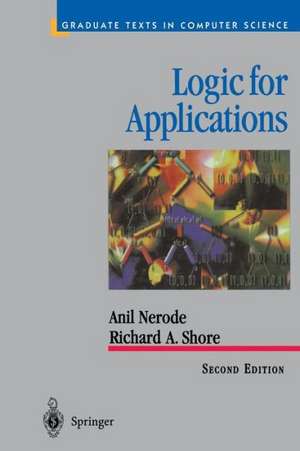
Logic for Applications: Texts in Computer Science
Autor Anil Nerode, Richard A. Shoreen Limba Engleză Paperback – 28 sep 2012
Din seria Texts in Computer Science
- 20%
 Preț: 507.43 lei
 - 17%
 Preț: 432.01 lei
 - 20%
 Preț: 398.51 lei
 - 20%
 Preț: 330.09 lei
 - 20%
 Preț: 501.79 lei
 - 20%
 Preț: 424.97 lei
 - 17%
 Preț: 396.70 lei
 - 15%
 Preț: 617.83 lei
 - 20%
 Preț: 469.65 lei
 - 20%
 Preț: 335.61 lei
 - 20%
 Preț: 331.62 lei
 - 20%
 Preț: 570.30 lei
 - 20%
 Preț: 660.56 lei
 - 20%
 Preț: 320.09 lei
 -
 Preț: 491.23 lei
 - 20%
 Preț: 463.56 lei
 - 20%
 Preț: 400.45 lei
 - 15%
 Preț: 727.69 lei
 - 20%
 Preț: 395.88 lei
 - 20%
 Preț: 583.46 lei
 - 20%
 Preț: 369.06 lei
 - 20%
 Preț: 492.01 lei
 - 20%
 Preț: 382.84 lei
 - 20%
 Preț: 337.48 lei
 - 20%
 Preț: 597.66 lei
 - 20%
 Preț: 568.86 lei
 - 23%
 Preț: 758.41 lei
 - 20%
 Preț: 574.48 lei
 - 20%
 Preț: 322.61 lei
 - 24%
 Preț: 310.97 lei
 - 20%
 Preț: 636.67 lei
 - 20%
 Preț: 328.79 lei
 -
 Preț: 401.15 lei
 - 20%
 Preț: 469.91 lei
 - 20%
 Preț: 645.78 lei
 - 20%
 Preț: 333.38 lei
 - 20%
 Preț: 310.74 lei
 - 20%
 Preț: 522.08 lei
 - 20%
 Preț: 174.78 lei
 - 20%
 Preț: 722.47 lei
Preț: 331.42 lei
Preț vechi: 414.29 lei
-20%
Puncte Express: 497
Carte tipărită la comandă
Livrare economică 20 mai-03 iunie
Specificații
ISBN-13: 9781461268550
ISBN-10: 1461268559
Pagini: 476
Ilustrații: XIII, 456 p.
Dimensiuni: 155 x 235 x 26 mm
Greutate: 0.72 kg
Ediția:Second Edition 1997
Editura: Springer
Colecția Texts in Computer Science
Seria Texts in Computer Science
Locul publicării:New York, NY, United States
ISBN-10: 1461268559
Pagini: 476
Ilustrații: XIII, 456 p.
Dimensiuni: 155 x 235 x 26 mm
Greutate: 0.72 kg
Ediția:Second Edition 1997
Editura: Springer
Colecția Texts in Computer Science
Seria Texts in Computer Science
Locul publicării:New York, NY, United States
V-ar putea interesa
-
 -24%Preț: 491.51 lei649.72 lei
 -
 A Student's Guide to Data and Error AnalysisHerman J. C. BerendsenPreț: 232.62 lei
 -
 The Logic of Quantum Mechanics: Volume 15Enrico G. Beltrametti-11%Preț: 440.38 lei494.80 lei
 -
 -8%Preț: 475.75 lei517.12 lei
 -
 Modeling and Simulation in Scilab/Scicos with Scicoslab 4.4Stephen L. CampbellPreț: 390.75 lei
 -
 Fractal Geometry, Complex Dimensions and Zeta FunctionsMichel L. Lapidus-18%Preț: 866.37 lei1056.54 lei
 -
 Alfred TarskiAndrew Mcfarland-15%Preț: 638.17 lei750.79 lei
 -
 Universal Logic: An AnthologyJean-Yves BéziauPreț: 383.33 lei
 -
 The Mathematics of Coordinated Inference: A Study of Generalized Hat ProblemsChristopher S. HardinPreț: 370.84 lei
 -
 Categories and SheavesMasaki Kashiwara-15%Preț: 690.06 lei811.84 lei
 -
 -18%Preț: 1343.07 lei1637.88 lei
 -
 Algebraic OperadsJean-Louis Loday-18%Preț: 765.44 lei933.47 lei
Public țintă
Professional/practitionerCuprins
I Propositional Logic.- 1 Orders and Trees.- 2 Propositions, Connectives and Truth Tables.- 3 Truth Assignments and Valuations.- 4 Tableau Proofs in Propositional Calculus.- 5 Soundness and Completeness of Tableau Proofs.- 6 Deductions from Premises and Compactness.- 7 An Axiomatic Approach*.- 8 Resolution.- 9 Refining Resolution.- 10 Linear Resolution, Horn Clauses and PROLOG.- II Predicate Logic.- 1 Predicates and Quantifiers.- 2 The Language: Terms and Formulas.- 3 Formation Trees, Structures and Lists.- 4 Semantics: Meaning and Truth.- 5 Interpretations of PROLOG Programs.- 6 Proofs: Complete Systematic Tableaux.- 7 Soundness and Completeness of Tableau Proofs.- 8 An Axiomatic Approach*.- 9 Prenex Normal Form and Skolemization.- 10 Herbrand’s Theorem.- 11 Unification.- 12 The Unification Algorithm.- 13 Resolution.- 14 Refining Resolution: Linear Resolution.- III PROLOG.- 1 SLD-Resolution.- 2 Implementations: Searching and Backtracking.- 3 Controlling the Implementation: Cut.- 4 Termination Conditions for PROLOG Programs.- 5 Equality.- 6 Negation as Failure.- 7 Negation and Nonmonotonic Logic.- 8 Computability and Undecidability.- IV Modal Logic.- 1 Possibility and Necessity; Knowledge or Belief.- 2 Frames and Forcing.- 3 Modal Tableaux.- 4 Soundness and Completeness.- 5 Modal Axioms and Special Accessibility Relations.- 6 An Axiomatic Approach*.- V Intuitionistic Logic.- 1 Intuitionism and Constructivism.- 2 Frames and Forcing.- 3 Intuitionistic Tableaux.- 4 Soundness and Completeness.- 5 Decidability and Undecidability.- 6 A Comparative Guide.- VI Elements of Set Theory.- 1 Some Basic Axioms of Set Theory.- 2 Boole’s Algebra of Sets.- 3 Relations, Functions and the Power Set Axiom.- 4 The Natural Numbers, Arithmetic and Infinity.- 5 Replacement, Choice andFoundation.- 6 Zermelo-Fraenkel Set Theory in Predicate Logic.- 7 Cardinality: Finite and Countable.- 8 Ordinal Numbers.- 9 Ordinal Arithmetic and Transfinite Induction.- 10 Transfinite Recursion, Choice and the Ranked Universe.- 11 Cardinals and Cardinal Arithmetic.- Appendix A: An Historical Overview.- 1 Calculus.- 2 Logic.- 3 Leibniz’s Dream.- 4 Nineteenth Century Logic.- 5 Nineteenth Century Foundations of Mathematics.- 6 Twentieth Century Foundations of Mathematics.- 7 Early Twentieth Century Logic.- 8 Deduction and Computation.- 9 Recent Automation of Logic and PROLOG.- 10 The Future.- Appendix B: A Genealogical Database.- Index of Symbols.- Index of Terms.
Recenzii
From reviews of the first edition: "... must surely rank as one of the most fruitful textbooks introduced into computer science ... We strongly suggest it as a textbook ..." SIGACT News
From the reviews of the second edition:
"…the book achieves its goal of being a unified introduction into classical logic, logic programming and certain non-classical logics. …the book succeeded in presenting a uniform framework for describing different logics. The author’s thorough approach to describing logic programming, via introduction of resolution-based refutations and subsequent study of different kinds of resolutions allows the reader to gradually switch from the study of logic to the study of logical programming paradigm and provides a lot of intuition about the behavior of logic programs.
As such the book can be recommended both as a textbook for senior/graduate course in logic/logic programming, and as a reading or reference for graduate students in the areas related to discrete mathematics."
(Alexander Dekhtyar, William Gasarch’s Book Review Column, SIGACT News)
From the reviews of the second edition:
"…the book achieves its goal of being a unified introduction into classical logic, logic programming and certain non-classical logics. …the book succeeded in presenting a uniform framework for describing different logics. The author’s thorough approach to describing logic programming, via introduction of resolution-based refutations and subsequent study of different kinds of resolutions allows the reader to gradually switch from the study of logic to the study of logical programming paradigm and provides a lot of intuition about the behavior of logic programs.
As such the book can be recommended both as a textbook for senior/graduate course in logic/logic programming, and as a reading or reference for graduate students in the areas related to discrete mathematics."
(Alexander Dekhtyar, William Gasarch’s Book Review Column, SIGACT News)