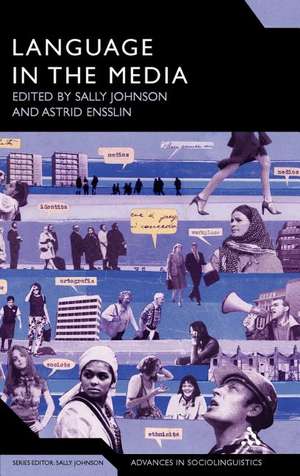
Language in the Media: Representations, Identities, Ideologies: Advances in Sociolinguistics
Editat de Professor Sally Johnson, Professor Astrid Ensslinen Limba Engleză Hardback – 19 sep 2007
This book examines the ways in which the media represents language-related issues, but also how the media's use of language is central to the construction of what people think language is, could or ought to be like. The chapters examine issues of identity, gender, youth, citizenship, politics and ideology across a range of media, including television, radio, newspapers, magazines and the internet. The result is a multilingual survey of the construction of language in and by the media that will be essential reading for students and researchers of sociolinguistics or language and communication.
Din seria Advances in Sociolinguistics
- 28%
 Preț: 286.38 lei
 - 14%
 Preț: 320.61 lei
 - 27%
 Preț: 249.92 lei
 - 28%
 Preț: 206.34 lei
 - 25%
 Preț: 242.50 lei
 - 16%
 Preț: 278.06 lei
 -
 Preț: 283.09 lei
 - 36%
 Preț: 615.38 lei
 - 27%
 Preț: 277.20 lei
 - 30%
 Preț: 218.44 lei
 - 30%
 Preț: 213.23 lei
 - 14%
 Preț: 1152.30 lei
 -
 Preț: 278.87 lei
 - 24%
 Preț: 281.35 lei
 - 16%
 Preț: 276.77 lei
 -
 Preț: 279.35 lei
 - 49%
 Preț: 685.56 lei
 - 24%
 Preț: 255.48 lei
 -
 Preț: 234.37 lei
 - 25%
 Preț: 1090.72 lei
 - 25%
 Preț: 240.36 lei
 - 15%
 Preț: 279.17 lei
 - 27%
 Preț: 405.54 lei
 - 34%
 Preț: 1097.80 lei
 - 15%
 Preț: 279.17 lei
 - 26%
 Preț: 280.18 lei
 -
 Preț: 278.06 lei
 - 21%
 Preț: 504.94 lei
 - 23%
 Preț: 238.07 lei
Preț: 1244.01 lei
Preț vechi: 1446.53 lei
-14%
Puncte Express: 1866
Carte tipărită la comandă
Livrare economică 01-15 decembrie
Livrare prin curier în România Termenul estimat este afișat lângă disponibilitate.
Transport gratuit pentru acest produs Plată online sau ramburs, în funcție de opțiunile comenzii.
Retur gratuit în 14 zile Comandă securizată și suport în română.
Specificații
ISBN-13: 9780826495488
ISBN-10: 0826495486
Pagini: 328
Dimensiuni: 156 x 234 x 23 mm
Greutate: 0.5 kg
Editura: Bloomsbury Publishing
Colecția Continuum
Seria Advances in Sociolinguistics
Locul publicării:London, United Kingdom
ISBN-10: 0826495486
Pagini: 328
Dimensiuni: 156 x 234 x 23 mm
Greutate: 0.5 kg
Editura: Bloomsbury Publishing
Colecția Continuum
Seria Advances in Sociolinguistics
Locul publicării:London, United Kingdom
V-ar putea interesa
-
 SociolinguisticsPeter TrudgillPreț: 92.53 lei
 -
 Language Contact and Change: Spanish in Los AngelesCarmen Silva-Corvalán-28%Preț: 399.31 lei557.03 lei
 -
 -21%Preț: 301.93 lei380.19 lei
 -
 Language in Society: An Introduction to SociolinguisticsSuzanne Romaine-14%Preț: 271.06 lei314.47 lei
 -
 Talking Proper: The Rise of Accent as Social SymbolLynda Mugglestone-21%Preț: 421.21 lei533.94 lei
 -
 English in EuropeManfred Görlach-28%Preț: 362.86 lei501.81 lei
 -
 Language and National Identity in AfricaAndrew Simpson-28%Preț: 423.39 lei587.45 lei
 -
 The Elephants Teach: Creative Writing Since 1880David Gershom MyersPreț: 268.00 lei
 -
 The Language of GamingProfessor Astrid Ensslin-24%Preț: 255.36 lei337.26 lei
 -
 Advances in Health Psychology: Critical ApproachesChristine HorrocksPreț: 322.44 lei
 -
 PragmaticsJean Stilwell PecceiPreț: 277.71 lei
 -
 Vice SlangTom DalzellPreț: 290.61 lei
 -
 On Language and Sexual PoliticsDeborah CameronPreț: 483.57 lei
 -
 Sociolinguistics: A Resource Book for StudentsPeter StockwellPreț: 339.83 lei
 -
 The Language , Society and Power ReaderAnnabelle MooneyPreț: 409.70 lei
 -
 Language PolicyBernard SpolskyPreț: 380.60 lei
 -
 Sequence Organization in InteractionEmanuel A. SchegloffPreț: 459.80 lei
 -
 Language in the British IslesDavid BritainPreț: 418.37 lei
 -
 Critical Approaches to Creative WritingGraeme HarperPreț: 212.30 lei
 -
 The New Sociolinguistics ReaderNikolas CouplandPreț: 353.66 lei
 -
 Intercultural InteractionH. Spencer-Oatey-15%Preț: 665.80 lei783.29 lei
 -
 Becoming a WriterDorothea BrandePreț: 127.96 lei
Cuprins
Introduction
Chapter 1 Language in the Media: Theory and Practice.
Sally Johnson (University of Leeds) and Astrid Ensslin (University of Wales, Bangor)
PART I Metaphors and Meanings
Chapter 2 Metaphors for Speaking and Writing in the British Press.
John Heywood and Elena Semino (Lancaster University)
Chapter 3 Journalistic Constructions of Blair's 'Apology' for the Intelligence Leading to the Iraq War.
Lesley Jeffries (University of Huddersfield)
Chapter 4 Crises of Meaning: Personalist Language Ideology in US Media Discourse.
Jane Hill (University of Arizona)
PART II National Identities, Citizenship and Globalization
Chapter 5 The Iconography of Orthography: Representing German Spelling Reform in the News Magazine, Der Spiegel.
Sally Johnson (University of Leeds)
Chapter 6 A Language Ideology in Print: the Case of Sweden.
Tommaso M. Milani (University of Stockholm)
Chapter 7 Global Challenges to Nationalist Ideologies: Language and Education in the Luxembourg Press.
Kristine Horner (University of Leeds)
PART III Contact and Codeswitching in Multilingual Mediascapes
Chapter 8 Corsican on the Airwaves: Media Discourse in a Context of Minority Language Shift.
Alexandra Jaffe (California State University, Long Beach)
Chapter 9 'When Hector met Tom Cruise': Attitudes to Irish in a Radio Satire.
Helen Kelly-Holmes and David Atkinson (University of Limerick)
Chapter 10 Dealing with Linguistic Difference in Encounters with Others on British Television.
Simon Gieve and Julie Norton (University of Leicester)
PART IV Youth, Gender and Cyber-Identities
Chapter 11 Fabricating Youth: New-media Discourse and the Technologization of Young People.
Crispin Thurlow (University of Washington)
Chapter 12 Dreaming of Genie: Gender Difference and Identity on the Web.
Deborah Cameron (Oxford University)
Chapter 13 Of Chords, Machines and Bumble-bees: The Metalinguistics of Hyperpoetry.
Astrid Ensslin (University of Wales, Bangor)
Commentary
Chapter 14 Language in the Media: Authenticity and Othering.
Adam Jaworski (Cardiff University)
Chapter 1 Language in the Media: Theory and Practice.
Sally Johnson (University of Leeds) and Astrid Ensslin (University of Wales, Bangor)
PART I Metaphors and Meanings
Chapter 2 Metaphors for Speaking and Writing in the British Press.
John Heywood and Elena Semino (Lancaster University)
Chapter 3 Journalistic Constructions of Blair's 'Apology' for the Intelligence Leading to the Iraq War.
Lesley Jeffries (University of Huddersfield)
Chapter 4 Crises of Meaning: Personalist Language Ideology in US Media Discourse.
Jane Hill (University of Arizona)
PART II National Identities, Citizenship and Globalization
Chapter 5 The Iconography of Orthography: Representing German Spelling Reform in the News Magazine, Der Spiegel.
Sally Johnson (University of Leeds)
Chapter 6 A Language Ideology in Print: the Case of Sweden.
Tommaso M. Milani (University of Stockholm)
Chapter 7 Global Challenges to Nationalist Ideologies: Language and Education in the Luxembourg Press.
Kristine Horner (University of Leeds)
PART III Contact and Codeswitching in Multilingual Mediascapes
Chapter 8 Corsican on the Airwaves: Media Discourse in a Context of Minority Language Shift.
Alexandra Jaffe (California State University, Long Beach)
Chapter 9 'When Hector met Tom Cruise': Attitudes to Irish in a Radio Satire.
Helen Kelly-Holmes and David Atkinson (University of Limerick)
Chapter 10 Dealing with Linguistic Difference in Encounters with Others on British Television.
Simon Gieve and Julie Norton (University of Leicester)
PART IV Youth, Gender and Cyber-Identities
Chapter 11 Fabricating Youth: New-media Discourse and the Technologization of Young People.
Crispin Thurlow (University of Washington)
Chapter 12 Dreaming of Genie: Gender Difference and Identity on the Web.
Deborah Cameron (Oxford University)
Chapter 13 Of Chords, Machines and Bumble-bees: The Metalinguistics of Hyperpoetry.
Astrid Ensslin (University of Wales, Bangor)
Commentary
Chapter 14 Language in the Media: Authenticity and Othering.
Adam Jaworski (Cardiff University)
Recenzii
"This is not just another book on media language. In a sophisticated, original and sharply critical way, it shows us how the media lens gives language distinctive forms and values. Sociolinguistics comes of age when it analyses the mediation of language - a truly contemporary phenomenon. That is what this book achieves, comprehensively and brilliantly." - Professor Nikolas Coupland, Centre for Language and Communication Research, Cardiff University, UK
"...consistently reflects its authors' ability to meld fresh empirical study to thought-provoking analytical and theoretical insight vis-à-vis the intersections between media representations of language issues and larger societal understandings of these issues...Adam Jaworski concludes the volume with a reflective chapter (Chapter 14) entitled 'Language in the media: Authenticity and othering'. Jaworski notes the ways in which many of the volume's chapters display a growing self-reflexivity among researchers of language. Given the clear critical orientation of most of the volume's authors, the seems an apt observation with which to conclude Language in the Media." Journal of Sociolinguistics 13/4. 2009
"The book Language in the Media...exhibits several underlying linking qualities that give the book a desirable level of coherence, which is also enhanced formally by the fact that there is only one bibliographical section at the end of the book. The book is not the typical book on language and the media...it focuses on very specific and ideology-connoted aspects of the relationship of language and media, but at the same time it will no doubt draw the attention of readers from a wide range of research perspectives, including pragmatics, (critical) discourse analysis, ethnological approaches, etc...the book is invaluable and no doubt offers interesting insights in a field on which so much has been published already." - Francisco Yus, The Linguist List, November 3, 2008
"...consistently reflects its authors' ability to meld fresh empirical study to thought-provoking analytical and theoretical insight vis-à-vis the intersections between media representations of language issues and larger societal understandings of these issues...Adam Jaworski concludes the volume with a reflective chapter (Chapter 14) entitled 'Language in the media: Authenticity and othering'. Jaworski notes the ways in which many of the volume's chapters display a growing self-reflexivity among researchers of language. Given the clear critical orientation of most of the volume's authors, the seems an apt observation with which to conclude Language in the Media." Journal of Sociolinguistics 13/4. 2009
"The book Language in the Media...exhibits several underlying linking qualities that give the book a desirable level of coherence, which is also enhanced formally by the fact that there is only one bibliographical section at the end of the book. The book is not the typical book on language and the media...it focuses on very specific and ideology-connoted aspects of the relationship of language and media, but at the same time it will no doubt draw the attention of readers from a wide range of research perspectives, including pragmatics, (critical) discourse analysis, ethnological approaches, etc...the book is invaluable and no doubt offers interesting insights in a field on which so much has been published already." - Francisco Yus, The Linguist List, November 3, 2008