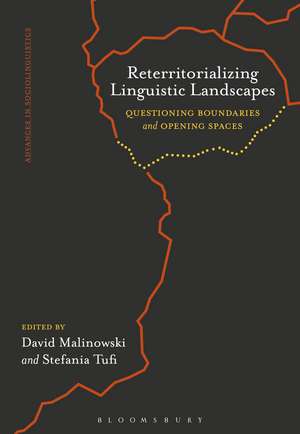
Reterritorializing Linguistic Landscapes: Questioning Boundaries and Opening Spaces: Advances in Sociolinguistics
Editat de Dr David Malinowski, Dr Stefania Tufien Limba Engleză Paperback – 27 ian 2022
Divided into four parts, chapters bring into dialogue themes relating to reterritorialization practices and the productive nature of boundaries and spaces. This book considers the contemporary challenges facing the field, the politics and processes of identifying and demarcating 'sites of research', and the ethics and pedagogical applications of LL research.
With comprehensive lists of further reading, extended discussion questions and suggestions for independent research at the end of each chapter, this is an essential reference work for all LL scholars and students who wish to keep abreast of the current state of the art.
Din seria Advances in Sociolinguistics
- 30%
 Preț: 271.66 lei
 -
 Preț: 264.88 lei
 - 28%
 Preț: 238.15 lei
 - 30%
 Preț: 196.56 lei
 - 26%
 Preț: 231.46 lei
 - 17%
 Preț: 264.88 lei
 - 27%
 Preț: 268.81 lei
 - 50%
 Preț: 653.31 lei
 - 28%
 Preț: 265.49 lei
 - 31%
 Preț: 205.78 lei
 - 32%
 Preț: 203.12 lei
 - 14%
 Preț: 1103.67 lei
 -
 Preț: 265.75 lei
 - 26%
 Preț: 268.12 lei
 - 17%
 Preț: 263.65 lei
 -
 Preț: 265.33 lei
 - 26%
 Preț: 237.50 lei
 - 26%
 Preț: 1039.23 lei
 - 26%
 Preț: 228.96 lei
 - 17%
 Preț: 266.18 lei
 - 27%
 Preț: 388.41 lei
 - 34%
 Preț: 1097.80 lei
 - 17%
 Preț: 265.91 lei
 -
 Preț: 266.10 lei
 - 22%
 Preț: 483.68 lei
 - 15%
 Preț: 305.12 lei
 - 24%
 Preț: 227.95 lei
Preț: 225.66 lei
Puncte Express: 338
Carte tipărită la comandă
Livrare economică 06-20 iunie
Specificații
ISBN-13: 9781350247116
ISBN-10: 1350247111
Pagini: 432
Dimensiuni: 168 x 244 x 26 mm
Greutate: 0.78 kg
Editura: Bloomsbury Publishing
Colecția Bloomsbury Academic
Seria Advances in Sociolinguistics
Locul publicării:London, United Kingdom
ISBN-10: 1350247111
Pagini: 432
Dimensiuni: 168 x 244 x 26 mm
Greutate: 0.78 kg
Editura: Bloomsbury Publishing
Colecția Bloomsbury Academic
Seria Advances in Sociolinguistics
Locul publicării:London, United Kingdom
Cuprins
List of Contributors
Acknowledgements
Introduction
Part A: Questioning Boundaries, Opening Spaces
Section I. Questioning Disciplinary and Methodological Boundaries
1. What do People Notice from Real-World Linguistic Landscapes? A Review of the Literature and Recommendations for Future Eye-Tracking Research, Jakob R. E. Leimgruber, Naomi Vingron & Debra Titone
2. The Quality of Quantity, Kate Lyons
3. Quantitative 2.0: Towards Variationist Linguistic Landscape Study (VaLLS) and a Standard Canon of LL Variables, Will Amos and Barbara Soukup
4. 'Mind the Gap': Social Space in Linguistic Landscape Studies, Diarmait Mac Giolla Chríost
Section II. The Spaces and Places of LL Research
5. Online Linguistic Landscapes: Discourse, Globalization, and Enregisterment, Jeffrey L. Kallen, Esther Ní Dhonnacha and Karen Wade
6. The Semiotics of Spatial Turbulence: Re/Deterritorialising Israel/Palestine at a South African University, Natalija Cerimaj, Tommaso M. Milani and E. Dimitris Kitis
7. Hong Kong's Paper Cities: Heterotopia and the Semiotic Landscape of Civil Disobedience, Aaron Anfinson
8. From Graffiti to Street Art and Back: Connections between Past and Present, Sabrina Machetti and Claudio Pizzorusso
9. F/Anfield: Banners, Tweets and 'Owning' Football's Linguistic Landscape, Frank Monaghan
10. Exploring the Mediation Styles of LL Sites by Tourist Guides, Shoshana Waksman and Elana Shohamy
Part B: Reterritorializing Linguistic Landscapes
Section III. Re-Writing, Re-Working, Re-Inventing Place
11. The Semiotics of Heritage and Regeneration: Post-Apartheid Urban Development in Johannesburg, Gilles Baro
12. Blurred Lines: The Effect of Regional Borders on the LL in Northern Spain, Deirdre A. Dunlevy
13. Politically Open - Sociolinguistically Semi-Permeable: A Linguistic Landscape View into the Lithuanian-Polish Borderland, Gintare Kudzmaite and Kasper Juffermans
14. The Language of Public Mourning - De- and Reterritorialization of Public Spaces as a Reaction to Terrorist Attacks, Rolf Kailuweit and Aldina Quintana
15. A Swimming Pool, an Abattoir, and a Biscuit Factory: Discursive Presentations of Adaptive Reuse for Museum Spaces in France, Robert Blackwood
16. A Diachronic Examination and Interpretation of the Street-Signage Transformation in Granada, Spain, during the Transition to Democracy (1975-1983), Yael Guilat and Antonio B. Espinosa-Ramírez
Section IV.Experimenting Space
17. A Methodological and Pedagogical Framework for Designing L2 Student-Based Linguistic Landscape Research, Hiram Maxim
18. Linguistic Landscape as a Tool for Literacy-Based Language Teaching and Learning: Application for the Foreign Language Classroom, Olga Bever and Diane Richardson
19. Parents Interpreting their Children's Schoolscapes: Building an Insider's Perspective, Tamás Péter Szabó and Robert A. Troyer
Index
Acknowledgements
Introduction
Part A: Questioning Boundaries, Opening Spaces
Section I. Questioning Disciplinary and Methodological Boundaries
1. What do People Notice from Real-World Linguistic Landscapes? A Review of the Literature and Recommendations for Future Eye-Tracking Research, Jakob R. E. Leimgruber, Naomi Vingron & Debra Titone
2. The Quality of Quantity, Kate Lyons
3. Quantitative 2.0: Towards Variationist Linguistic Landscape Study (VaLLS) and a Standard Canon of LL Variables, Will Amos and Barbara Soukup
4. 'Mind the Gap': Social Space in Linguistic Landscape Studies, Diarmait Mac Giolla Chríost
Section II. The Spaces and Places of LL Research
5. Online Linguistic Landscapes: Discourse, Globalization, and Enregisterment, Jeffrey L. Kallen, Esther Ní Dhonnacha and Karen Wade
6. The Semiotics of Spatial Turbulence: Re/Deterritorialising Israel/Palestine at a South African University, Natalija Cerimaj, Tommaso M. Milani and E. Dimitris Kitis
7. Hong Kong's Paper Cities: Heterotopia and the Semiotic Landscape of Civil Disobedience, Aaron Anfinson
8. From Graffiti to Street Art and Back: Connections between Past and Present, Sabrina Machetti and Claudio Pizzorusso
9. F/Anfield: Banners, Tweets and 'Owning' Football's Linguistic Landscape, Frank Monaghan
10. Exploring the Mediation Styles of LL Sites by Tourist Guides, Shoshana Waksman and Elana Shohamy
Part B: Reterritorializing Linguistic Landscapes
Section III. Re-Writing, Re-Working, Re-Inventing Place
11. The Semiotics of Heritage and Regeneration: Post-Apartheid Urban Development in Johannesburg, Gilles Baro
12. Blurred Lines: The Effect of Regional Borders on the LL in Northern Spain, Deirdre A. Dunlevy
13. Politically Open - Sociolinguistically Semi-Permeable: A Linguistic Landscape View into the Lithuanian-Polish Borderland, Gintare Kudzmaite and Kasper Juffermans
14. The Language of Public Mourning - De- and Reterritorialization of Public Spaces as a Reaction to Terrorist Attacks, Rolf Kailuweit and Aldina Quintana
15. A Swimming Pool, an Abattoir, and a Biscuit Factory: Discursive Presentations of Adaptive Reuse for Museum Spaces in France, Robert Blackwood
16. A Diachronic Examination and Interpretation of the Street-Signage Transformation in Granada, Spain, during the Transition to Democracy (1975-1983), Yael Guilat and Antonio B. Espinosa-Ramírez
Section IV.Experimenting Space
17. A Methodological and Pedagogical Framework for Designing L2 Student-Based Linguistic Landscape Research, Hiram Maxim
18. Linguistic Landscape as a Tool for Literacy-Based Language Teaching and Learning: Application for the Foreign Language Classroom, Olga Bever and Diane Richardson
19. Parents Interpreting their Children's Schoolscapes: Building an Insider's Perspective, Tamás Péter Szabó and Robert A. Troyer
Index
Recenzii
Anyone interested in LL must attend to the inherent instability of the spaces they examine, the meanings they glean, the fragile connection between the two, and their own mutable relationship to all of the above. This volume is valuable precisely because it does not shy away from this necessity.
This volume succeeds in combining in-depth case studies of linguistic landscape phenomena with detailed engagement with current theoretical models. The essay questions and ideas for projects at the end of each chapter will be invaluable for instructors of courses incorporating linguistic landscape material.
Reterritorializing Linguistic Landscapes is a provocative collection that holds up a mirror to the field itself. It shines a light on theoretical and methodological challenges with contributions that represent the leading edge of innovation and creativity. In this book, we see linguistic landscape analysis maturing.
This is an excellent way to approach the study of the linguistic landscape. The volume presents a vivid picture of the theoretical and methodological debates within the field and is truly interdisciplinary, with insightful contributions that reterritorialize linguistic landscapes. With a wide range of contexts, it is essential reading for researchers and professionals who are interested in languages and multimodality in the public space.
This volume succeeds in combining in-depth case studies of linguistic landscape phenomena with detailed engagement with current theoretical models. The essay questions and ideas for projects at the end of each chapter will be invaluable for instructors of courses incorporating linguistic landscape material.
Reterritorializing Linguistic Landscapes is a provocative collection that holds up a mirror to the field itself. It shines a light on theoretical and methodological challenges with contributions that represent the leading edge of innovation and creativity. In this book, we see linguistic landscape analysis maturing.
This is an excellent way to approach the study of the linguistic landscape. The volume presents a vivid picture of the theoretical and methodological debates within the field and is truly interdisciplinary, with insightful contributions that reterritorialize linguistic landscapes. With a wide range of contexts, it is essential reading for researchers and professionals who are interested in languages and multimodality in the public space.