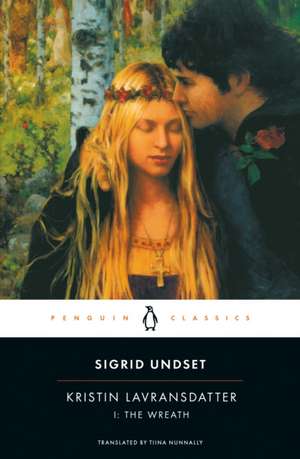
Kristin Lavransdatter, I: Penguin Publishing Group
Autor Sigrid Undset Traducere de Tiina Nunnallyen Limba Engleză Paperback – dec 1997
Ne-a atras atenția modul în care o existență individuală poate deveni oglinda unei întregi epoci. În acest prim volum al trilogiei, suntem martorii tensiunii dintre voința unei tinere femei și structurile rigide ale unei societăți medievale aflate la granița dintre vechile legende și dogmele creștine. Premisa nu este doar una istorică; este dilema universală a maturizării sub povara așteptărilor părintești și a pasiunilor care sfidează convențiile. Notăm cu interes cum Sigrid Undset reușește să transforme detaliul domestic — de la textura straielor la rânduiala fermelor din Gudbrand — într-o poezie a cotidianului ce depășește granițele genului istoric. La intersecția dintre The Bridal Wreath și The Wreath, această versiune tradusă de Tiina Nunnally combină acuratețea istorică a vieții în secolul al XIV-lea cu un flux narativ natural, eliminând barierele lingvistice ale traducerilor vechi. Dacă în Gunnar's Daughter autoarea explora o perioadă mai violentă a Norvegiei (Era Sagelor), aici observăm o maturizare a stilului, unde conflictul interior și dimensiunea spirituală capătă o profunzime ce anticipează complexitatea din The Mistress of Husaby. Este o scriitură care nu se grăbește, invitând la o contemplare a legăturilor invizibile dintre trecut și prezent, într-un peisaj nordic redat cu o precizie aproape tactilă.
Din seria Penguin Publishing Group
-
 Preț: 105.65 lei
 -
 Preț: 98.01 lei
 -
 Preț: 102.45 lei
 -
 Preț: 98.24 lei
 -
 Preț: 98.32 lei
 -
 Preț: 100.09 lei
 -
 Preț: 99.19 lei
 -
 Preț: 110.25 lei
 -
 Preț: 86.94 lei
 -
 Preț: 56.29 lei
 - 19%
 Preț: 58.22 lei
 -
 Preț: 57.14 lei
 -
 Preț: 72.72 lei
 -
 Preț: 104.42 lei
 -
 Preț: 56.30 lei
 -
 Preț: 83.28 lei
 -
 Preț: 95.90 lei
 -
 Preț: 105.46 lei
 -
 Preț: 109.93 lei
 - 33%
 Preț: 48.86 lei
 -
 Preț: 105.28 lei
 -
 Preț: 104.57 lei
 -
 Preț: 113.65 lei
 -
 Preț: 159.45 lei
 -
 Preț: 89.90 lei
 -
 Preț: 101.95 lei
 -
 Preț: 243.61 lei
 -
 Preț: 98.37 lei
 -
 Preț: 78.28 lei
 -
 Preț: 105.86 lei
 -
 Preț: 104.88 lei
 -
 Preț: 105.24 lei
 -
 Preț: 108.84 lei
 -
 Preț: 62.28 lei
 -
 Preț: 111.02 lei
 -
 Preț: 41.80 lei
 -
 Preț: 103.83 lei
 -
 Preț: 116.91 lei
 -
 Preț: 106.49 lei
 -
 Preț: 93.21 lei
 -
 Preț: 90.76 lei
 -
 Preț: 98.98 lei
 -
 Preț: 120.22 lei
 -
 Preț: 54.75 lei
 -
 Preț: 88.72 lei
 -
 Preț: 144.54 lei
 -
 Preț: 102.93 lei
 -
 Preț: 87.20 lei
 -
 Preț: 55.39 lei
 -
 Preț: 100.51 lei
Preț: 96.33 lei
Carte tipărită la comandă
Livrare economică 17 noiembrie-01 decembrie
Livrare express 10-16 octombrie pentru 38.00 lei
Specificații
ISBN-10: 0141180412
Pagini: 338
Ilustrații: b/w map on page xxv
Dimensiuni: 128 x 195 x 22 mm
Greutate: 0.32 kg
Editura: Random House
Colecția Penguin Publishing Group
Seria Penguin Publishing Group
V-ar putea interesa
-
 Independent PeopleHalldór LaxnessPreț: 81.29 lei
 -
 Gunnar's DaughterSigrid UndsetPreț: 84.16 lei
 -
 Kristin Lavransdatter, IIISigrid UndsetPreț: 99.53 lei
 -
 Kristin Lavransdatter: The WreathJessica HischePreț: 141.89 lei
 -
 A Doll's House, Men of Honour, When We Dead AwakenHenrik Ibsen-18%Preț: 53.75 lei65.53 lei
 -
 A Tale UnaskedLady NijoPreț: 92.82 lei
 -
 The Half-Drowned KingLinnea HartsuykerPreț: 73.67 lei
 -
 Eyes of the RigelRoy Jacobsen-27%Preț: 47.02 lei64.06 lei
 -
 -26%Preț: 67.68 lei92.06 lei
 -
 Preț: 261.87 lei
 -
 Heimskringla: Volume 1 -- The Beginnings to Óláfr TryggvasonSnorri Sturluson-15%Preț: 84.95 lei100.26 lei
 -
 The Nightingale. 10th Anniversary EditionKristin HannahPreț: 194.35 lei
 -
 Beside the Ocean of TimeGeorge Mackay Brown-27%Preț: 56.19 lei77.26 lei
 -
 Olav Audunssøn: III. CrossroadsSigrid UndsetPreț: 99.70 lei
 -
 -26%Preț: 58.75 lei79.07 lei
 -
 Just a MotherRoy Jacobsen-26%Preț: 52.44 lei71.03 lei
 -
 -24%Preț: 94.53 lei124.21 lei
 -
 Preț: 124.35 lei
 -
 Catherine of SienaSigrid UndsetPreț: 70.65 lei
 -
 The Ferryman and His WifeFrode Grytten-20%Preț: 73.36 lei92.11 lei
De ce să citești această carte
Recomandăm această carte cititorilor care caută o literatură densă, contemplativă, ce refuză simplificările moderne. Veți câștiga o perspectivă nuanțată asupra condiției feminine și a spiritualității medievale, totul sub semnătura unei laureate Nobel. Este o lectură esențială pentru cei care apreciază romanele de epocă unde rigoarea istorică servește drept scenă pentru o analiză psihologică profundă, oferind o experiență imersivă în cultura și tradițiile Norvegiei.
Despre autor
Sigrid Undset (1882–1949) a fost o romancieră norvegiană de origine daneză, distinsă cu Premiul Nobel pentru Literatură în 1928, în special pentru descrierile sale monumentale ale vieții din Nordul medieval. Fiică de arheolog, a crescut absorbind istoria și legendele vechi, elemente care i-au infuzat opera cu o autenticitate rară. Convertirea sa la catolicism în 1924 și experiențele personale ca mamă au influențat profund temele de credință și responsabilitate din trilogia sa celebră. O voce morală puternică, Undset s-a opus regimului nazist, fiind nevoită să se refugieze în Statele Unite în timpul celui de-al Doilea Război Mondial.
Descriere scurtă
In Kristin Lavransdatter (1920-1922), Sigrid Undset interweaves political, social, and religious history with the daily aspects of family life to create a colorful, richly detailed tapestry of Norway during the fourteenth-century. The trilogy, however, is more than a journey into the past. Undset's own life—her familiarity with Norse sagas and folklore and with a wide range of medieval literature, her experiences as a daughter, wife, and mother, and her deep religious faith—profoundly influenced her writing. Her grasp of the connections between past and present and of human nature itself, combined with the extraordinary quality of her writing, sets her works far above the genre of "historical novels." This new translation by Tina Nunnally—the first English version since Charles Archer's translation in the 1920s—captures Undset's strengths as a stylist. Nunnally, an award-winning translator, retains the natural dialog and lyrical flow of the original Norwegian, with its echoes of Old Norse legends, while deftly avoiding the stilted language and false archaisms of Archer's translation. In addition, she restores key passages left out of that edition. Undset's ability to present a meticulously accurate historical portrait without sacrificing the poetry and narrative drive of masterful storytelling was particularly significant in her homeland. Granted independence in 1905 after five hundred years of foreign domination, Norway was eager to reclaim its national history and culture. Kristin Lavransdatter became a touchstone for Undset's contemporaries, and continues to be widely read by Norwegians today. In the more than 75 years since it was first published, it has also become a favorite throughout the world.
Textul de pe ultima copertă
Descriere
Notă biografică
Undset’s first published works—the novel Mrs. Marta Oulie (1907) and a short-story collection, The Happy Age (1908)—were set in contemporary times and achieved both critical and popular success.
With her reputation as a writer well-established, Undset had the freedom to explore the world that had first fired her imagination, and in Gunnar's Daughter (1909) she drew upon her knowledge of Norway's history and legends, including the Icelandic Sagas, to recreate medieval life with compelling immediacy. In 1912, Undset married the painter Anders Castus Svarstad and over the next ten years faced the formidable challenge of raising three stepchildren and her own three off-spring with little financial or emotional support from her husband. Eventually, she and her children moved from Oslo to Lillehammer, and her marriage was annulled in 1924, when Undset converted to Catholicism.
Although Undset wrote more modern novels, a collection of essays on feminism, as well as numerous book reviews and newspaper articles, her fascination with the Middle Ages never ebbed, and in 1920 she published The Wreath, the first volume of her most famous work, Kristin Lavransdatter. The next two volumes quickly followed—The Wife in 1921, and The Cross in 1922. The trilogy earned Undset worldwide acclaim, and her second great medieval epic—the four-volume The Master of Hestviken (1925–1927)—confirmed her place as one of the twentieth century’s greatest writers. In 1928, at the age of 46, she received the Nobel Prize in Literature, only the third woman to be so honored.
Undset went on to publish more novels—including the autobiographical The Longest Years—and several collections of essays during the 1930s. As the Germans advanced through Norway in 1940, Undset, an outspoken critic of Nazism, fled the country and eventually settled in Brooklyn, New York. She returned to her homeland in 1945, and two years later she was awarded Norway’s highest honor for her “distinguished literary work and for service to her country.” The years of exile, however, had taken a great toll on her, and she died of a stroke on June 10, 1949.