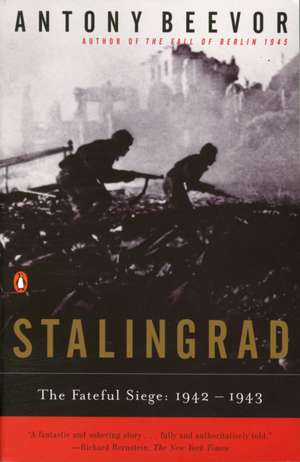
Stalingrad: Penguin Publishing Group
Autor Antony Beevoren Limba Engleză Paperback – mai 1999
Analiza noastră asupra acestui volum pornește de la secțiunile dedicate conceptului de „Rattenkrieg” și „Fortresses of Rubble and Iron”, unde Antony Beevor reconstruiește tactica brutală a luptelor de gherilă urbană. Considerăm că forța acestui text rezidă în capacitatea autorului de a alterna între deciziile strategice de la nivelul înaltului comandament și realitatea viscerală a soldatului din prima linie, folosind mărturii care atestă limitele rezistenței umane în condiții extreme.
Subliniem rigoarea documentară a celor cinci părți ale cărții, care ghidează cititorul de la hubrisul inițial al lui Hitler din 1941 până la „Capcana lui Jukov” și capitularea finală din 1943. Reținem modul în care Beevor integrează efortul de război sovietic nu doar ca o reacție defensivă, ci ca o transformare radicală a artei militare sub presiunea supraviețuirii. Această ediție publicată de Penguin Books în colecția Penguin Classics reprezintă un standard pentru istoria narativă, reușind să explice eșecul Operațiunii Barbarossa prin prisma detaliului uman și logistic.
Lucrarea completează perspectiva strategică oferită de Victory at Stalingrad de Geoffrey Roberts, adăugând o dimensiune socială și psihologică pe care analizele pur militare tind să o omită. În contextul operei sale, Stalingrad se situează între cercetările despre războiul civil din The Battle for Spain și prăbușirea celui de-al Treilea Reich descrisă în Berlin. Dacă alte titluri similare, precum Stalingrad Battle Atlas, se concentrează pe cartografie și mișcări de trupe, Beevor reușește să ofere o viziune de ansamblu asupra colapsului ambițiilor teritoriale germane în Europa.
Din seria Penguin Publishing Group
-
 Preț: 108.48 lei
 - 32%
 Preț: 49.22 lei
 -
 Preț: 107.38 lei
 -
 Preț: 88.72 lei
 -
 Preț: 109.51 lei
 -
 Preț: 57.49 lei
 -
 Preț: 90.76 lei
 -
 Preț: 117.16 lei
 -
 Preț: 103.42 lei
 -
 Preț: 57.31 lei
 -
 Preț: 105.01 lei
 -
 Preț: 104.88 lei
 -
 Preț: 98.37 lei
 -
 Preț: 113.52 lei
 -
 Preț: 243.61 lei
 -
 Preț: 109.75 lei
 -
 Preț: 93.21 lei
 -
 Preț: 98.01 lei
 -
 Preț: 105.89 lei
 -
 Preț: 104.57 lei
 -
 Preț: 87.20 lei
 -
 Preț: 86.94 lei
 -
 Preț: 112.71 lei
 -
 Preț: 56.64 lei
 - 18%
 Preț: 76.96 lei
 -
 Preț: 90.45 lei
 -
 Preț: 98.83 lei
 -
 Preț: 73.17 lei
 -
 Preț: 104.42 lei
 -
 Preț: 106.53 lei
 -
 Preț: 103.10 lei
 -
 Preț: 100.09 lei
 -
 Preț: 55.56 lei
 -
 Preț: 62.67 lei
 -
 Preț: 101.83 lei
 -
 Preț: 98.83 lei
 -
 Preț: 105.46 lei
 -
 Preț: 110.61 lei
 -
 Preț: 98.24 lei
 -
 Preț: 42.74 lei
 -
 Preț: 160.43 lei
 -
 Preț: 98.98 lei
 -
 Preț: 105.28 lei
 -
 Preț: 113.65 lei
 - 18%
 Preț: 59.56 lei
 -
 Preț: 105.68 lei
 -
 Preț: 83.79 lei
 -
 Preț: 120.85 lei
 -
 Preț: 57.08 lei
Preț: 145.44 lei
Carte disponibilă
Livrare economică 03-17 noiembrie
Specificații
ISBN-10: 0140284583
Pagini: 530
Dimensiuni: 140 x 214 x 30 mm
Greutate: 0.48 kg
Editura: Random House
Colecția Penguin Publishing Group
Seria Penguin Publishing Group
V-ar putea interesa
-
 Thinking, Fast and SlowDaniel Kahneman-27%Preț: 90.73 lei123.57 leiRecomandat
 -
 Crete 1941Antony BeevorPreț: 124.43 lei
 -
 D-DayAntony Beevor-16%Preț: 81.51 lei96.97 lei
 -
 Ardennes 1944Antony Beevor-18%Preț: 77.83 lei94.78 lei
 -
 The Forgotten SoldierGuy Sajer-25%Preț: 81.53 lei109.04 lei
 -
 The Road To StalingradProf John Erickson-25%Preț: 91.24 lei122.24 lei
 -
 A World at ArmsGerhard L WeinbergPreț: 353.96 lei
 -
 ArnhemAntony Beevor-18%Preț: 76.82 lei93.76 lei
 -
 Armageddon in StalingradDavid M GlantzPreț: 591.71 lei
 -
 Preț: 434.23 lei
 -
 Preț: 575.87 lei
 -
 Endgame at Stalingrad: the Stalingrad Trilogy, Volume 3David M. Glantz-8%Preț: 453.02 lei492.42 lei
 -
 Crete: The Battle and the ResistanceAntony Beevor-26%Preț: 79.35 lei107.93 lei
 -
 Death on the DonJonathan Trigg-6%Preț: 132.78 lei142.01 lei
 -
 The Second World WarAntony Beevor-23%Preț: 110.02 lei142.12 lei
 -
 -26%Preț: 68.53 lei92.56 lei
 -
 Where the Iron Crosses Grow: The Crimea 1941–44Robert Forczyk-35%Preț: 61.80 lei95.04 lei
 -
 -22%Preț: 98.97 lei127.46 lei
 -
 The Lighthouse of StalingradIain MacgregorPreț: 110.46 lei
De ce să citești această carte
Recomandăm această carte oricărui pasionat de istorie care dorește să înțeleagă nu doar cifrele, ci și psihologia din spatele celui mai important punct de cotitură al celui de-al Doilea Război Mondial. Cititorul câștigă o perspectivă clară asupra modului în care logistica, eroarea umană și reziliența civilă au modelat soarta frontului de est. Este o lectură esențială pentru înțelegerea mecanismelor războiului total.
Despre autor
Sir Antony Beevor este un istoric militar britanic de renume, format la Sandhurst, a cărui carieră s-a concentrat pe marile conflicte ale secolului XX. Stilul său distinctiv combină rigoarea academică a cercetării de arhivă cu un talent narativ remarcabil, transformând documentele istorice în relatări vii. Pentru Stalingrad, a fost recompensat cu premii prestigioase precum Samuel Johnson și Wolfson Prize, consolidându-și statutul de cel mai important cronicar contemporan al celui de-al Doilea Război Mondial. Opera sa vastă include titluri fundamentale care analizează atât frontul de est, cât și campaniile din vest sau Războiul Civil Spaniol.
Descriere scurtă
Cuprins
Preface
Part One. 'The World Will Hold Its Breath'
1. The Double-Edged Sword of Barbarossa
2. 'Nothing is Impossible for the German Soldier!'
3. 'Smash in the Door and the Whole Rotten Structure Will Come Crashing Down!'
4. Hitler's Hubris: The Delayed Battle for Moscow
Part Two. Barbarossa Relaunched
5. General Paulus's First Battle
6. 'How Much Land Does a Man Need?'
7. 'Not One Step Backwards'
8. 'The Volga is Reached!'
Part Three. 'The Fateful City'
9. 'Time is Blood': The September Battles
10. Rattenkrieg
11. Traitors and Allies
12. Fortresses of Rubble and Iron
13. Paulus's Final Assault
14. 'All For the Front!'
Part Four. Zhukov's Trap
15. Operation Uranus
16. Hitler's Obsession
17. 'The Fortress Without a Roof'
18. 'Der Manstein Kommit!'
19. 'Christmas in the German Way'
Part Five. The Subjugation of the Sixth Army
20. The Air-Bridge
21. 'Surrender Out of the Question'
22. 'A German Field Marshall Does Not Commit Suicide with a Pair of Nail Scissors!'
23. 'Stop Dancing! Stalingrad Has Fallen'
24. The City of the Dead
25. The Sword of Stalingrad
Appendix A: German and Soviet Orders of Battle, 19 November 1942
Appendix B: The Statistical Debate: Sixth Army Strength in the Kessel
References
Source Notes
Select Bibliography
Index
Extras
The grisly evidence of the fighting did not disappear swiftly. After the Volga thawed in spring, lumps of coagulated blackened skin were found on the river bank. General de Gaulle, when he stopped in his Stalingrad on his way north to Moscow in December 1944, was struck to find that bodies were still being dug up, but this was to continue for several decades. Almost any building work in the city uncovered human remains from the battle.
More astonishing than the number of dead was the capacity for human survival. The Stalingrad Party Committee held meetings in all districts 'liberated from Fascist occupation', and rapidly organized a census. They found that at least 9,976 civilians had lived through the fighting, surviving in the battlefield ruins. They included 994 children, of whom only nine were reunited with their parents. The vast majority were sent off to state orphanages or given work clearing the city. The report says nothing of their physical or mental state, witnessed by an American aid worker, who arrived very soon after the fighting to distribute clothes. 'Most of the children', she wrote, 'had been living in the ground for four or five winter months. They were swollen with hunger. They cringed in corners, afraid to speak, to even look people in the face.'
The Stalingrad Party Committee had higher priorities. 'Soviet authorities were immediately reinstalled in all districts of the city', it reported to Moscow. On 4 February, Red Army Commissars held a political rally for 'the whole city', both civilian survivors and soldiers. This assembly, with its long speeches in praise of Comrade Stalin and his leadership of the Red Army, was the Party's version of a service of thanksgiving.
The authorities did not at first allow civilians who had escaped to the East Bank to return to their homes, because of the need to clear unexploded shells. Mine-clearance teams had to prepare a basic pattern of 'special safe paths'. But many soon managed to slip back over the frozen Volga without permission. Messages appeared chalked on the side of ruined buildings, testifying to the numbers of families broken up by the fighting: Mama, we are all right. Look for us in Beketovka. Klava.' Many people never discovered which of their relatives were alive or dead until after the war was over.
Descriere
Recenzii
Antony Beevor gained access to the unplumbed records, and he reveals the full awfulness and human cost of the conflict with scholarly verve and deep sympathy. The pity of war has seldom been rendered so well
A brilliantly researched tour de force of military history
Antony Beevor's account of this historic turning-point is truly powerful, written with a compelling narrative drive . . . This is a fine achievement
A superb re-telling. Beevor combines a soldier's understanding of war's realities with the narrative techniques of a novelist . . . This is a book that lets the reader look into the face of battle