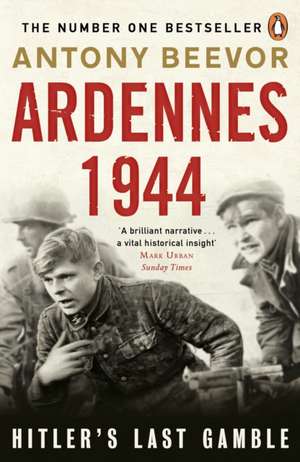
Ardennes 1944
Autor Antony Beevoren Limba Engleză Paperback – 6 oct 2016
În cadrul programelor de studiu dedicate istoriei secolului XX, bătălia cunoscută sub numele de „The Battle of the Bulge” reprezintă un punct de cotitură esențial pentru înțelegerea prăbușirii celui de-al Treilea Reich. Descoperim aici, în Ardennes 1944, o reconstrucție metodică a ultimei mize a lui Hitler, lansată în pădurile înghețate ale Belgiei. Notăm cu interes modul în care Antony Beevor reușește să echilibreze analiza strategică la nivel de comandament cu detaliul uman, surprinzând panică ce a ajuns până la Paris și eroismul unităților americane care au încetinit înaintarea panzerelor germane. Comparabil cu Hitler's Winter de Anthony Tucker-Jones în rigurozitate, volumul lui Beevor se distinge prin capacitatea de a integra perspective multiple — de la ofițerii germani disperați să creadă într-o victorie salvatoare, până la civilii belgieni prinși în focul încrucișat. Dacă lucrările anterioare ale autorului, precum Stalingrad sau Berlin. 75th Anniversary Edition, explorau brutalitatea Frontului de Est, Ardennes 1944 demonstrează că intensitatea luptelor din Vest, în acea iarnă a anului 1944, a atins niveluri de ferocitate similare, încălcând adesea regulile convenționale ale conflictului militar. Stilul este cel consacrat al lui Beevor: o narațiune fluidă, dar ancorată în date de arhivă, care transformă istoria militară într-o experiență captivantă pentru cititorul modern. Această ediție de la Penguin Books oferă o perspectivă definitivă asupra momentului care a frânt definitiv coloana vertebrală a Wehrmacht-ului.
Preț: 78.41 lei
Preț vechi: 94.93 lei
-17%
Carte disponibilă
Livrare economică 06-18 noiembrie
Livrare express 22-28 octombrie pentru 43.73 lei
Specificații
ISBN-10: 0241975158
Pagini: 472
Dimensiuni: 126 x 195 x 38 mm
Greutate: 0.37 kg
Editura: Penguin Books
Colecția Penguin Classics
Locul publicării:London, United Kingdom
V-ar putea interesa
-
 Mrs McGinty's DeadAgatha ChristiePreț: 72.05 lei
 -
 They Do It With MirrorsAgatha ChristiePreț: 71.48 lei
 -
 The Mystery of Olga ChekhovaAntony Beevor-38%Preț: 74.01 lei119.01 lei
 -
 Masters and CommandersAndrew Roberts-18%Preț: 135.89 lei166.30 lei
 -
 Berlin. 75th Anniversary EditionAntony Beevor-17%Preț: 79.09 lei95.52 lei
 -
 StalingradAntony BeevorPreț: 79.25 lei
 -
 1939Richard Overy-31%Preț: 63.37 lei92.43 lei
 -
 YaltaS. M. PlokhyPreț: 80.77 lei
 -
 Rendezvous with DestinyMichael FullilovePreț: 146.41 lei
 -
 Crete 1941Antony BeevorPreț: 125.07 lei
 -
 Indias WarSrinath RaghavanPreț: 133.64 lei
 -
 Survivor on the River KwaiReg TwiggPreț: 79.82 lei
 -
 D-DayAntony Beevor-15%Preț: 82.11 lei97.10 lei
 -
 Patton, Montgomery, RommelTerry BrightonPreț: 109.41 lei
 -
 A Higher CallAdam MakosPreț: 146.52 lei
 -
 ArnhemAntony Beevor-18%Preț: 76.82 lei93.76 lei
 -
 Crete: The Battle and the ResistanceAntony Beevor-26%Preț: 79.35 lei107.93 lei
 -
 The Battle for Spain: The Spanish Civil War 1936-1939Antony Beevor-24%Preț: 94.74 lei124.11 lei
 -
 Where the Iron Crosses Grow: The Crimea 1941–44Robert Forczyk-35%Preț: 61.80 lei95.04 lei
 -
 B-24 Bridge BustersColin Pateman-12%Preț: 125.31 lei142.91 lei
 -
 The History of the Galician Division of the Waffen SSMichael Melnyk-10%Preț: 287.42 lei317.97 lei
De ce să citești această carte
Recomandăm această carte pasionaților de istorie militară care doresc să înțeleagă complexitatea ultimei mari ofensive germane din Al Doilea Război Mondial. Cititorul câștigă o perspectivă clară asupra modului în care logistica, vremea extremă și moralul trupelor au influențat rezultatul final al războiului. Este o lucrare esențială pentru cei care apreciază stilul narativ riguros al lui Antony Beevor, oferind o documentare mult mai amplă decât manualele clasice de istorie.
Despre autor
Sir Antony James Beevor este un istoric militar britanic de renume mondial, născut în 1946. Fost ofițer în armata britanică, Beevor s-a impus ca unul dintre cei mai citiți autori de istorie narativă, fiind premiat pentru capacitatea sa de a aduce la viață evenimente complexe. Opera sa vastă include titluri fundamentale despre conflictele secolului XX, precum The Battle for Spain, unde analizează Războiul Civil Spaniol, și Russia, o cronică a perioadei revoluționare dintre 1917 și 1921. Stilul său este recunoscut pentru echilibrul dintre rigoarea academică și accesibilitatea pentru publicul larg.
Notă biografică
Recenzii
Rightly deserves its place on the shelves of any serious historian of the Second World War. Powerful and authoritative . . . Beevor weaves a masterful narrative based on the viewpoints of a vast range of people. Marshalling a coherent narrative out of an unwieldy sequence of localised attacks, counterattacks, deceptions, and feints demands the attention of a master military historian. In Antony Beevor, the Ardennes offensive has found one
What leaves a lasting impression is the huge power the American army as a whole mustered to smash back the Germans. A superpower was being born
If you're a fan of Beevor's work, find some space on your bookshelf for this one. If you've never read him before, start here and work your way back - it's history nerd heaven!
Unflinching. As Ardennes 1944 makes clear, Hitler misjudged the strength and resilience of the US army. It was his last gamble and it failed
What stands out most . . . is the effects of violent warfare. By the end of the counteroffensive the snowfields were littered with frozen corpses and the wreckage of hundreds of tanks and armoured vehicles
A superb addition to the canon which has taken us from Stalingrad to Normandy in 1944 and the final gruesome battle for Berlin, not forgetting the masterly single-volume history of the entire war. It is written with all of Beevor's customary verve and elegance. His remarkable and trademark ability is to encompass the wide sweep of campaigns yet never forget the piquant details of what happened to the individual . . . He focuses brilliantly on the key moments that turned the battle
As impeccably researched, insightfully observed and superbly written as its bestselling predecessors
Rich in detail and drama. Enthralling
If there's one thing that sets Beevor apart from other historians - beyond his gifts as a storyteller - it's that he is not afraid to look at the most uncomfortable, even frightening subjects, but does so in a way that doesn't threaten the reader. It's like having Virgil there to lead you through the underworld: he doesn't leave you stranded amid the horror but leads you back again, a wiser person for having undergone the journey
An indispensable book. It is a great strength of Beevor's writing that he takes time to explain how small pieces of knowledge - the kind of thing passed on by battle-hardened soldiers themselves - could make the difference between survival and a futile death
Beevor weaves a brilliant narrative out of all this drama. As in his previous books, his gifts are strongest in focusing on telling details from different perspectives . . . A vital historical insight
A portrait of war . . . startling in its detail. Beevor has the art of preserving the individual perspective on the battlefield while placing it among the perspectives of platoon, regiment, division, commanders, politicians and civilians. This book clarifies, without simplifying, the human experiences and political stakes of the battle for the Ardennes Forest, bringing realism to the battlefield and coherence to the larger history of the war
A sweeping, sobering read, written with all the confidence and aplomb that Beevor fans would expect. Beevor is as good on the rows behind the front lines as he is on the battles themselves
Formidable . . . Beevor is a field marshal of facts. Under his brisk control the story of Hitler's final gamble is another example of the kind of action-packed, densely informed narrative that has proved such a formidable model
Like Beevor's magisterial account of the Second World War, Ardennes 1944 benefits from the same depth of field, seamlessly shifting its point to focus from the macro level to the micro and back again
Wonderfully compelling. The Ardennes was a short, brutal and ultimately futile battle - the last spasm of a dying regime - and no one has recounted it better than Beevor. His gripping, beautifully written narrative moves seamlessly from the generals' command posts to the privates in their snow-covered foxholes, and confirms him as the finest chronicler of war in the business. His particular genius is for ferreting out those telling details that paint a picture
First-rank history. Beevor's triumph is to add layers to a book that is gently but precisely judgmental, acute on character and gaudy and grisly in detail. With his sure hand on detail and his strong opinion on how and why the German offensive was prosecuted and why it failed . . . Beevor shows how plans freeze on icy roads, how individual acts of bravery have significant effects, how generals can be wrong but proved right by the vagaries of weather, fortune or a providence that is unfathomable
Descriere scurtă
On 16 December, 1944, Hitler launched his 'last gamble' in the snow-covered forests and gorges of the Ardennes. He believed he could split the Allies by driving all the way to Antwerp, then force the Canadians and the British out of the war. Although his generals were doubtful of success, younger officers and NCOs were desperate to believe that their homes and families could be saved from the vengeful Red Army approaching from the east. Many were exultant at the prospect of striking back.
The Ardennes offensive, with more than a million men involved, became the greatest battle of the war in western Europe. American troops, taken by surprise, found themselves fighting two panzer armies. Belgian civilians fled, justifiably afraid of German revenge. Panic spread even to Paris. While many American soldiers fled or surrendered, others held on heroically, creating breakwaters which slowed the German advance.
The harsh winter conditions and the savagery of the battle became comparable to the eastern front. And after massacres by the Waffen-SS, even American generals approved when their men shot down surrendering Germans. The Ardennes was the battle which finally broke the back of the Wehrmacht.