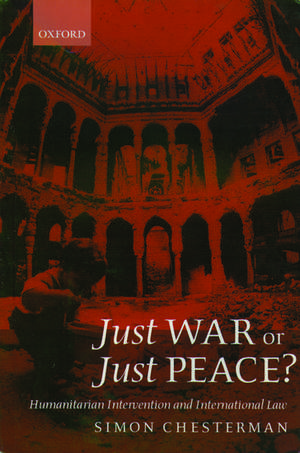
Just War or Just Peace?: Humanitarian Intervention and International Law
Autor Simon Chestermanen Limba Engleză Paperback – 7 noi 2002
Preț: 447.32 lei
Preț vechi: 576.63 lei
-22%
Carte tipărită la comandă
Livrare economică 10-16 decembrie
Specificații
ISBN-10: 019925799X
Pagini: 326
Ilustrații: bibliography
Dimensiuni: 155 x 235 x 18 mm
Greutate: 0.51 kg
Ediția:Revised
Editura: Oxford University Press
Colecția OUP Oxford
Locul publicării:Oxford, United Kingdom
V-ar putea interesa
-
 Preț: 151.42 lei
 -
 -19%Preț: 358.11 lei439.66 lei
 -
 Intercultural PragmaticsIstvan Kecskes-31%Preț: 741.55 lei1080.82 lei
 -
 Humanity's LawRuti Teitel-19%Preț: 314.73 lei388.16 lei
 -
 The Practice of Public DiplomacyW. RughPreț: 404.47 lei
 -
 Freedom's BattleGary J. BassPreț: 153.36 lei
 -
 Advocacy and Social Work PracticeTom Wilks-21%Preț: 200.22 lei252.11 lei
 -
 Branding Cities: Cosmopolitanism, Parochialism, and Social ChangeStephanie Hemelryk DonaldPreț: 477.89 lei
 -
 Citizens, Politics and Social CommunicationR. Robert HuckfeldtPreț: 304.24 lei
 -
 The Nature and Origins of Mass OpinionJohn R. ZallerPreț: 267.49 lei
 -
 -37%Preț: 250.76 lei398.75 lei
 -
 The Ethics of Armed Humanitarian InterventionDon E. ScheidPreț: 221.43 lei
 -
 International Law and International RelationsDavid ArmstrongPreț: 380.80 lei
 -
 International Public Relations and Public DiplomacyGuy J. GolanPreț: 415.54 lei
 -
 Managing the Public's Trust in Non-profit OrganizationsChristopher D.B. BurtPreț: 361.78 lei
Descriere
The question of the legality of humanitarian intervention is, at first blush, a simple one. The Charter of the United Nations clearly prohibits the use of force, with the only exceptions being self-defence and enforcement actions authorized by the Security Council. There are, however, long-standing arguments that a right of unilateral intervention pre-existed the Charter.This book, which won the ASIL Certificate of Merit in 2002, begins with an examination of the genealogy of that right, and arguments that it might have survived the passage of the Charter, either through a loophole in Article 2(4) or as part of customary international law. It has also been argued that certain `illegitimate' regimes lose the attributes of sovereignty and thereby the protection given by the prohibition of the use of force. None of these arguments is found to have merit, either inprinciple or in the practice of states.A common justification for a right of unilateral humanitarian intervention concerns the failure of the collective security mechanism created after the Second World War. Chapters 4 and 5, therefore, examine Security Council activism in the 1990s, notable for the plasticity of the circumstances in which the Council was prepared to assert its primary responsibility for international peace and security, and the contingency of its actions on the willingness of states to carry them out. Thisreduction of the Council's role from substantive to formal partly explains the recourse to unilateralism in that decade, most spectacularly in relation to the situation in Kosovo.Crucially, the book argues that such unilateral enforcement is not a substitute for but the opposite of collective action. Though often presented as the only alternative to inaction, incorporating a `right' of intervention would lead to more such interventions being undertaken in bad faith, it would be incoherent as a principle, and it would be inimical to the emergence of an international rule of law.
Recenzii
Dr Chesterman's new work is a useful corrective to those who would cheerily dissolve the distinction between legality and power, or between legal analysis and agitprop. ... [The] book provides legal and analytical tools that, hopefully, will help us differentiate between an excusable illegality, and yet another cynical usurpation of international law in the service of raison d'état.
Review from previous edition In this lucid and insightful volume, Chesterman provides a sophisticated but accessible account of the historical and contemporary relationship between humanitarian intervention and international law. Just War or Just Peace? provides both an excellent teaching resource for advanced undergraduates and beyond, and a wealth of information for researchers and professionals working in this area.
a tightly argued and complex presentation, with numbered, easily referenced topics in the style of a doctoral thesis (which it is). A more textured work [than Christine Gray's International Law and the Use of Force], it is arguably a more interesting read for an audience that does not already have at ready access the historical background or international law perspective to this difficult subject. It is also a more accessible work for students, and decidedly less dry and fragmented than many standard international law texts ... Dr Chesterman gives us a fairly riveting review of the history behind the modern rise of humanitarian intervention.
Notă biografică
Simon Chesterman is a Senior Associate at the International Peace Academy in New York