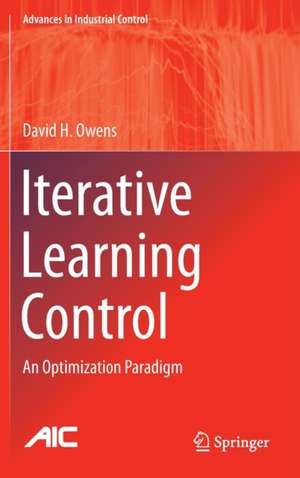
Iterative Learning Control: Advances in Industrial Control
Autor David H. Owensen Limba Engleză Hardback – 10 noi 2015
Using detailed examples taken from linear, discrete and continuous-time systems, the author gives the reader access to theories based on either signal or parameter optimization. Although the two approaches are shown to be related in a formal mathematical sense, the text presents them separately as their relevant algorithm design issues are distinct and give rise to different performance capabilities.
Together with algorithm design, the text demonstrates the underlying robustness of the paradigm and also includes new control laws that are capable of incorporating input and output constraints, enable the algorithm to reconfigure systematically in order to meet the requirements of different reference and auxiliary signals and also to support new properties such as spectral annihilation.
Iterative Learning Control will interest academics and graduate students working in control who will find it a useful reference to the current status of a powerful and increasingly popular method of control. The depth of background theory and links to practical systems will be of use to engineers responsible for precision repetitive processes.
Din seria Advances in Industrial Control
- 15%
 Preț: 664.95 lei
- 18%
 Preț: 812.62 lei
- 18%
 Preț: 932.22 lei
- 18%
 Preț: 758.73 lei
- 18%
 Preț: 996.30 lei
- 18%
 Preț: 951.24 lei
- 15%
 Preț: 663.48 lei
- 18%
 Preț: 755.41 lei
- 18%
 Preț: 1458.15 lei
- 18%
 Preț: 1155.07 lei
- 15%
 Preț: 663.00 lei
- 18%
 Preț: 925.33 lei
- 18%
 Preț: 931.50 lei
- 15%
 Preț: 670.62 lei
- 18%
 Preț: 812.11 lei
- 18%
 Preț: 986.31 lei
- 18%
 Preț: 987.51 lei
- 15%
 Preț: 666.44 lei
- 15%
 Preț: 664.72 lei
- 18%
 Preț: 983.57 lei
- 15%
 Preț: 663.58 lei
- 18%
 Preț: 1436.95 lei
- 18%
 Preț: 980.03 lei
- 18%
 Preț: 984.66 lei
- 18%
 Preț: 982.24 lei
- 18%
 Preț: 985.21 lei
- 18%
 Preț: 1148.21 lei
- 15%
 Preț: 669.91 lei
- 15%
 Preț: 663.58 lei
- 18%
 Preț: 979.63 lei
- 18%
 Preț: 982.74 lei
- 18%
 Preț: 1153.23 lei
- 15%
 Preț: 664.01 lei
- 18%
 Preț: 982.58 lei
- 18%
 Preț: 980.78 lei
- 15%
 Preț: 660.75 lei
- 15%
 Preț: 663.58 lei
- 20%
 Preț: 669.73 lei
- 18%
 Preț: 1148.59 lei
- 20%
 Preț: 1029.39 lei
- 15%
 Preț: 667.27 lei
- 24%
 Preț: 1082.44 lei
- 18%
 Preț: 978.15 lei
- 18%
 Preț: 1342.56 lei
- 15%
 Preț: 676.08 lei
- 15%
 Preț: 666.52 lei
- 20%
 Preț: 620.99 lei
- 18%
 Preț: 1080.75 lei
- 18%
 Preț: 1269.37 lei
Preț: 938.33 lei
Preț vechi: 1144.30 lei
-18%
Puncte Express: 1407
Carte tipărită la comandă
Livrare economică 07-21 decembrie
Livrare prin curier în România Termenul estimat este afișat lângă disponibilitate.
Transport gratuit pentru acest produs Plată online sau ramburs, în funcție de opțiunile comenzii.
Retur gratuit în 14 zile Comandă securizată și suport în română.
Specificații
ISBN-13: 9781447167709
ISBN-10: 1447167708
Pagini: 484
Ilustrații: XXVIII, 456 p.
Dimensiuni: 160 x 241 x 32 mm
Greutate: 0.84 kg
Ediția:1st edition 2016
Editura: Springer
Colecția Advances in Industrial Control
Seria Advances in Industrial Control
Locul publicării:London, United Kingdom
ISBN-10: 1447167708
Pagini: 484
Ilustrații: XXVIII, 456 p.
Dimensiuni: 160 x 241 x 32 mm
Greutate: 0.84 kg
Ediția:1st edition 2016
Editura: Springer
Colecția Advances in Industrial Control
Seria Advances in Industrial Control
Locul publicării:London, United Kingdom
V-ar putea interesa
-
 -39%Preț: 359.16 lei590.66 lei
-
 -38%Preț: 160.69 lei260.20 lei
-
 Handbook of Hybrid Systems ControlJan Lunze-14%Preț: 961.04 lei1117.48 lei
-
 Fundamentals of Object TrackingSubhash Challa-11%Preț: 730.64 lei820.93 lei
-
 Nonlinear Dynamical Systems and ControlWassim M. Haddad-23%Preț: 1071.77 lei1391.91 lei
-
 Beginning Arduino ProgrammingBrian EvansPreț: 367.84 lei
-
 Engineering Systems Integration: Theory, Metrics, and MethodsGary O. Langford-20%Preț: 1359.34 lei1699.18 lei
-
 Make: Arduino Bots and GadgetsTero KarvinenPreț: 210.49 lei
-
 Geometric Methods and ApplicationsJean Gallier-15%Preț: 552.23 lei649.67 lei
-
 Model Predictive ControlEduardo F. Camacho-15%Preț: 521.46 lei613.47 lei
-
 Mechatronic SystemsRolf Isermann-15%Preț: 605.64 lei712.51 lei
-
 Logistik-Wörterbuch. Dictionary of LogisticsVanessa Scott-Sabic-18%Preț: 838.28 lei1022.30 lei
-
 Automotive Mechatronics: Operational and Practical IssuesB. T. Fijalkowski-18%Preț: 1194.66 lei1456.91 lei
Public țintă
ResearchCuprins
Iterative Learning Control: Background and Review. Mathematical and Linear Modelling Methodologies.- Norm Optimal Iterative Learning Control: An Optimal Control Perspective.- Predicting the Effects of Non-minimum-phase Zeros.- Predictive Norm Optimal Iterative Learning Control.- Other Applications of Norm Optimal Iterative Learning Control.- Successive Projection Algorithms.- Parameter Optimal Iterative Learning Control.- Robustness of Parameter Optimal Iterative Learning Control.- Multi-parameter Optimal Iterative Learning Control.- No Normal 0 false false false EN-GB X-NONE X-NONE/* Style Definitions */ table.MsoNormalTable {mso-style-name:"Table Normal"; mso-tstyle-rowband-size:0; mso-tstyle-colband-size:0; mso-style-noshow:yes; mso-style-priority:99; mso-style-parent:""; mso-padding-alt:0cm 5.4pt 0cm 5.4pt; mso-para-margin-top:0cm; mso-para-margin-right:0cm; mso-para-margin-bottom:10.0pt; mso-para-margin-left:0cm; line-height:115%; mso-pagination:widow-orphan; font-size:11.0pt; font-family:"Calibri","sans-serif"; mso-ascii-font-family:Calibri; mso-ascii-theme-font:minor-latin; mso-hansi-font-family:Calibri; mso-hansi-theme-font:minor-latin; mso-fareast-language:EN-US;} nlinear Iterative Learning Control and Optimization.
Recenzii
“This book presents a comprehensive study of ILC from the optimization paradigm, more specifically, the NOILC optimization paradigm. The organization is clear, and the necessary fundamentals are self-contained. The mathematical analysis is rigorous, and the algorithms are detail complete. This book is suitable for academic researchers … . It can be used a textbook for graduate students who are interested in ILC. It also gives rich motivations for researchers to study ILC from the optimization perspective.” (Li Xia, IEEE Control Systems Magazine, Vol. 37 (2), April, 2017)
“This is a seminal text since it is very likely to generate interest and enthusiasm in the whole topic, and it provided a comprehensive overview of the mathematical methods that can be applied. It is very suitable for researchers in advanced control but it will also be useful to engineers involved with multi pass or repetitive processes where learning can provide a substantial improvement.” (ACTC applied control technology consortium, actc-control.com, March, 2016)
Notă biografică
Dr Bing Chu is an associate professor in Electronics and Computer Science at University of Southampton. Before joining University of Southampton in 2012, he was a postdoctoral researcher at University of Oxford (2010-2012). He teaches modules in the general physics, signals, systems and control area at undergraduate/postgraduate level. He has authored or co-authored 70 peer-reviewed scientific publications. He has been the recipient of many awards including the prestigious UKACC best paper prize and Certificate of Merit for IET Control and Automation Doctoral Dissertation Prize. He is a regular referee for a number of international journals and conferences. His current research interests include analysis and control of large scale networked systems, iterative and repetitive control, learning control, applied optimisation theory and their applications.
David H. Owens is a professor at University of Sheffield, UK and Zhengzhou University, China. He has 50 years of experience of Control Engineering theory and applications in areas including nuclear power, robotics and mechanical test. His research has included multivariable frequency domain theory and design, the theory of multivariable root loci, contributions to robust control theory, theoretical methods for controller design based on plant step data and involvement in aspects of adaptive control, model reduction and optimization-based design. His early experience of modelling and analysis of systems with repetitive dynamics originally arising in control of underground coal cutters led to substantial contributions (with collaborator E. Rogers and others) in the area of repetitive control systems (as part of 2D systems theory) but more specifically, since 1996, in the area of iterative learning control when he introduced the use of optimization to the ILC community in the form of "norm optimal iterative learning control". Since that time he has added considerable detail and depth to the approach and introducing the ideas of parameter optimal iterative learning to simplify the implementations. Applications have included industrial projects in automotive/mechanical tests and the development of data analysis tools for control of gantry robots and stroke rehabilitation equipment with collaborators at Southampton University. Professor Owens was elected a Fellow of the UK Royal Academy of Engineering for his contributions to knowledge in these and other areas.
Textul de pe ultima copertă
This book develops a coherent theoretical approach to algorithm design for iterative learning control based on the use of optimization concepts. Concentrating initially on linear, discrete-time systems, the author gives the reader access to theories based on either signal or parameter optimization. Although the two approaches are shown to be related in a formal mathematical sense, the text presents them separately because their relevant algorithm design issues are distinct and give rise to different performance capabilities.
Together with algorithm design, the text demonstrates that there are new algorithms that are capable of incorporating input and output constraints, enable the algorithm to reconfigure systematically in order to meet the requirements of different reference signals and also to support new algorithms for local convergence of nonlinear iterative control. Simulation and application studies are used to illustrate algorithm properties and performance in systems like gantry robots and other electromechanical and/or mechanical systems.
Iterative Learning Control will interest academics and graduate students working in control who will find it a useful reference to the current status of a powerful and increasingly popular method of control. The depth of background theory and links to practical systems will be of use to engineers responsible for precision repetitive processes.
Advances in Industrial Control aims to report and encourage the transfer of technology in control engineering. The rapid development of control technology has an impact on all areas of the control discipline. The series offers an opportunity for researchers to present an extended exposition of new work in all aspects of industrial control.
Caracteristici
Low-order worked examples aid in the understanding of the basic principles and computational processes of algorithm design Computational and application studies illustrate performance and help to identify the source of performance limitations Provides researchers with a convenient source of open problems and suggested research directions for their solution Includes supplementary material: sn.pub/extras