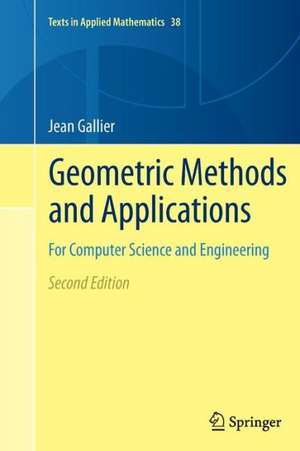
Geometric Methods and Applications: Texts in Applied Mathematics, cartea 38
Autor Jean Gallieren Limba Engleză Paperback – 19 apr 2013
Evoluția recentă a informaticii aplicate a demonstrat că algoritmii performanți în robotică sau viziune artificială nu pot fi decuplați de o înțelegere profundă a fundamentelor geometrice. Notăm cu interes modul în care lucrarea Geometric Methods and Applications de Jean Gallier reușește să umple golul dintre textele pur teoretice și manualele tehnice orientate strict pe implementare. Această a doua ediție, publicată de Springer, reflectă maturizarea domeniului prin integrarea unor instrumente matematice care au devenit esențiale în ultimul deceniu, precum optimizarea quadratică și analiza SVD. Descoperim aici o structură riguroasă ce ghidează cititorul de la elementele de bază ale geometriei afine și proiective către subiecte avansate de geometrie diferențială a curbelor și suprafețelor. Un element distinctiv al acestei ediții este extinderea masivă a secțiunilor dedicate mulțimilor convexe și complementului Schur, oferind suportul teoretic necesar pentru gruparea contururilor și cinematica roboților. Găsim în cele peste 600 de pagini o progresie logică: după stabilirea fundamentelor euclidiene, autorul introduce descompunerea valorilor singulare (SVD) și PCA, instrumente vitale pentru procesarea datelor multidimensionale. În contextul operei sale, această carte reprezintă pilonul aplicat, făcând legătura între rigoarea logică din Discrete Mathematics și conceptele de nișă explorate în Differential Geometry and Lie Groups. Ca alternativă la A Sampler of Useful Computational Tools for Applied Geometry, Computer Graphics, and Image Processing pentru cursurile de geometrie computațională, lucrarea lui Gallier aduce avantajul unei tratări mai sistematice și al unei profunzimi teoretice care lipsește adesea din compendiile de tip „sampler”, fiind ideală pentru cei care doresc să înțeleagă mecanismele din spatele formulelor.
Din seria Texts in Applied Mathematics
- 15%
 Preț: 553.34 lei
 -
 Preț: 479.91 lei
 -
 Preț: 474.24 lei
 - 13%
 Preț: 403.77 lei
 - 17%
 Preț: 412.34 lei
 - 15%
 Preț: 612.95 lei
 -
 Preț: 495.58 lei
 - 17%
 Preț: 433.33 lei
 - 15%
 Preț: 611.78 lei
 - 15%
 Preț: 421.07 lei
 -
 Preț: 420.89 lei
 - 19%
 Preț: 654.90 lei
 -
 Preț: 498.57 lei
 - 15%
 Preț: 552.77 lei
 -
 Preț: 376.75 lei
 - 15%
 Preț: 603.31 lei
 - 18%
 Preț: 1272.29 lei
 - 17%
 Preț: 595.96 lei
 -
 Preț: 449.88 lei
 - 15%
 Preț: 683.78 lei
 -
 Preț: 414.77 lei
 -
 Preț: 389.50 lei
 -
 Preț: 410.22 lei
 - 15%
 Preț: 518.51 lei
 - 15%
 Preț: 705.96 lei
 -
 Preț: 409.11 lei
 -
 Preț: 398.21 lei
 - 15%
 Preț: 680.25 lei
 -
 Preț: 474.96 lei
 - 15%
 Preț: 599.52 lei
 - 15%
 Preț: 616.43 lei
 - 15%
 Preț: 598.72 lei
Preț: 552.23 lei
Preț vechi: 649.67 lei
-15%
Carte tipărită la comandă
Livrare economică 07-21 decembrie
Specificații
ISBN-10: 1461428246
Pagini: 708
Ilustrații: XXVIII, 680 p.
Dimensiuni: 155 x 235 x 38 mm
Greutate: 1.05 kg
Ediția:Second Edition 2011
Editura: Springer
Colecția Texts in Applied Mathematics
Seria Texts in Applied Mathematics
Locul publicării:New York, NY, United States
V-ar putea interesa
-
 -39%Preț: 402.67 lei660.61 lei
 -
 Deep LearningIan Goodfellow-21%Preț: 684.46 lei865.01 lei
 -
 Probabilistic Machine LearningKevin P. Murphy-20%Preț: 862.85 lei1080.33 lei
 -
 Image Processing and Acquisition using PythonRavishankar Chityala-18%Preț: 1034.06 lei1261.06 lei
 -
 -20%Preț: 418.89 lei523.61 lei
 -
 Numerical Geometry of Non-Rigid ShapesAlexander M. Bronstein-20%Preț: 531.29 lei664.11 lei
 -
 Multiple View Geom Comp Vision 2edRichard Hartley-14%Preț: 766.84 lei891.67 lei
 -
 Data Structures and Algorithms in Python (WSE)Michael T. Goodrich-20%Preț: 1266.67 lei1583.33 lei
 -
 The Cyber Risk HandbookDomenic Antonucci-8%Preț: 516.27 lei561.16 lei
 -
 Database SystemsRamez Elmasri-20%Preț: 552.09 lei690.12 lei
 -
 Digital Image Processing, Global EditionRafael Gonzalez-11%Preț: 663.18 lei745.14 lei
 -
 Guide to Computational Geometry ProcessingJ. Andreas Bærentzen-15%Preț: 555.00 lei652.95 lei
 -
 Programming Robots with ROSMorgan Quigley-20%Preț: 265.08 lei331.35 lei
 -
 Bridging Relational and NoSQL DatabasesDrazena Gaspar-20%Preț: 1091.20 lei1364.00 lei
 -
 Docker in ActionBret Fisher-20%Preț: 302.80 lei378.50 lei
 -
 -20%Preț: 285.05 lei356.31 lei
 -
 Robot Operating System CookbookPackt Publishing-20%Preț: 274.91 lei343.64 lei
 -
 Mastering ROS for Robotics Programming - Second EditionLentin Joseph-19%Preț: 477.95 lei590.06 lei
 -
 Hands-On Computer Vision with TensorFlow 2Benjamin Planche-20%Preț: 214.62 lei268.28 lei
 -
 -20%Preț: 297.64 lei372.04 lei
 -
 Python Image Processing CookbookSandipan Dey-20%Preț: 300.32 lei375.40 lei
 -
 Computer Graphics and Geometric ModellingMax K. Agoston-20%Preț: 396.47 lei495.59 lei
 -
 Mathematical Image ProcessingKristian Bredies-15%Preț: 563.05 lei662.41 lei
 -
 Principles of Distributed Database SystemsM. Tamer Özsu-20%Preț: 637.99 lei797.49 lei
 -
 Robot Operating System (ROS)Anis Koubâa-18%Preț: 1160.23 lei1414.92 lei
 -
 Foundations of Computer VisionJames F. Peters-20%Preț: 687.07 lei858.83 lei
 -
 SQL & NoSQL DatabasesAndreas Meier-20%Preț: 336.75 lei420.93 lei
 -
 -20%Preț: 306.98 lei383.73 lei
 -
 Geometry of Deep LearningJong Chul Ye-15%Preț: 449.02 lei528.26 lei
Public țintă
GraduateDe ce să citești această carte
Această lucrare este esențială pentru studenții de la masterat și cercetătorii care doresc să stăpânească fundamentele matematice ale vederii artificiale și roboticii. Cititorul câștigă o bază solidă în metode geometrice, de la SVD la varietăți, beneficiind de numeroase exerciții și rezumate care facilitează asimilarea conceptelor complexe. Este resursa ideală pentru a trece de la simpla utilizare a bibliotecilor software la dezvoltarea de noi algoritmi geometrici.
Despre autor
Jean Gallier este un distins profesor și cercetător, cunoscut pentru capacitatea sa de a prezenta subiecte matematice abstracte într-o manieră accesibilă, dar riguroasă. Opera sa acoperă un spectru larg, de la logică matematică și matematici discrete până la geometrie diferențială și topologie algebrică. Prin lucrările sale, Gallier a influențat generații de informaticieni, oferindu-le instrumentele necesare pentru a naviga între teoria formală și aplicațiile practice în grafica pe calculator și viziunea artificială. Expertiza sa este recunoscută la nivel internațional, fiind un punct de referință în literatura academică de specialitate.
Cuprins
Recenzii
"This is a worthwhile book to have in the library of any univeristy which is involved with these areas of computer science." (The Mathematical Gazette, 2002)
"The treatment of each topic is in depth and to the point. It is a rigorous theorem-proof approach on the one hand, but there are plenty of comments and remarks that make for easier reading." (SIAM Review, 2002)
From the reviews of the second edition:
“The book contains a valuable collection of modern geometric methods and algorithms readily prepared for solving problems occurring in computer science and engineering. … The second edition is even more comprehensive and puts more emphasis on the links between different fields. It can be recommended to anybody who is interested in modern geometry and its applications.” (Anton Gfrerrer, Zentralblatt MATH, Vol. 1247, 2012)
“Anyone who likes to read about geometry, differential geometry, linear algebra, or Lie theory should find something of interest in this book. … this is, of course, a text in geometry, and many aspects of it are covered. … this book is filled with interesting mathematics, superbly presented. Aside from its potential use as a text, the book should be looked at by anyone who uses or is interested in the topics covered. It is highly recommended.” (Mark Hunacek, The Mathematical Association of America, September, 2011)
Notă biografică
Caracteristici
Descriere
This book is an introduction to the fundamental concepts and tools needed for solving problems of a geometric nature using a computer. It attempts to fill the gap between standard geometry books, which are primarily theoretical, and applied books on computer graphics, computer vision, robotics, or machine learning.
This book covers the following topics: affine geometry, projective geometry, Euclidean geometry, convex sets, SVD and principal component analysis, manifolds and Lie groups, quadratic optimization, basics of differential geometry, and a glimpse of computational geometry (Voronoi diagrams and Delaunay triangulations). Some practical applications of the concepts presented in this book include computer vision, more specifically contour grouping, motion interpolation, and robot kinematics.
In this extensively updated second edition, more material on convex sets, Farkas’s lemma, quadratic optimization and the Schur complement have been added. The chapter on SVD has been greatly expanded and now includes a presentation of PCA.
The book is well illustrated and has chapter summaries and a large number of exercises throughout. It will be of interest to a wide audience including computer scientists, mathematicians, and engineers.
Reviews of first edition:
"Gallier's book will be a useful source for anyone interested in applications of geometrical methods to solve problems that arise in various branches of engineering. It may help to develop the sophisticated concepts from the more advanced parts of geometry into useful tools for applications." (Mathematical Reviews, 2001)
"...it will be useful as a reference book for postgraduates wishing to find the connection between their current problem and the underlying geometry." (The Australian Mathematical Society, 2001)