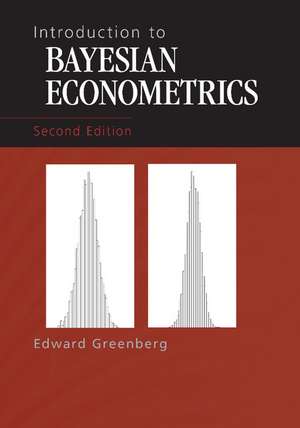
Introduction to Bayesian Econometrics
Autor Edward Greenbergen Limba Engleză Paperback – 16 apr 2014
Găsim în Introduction to Bayesian Econometrics un model riguros de analiză care pleacă de la premisa probabilității subiective, obligând cititorul să reevalueze modul în care datele empirice interacționează cu ipotezele prealabile. În viziunea lui Edward Greenberg, coerența inferenței depinde de respectarea strictă a regulilor de probabilitate în definirea funcțiilor de verosimilitate și a distribuțiilor posterioare. Suntem de părere că forța acestui volum rezidă în capacitatea de a explica de ce metodele analitice clasice pot eșua în derivarea distribuțiilor marginale, oferind în schimb soluții robuste prin simulare. Notăm cu interes structura progresivă a lucrării, organizată în trei piloni esențiali. Prima parte stabilește fundamentele teoretice, de la conceptele de bază la distribuțiile prior. A doua parte se concentrează pe mecanica simulării, explorând lanțurile Markov și metodele MCMC, în timp ce partea finală aplică aceste teorii în contexte complexe precum regresia liniară, seriile de timp și selecția eșantioanelor. Complementar volumului Bayesian Econometric Methods de Joshua Chan, care este axat pe exerciții și soluții aplicate, lucrarea lui Greenberg acoperă fundamentul teoretic și conceptual necesar pentru a înțelege „de ce-ul” din spatele algoritmilor, oferind o perspectivă pedagogică mai profundă asupra subiectivității în econometrie. Această a doua ediție marchează o evoluție semnificativă în opera autorului, integrând modele moderne precum ARCH-GARCH și volatilitatea stochastică. Față de lucrările sale anterioare, precum Cycles, Growth and the Great Recession, unde analiza se concentra pe fenomene macroeconomice specifice, acest manual reprezintă instrumentul tehnic universal care fundamentează cercetarea cantitativă în diverse domenii, de la biostatistică la științe politice, fiind acum strâns legat de implementarea practică în limbajul R.
Preț: 426.32 lei
Carte tipărită la comandă
Livrare economică 05-19 decembrie
Specificații
ISBN-10: 110743677X
Pagini: 270
Ilustrații: 29 b/w illus. 19 tables
Dimensiuni: 178 x 254 x 15 mm
Greutate: 0.51 kg
Ediția:Nouă
Editura: Cambridge University Press
Locul publicării:New York, United States
V-ar putea interesa
-
 -29%Preț: 499.12 lei707.54 lei
 -
 Bayesian Analysis with Excel and RConrad CarlbergPreț: 358.50 lei
 -
 The Oxford Handbook of Applied Bayesian AnalysisAnthony O' Hagan-19%Preț: 483.37 lei596.76 lei
 -
 Econometric Analysis of Cross Section and Panel DataJeffrey M. Wooldridge-18%Preț: 744.63 lei907.13 lei
 -
 An Introductory Handbook of Bayesian ThinkingStephen C. Loftus-32%Preț: 369.37 lei545.69 lei
 -
 Statistical Rethinking: A Bayesian Course with Examples in R and STANRichard McElreath-20%Preț: 713.42 lei891.77 lei
 -
 Pattern Recognition and Machine LearningChristopher M Bishop-20%Preț: 646.10 lei807.62 lei
 -
 Introduction to EconometricsGary KoopPreț: 482.92 lei
 -
 EconometricsFumio Hayashi-14%Preț: 486.87 lei566.12 lei
 -
 Bayesian Models - A Statistical Primer for Ecologists, 2nd EditionN. Thompson HobbsPreț: 431.89 lei
 -
 Statistical Modeling and ComputationJoshua C. C. Chan-20%Preț: 805.16 lei1006.45 lei
 -
 A Guide to Modern EconometricsMarno VerbeekPreț: 479.93 lei
 -
 Probability and Bayesian ModelingJim Albert-14%Preț: 753.82 lei876.53 lei
 -
 Applied EconometricsDimitrios Asteriou-26%Preț: 458.21 lei618.83 lei
 -
 A Guide to EconometricsPeter KennedyPreț: 253.92 lei
 -
 Introduction to EconometricsJeffrey Wooldridge-21%Preț: 528.99 lei668.39 lei
 -
 -8%Preț: 508.48 lei552.69 lei
 -
 EconometricsBadi H. Baltagi-19%Preț: 489.99 lei604.92 lei
 -
 A Primer for Spatial EconometricsGiuseppe ArbiaPreț: 488.40 lei
 -
 Introductory EconometricsJeffrey Wooldridge-20%Preț: 564.37 lei707.04 lei
De ce să citești această carte
Această carte este esențială pentru cercetătorii și studenții avansați care doresc să stăpânească inferența Bayesiană dincolo de simpla aplicare a unor formule. Veți câștiga o înțelegere profundă a modului în care distribuțiile posterioare fundamentează deciziile econometrice moderne. Este un ghid complet care face trecerea de la teorie la simulări complexe (MCMC), oferind un avantaj competitiv în modelarea datelor financiare și sociale.
Despre autor
Edward Greenberg este Profesor Emeritus de Economie la Washington University, St. Louis, unde a activat timp de peste trei decenii. Cu o carieră academică internațională ce include stagii la University of Warwick și Technion University, Greenberg s-a impus ca o autoritate în econometrie și analiză politică. Experiența sa vastă este reflectată în diversitatea operei sale, de la studii despre reglementări de piață și inovație, până la analize istorice ale impactului bolilor infecțioase asupra societății. Această expertiză multidisciplinară îi permite să abordeze econometria Bayesiană nu doar ca pe o ramură a matematicii, ci ca pe un instrument vital pentru înțelegerea fenomenelor sociale și economice complexe.
Descriere scurtă
Cuprins
Recenzii
'The apple has not fallen far from the tree, as this second edition of Introduction to Bayesian Econometrics continues in the fine tradition of its predecessor. Along with considerable new material, this second edition contains a thoughtful discussion of important models in time series and financial econometrics (including ARCH/GARCH and stochastic volatility models), as well as an introduction to flexible Bayesian techniques for distribution and regression function modeling. Throughout the text Greenberg engages the reader with an accessible writing style, real data applications, and references to the R programming language. There is much to be learned within these pages. Students and researchers in statistics, biostatistics, economics, and the social sciences will find this to be a tremendously valuable resource.' Justin Tobias, Purdue University
Review of the first edition: 'Professor Greenberg has assembled a tremendously valuable resource for anyone who wants to learn more about the Bayesian world. The book begins at an introductory level that should be accessible to a wide range of readers and then builds on these fundamental ideas to help the reader develop an in-depth understanding of modern Bayesian econometrics. The explanations are very clearly written, and the content is supported with many detailed examples and real-data applications.' Douglas J. Miller, University of Missouri, Columbia
Review of the first edition: 'This concise textbook covers the theoretical underpinnings of econometrics, the MCMC algorithm, and a large number of important econometric applications in an accessible yet rigorous manner. I highly recommend Greenberg's book as a PhD-level textbook and as a source of reference for researchers entering the field.' Rainer Winkelmann, University of Zurich
Review of the first edition: 'This book provides an excellent introduction to Bayesian econometrics and statistics with many references to the recent literature that will be very helpful for students and others who have a strong background in calculus.' Arnold Zellner, University of Chicago