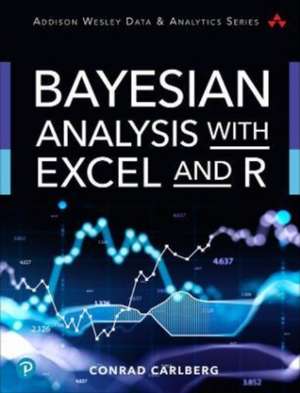
Bayesian Analysis with Excel and R
Autor Conrad Carlbergen Limba Engleză Paperback – 21 dec 2022
Recomandăm Bayesian Analysis with Excel and R analiștilor de date, consultanților în strategie și managerilor care doresc să depășească limitările statisticii convenționale pentru a obține un avantaj competitiv real. Descoperim aici o resursă pragmatică ce transformă concepte adesea considerate ezoterice în instrumente de lucru zilnice. Volumul ghidează cititorul prin procesul critic de distingere între distribuțiile de tip 'prior', 'likelihood' și 'posterior', oferind claritate acolo unde terminologia devine de obicei densă. Remarcăm structura progresivă a lucrării: primele capitole ancorează utilizatorul în mediul familiar al Excel-ului, utilizând funcții precum BETA.DIST sau BINOM.DIST, pentru ca ulterior să facă tranziția către puterea de calcul a limbajului R. Autorul nu se limitează la teorie, ci introduce rapid tehnici de 'gold-standard' precum Markov Chain Monte Carlo (MCMC), esențiale pentru optimizarea vitezei de execuție în scenarii de afaceri complexe. Complementar volumului Bayesian Analysis Made Simple de Phil Woodward, care se concentrează pe simplificarea aplicării pentru non-experți, lucrarea lui Carlberg oferă puntea tehnică necesară pentru a trece de la calculul tabelar la modelarea avansată în Stan. Această carte reprezintă o evoluție firească în opera lui Conrad Carlberg. Dacă în Business Analysis with Microsoft Excel acesta punea bazele gestionării financiare și de marketing, aici autorul rafinează precizia acestor analize prin prisma inferenței bayesiene. Este o abordare mult mai tehnică și mai specifică decât cea din Excel Sales Forecasting for Dummies, fiind orientată spre rezolvarea problemelor unde metodele frecventiste eșuează în a oferi predicții fiabile.
Preț: 358.50 lei
Carte disponibilă
Livrare economică 14-28 noiembrie
Livrare express 31 octombrie-06 noiembrie pentru 32.75 lei
Specificații
ISBN-10: 0137580983
Pagini: 192
Dimensiuni: 178 x 235 x 11 mm
Greutate: 0.35 kg
Ediția:1. Auflage
Editura: Pearson International
V-ar putea interesa
-
 -29%Preț: 499.12 lei707.54 lei
 -
 -20%Preț: 300.98 lei376.22 lei
 -
 Preț: 218.53 lei
 -
 An Introductory Handbook of Bayesian ThinkingStephen C. Loftus-32%Preț: 369.37 lei545.69 lei
 -
 Statistical Rethinking: A Bayesian Course with Examples in R and STANRichard McElreath-20%Preț: 713.42 lei891.77 lei
 -
 Marketing AnalyticsWayne L. Winston-20%Preț: 282.71 lei353.38 lei
 -
 R-ticulateMartin Bader-23%Preț: 655.33 lei851.08 lei
 -
 -5%Preț: 865.60 lei911.15 lei
 -
 Statistical Analysis with Excel For Dummies, 5th E ditionJoseph Schmuller-20%Preț: 207.06 lei258.83 lei
 -
 -4%Preț: 390.49 lei406.76 lei
 -
 -11%Preț: 659.13 lei740.59 lei
 -
 -26%Preț: 624.02 lei840.70 lei
 -
 Microsoft Excel 365 BibleMichael Alexander-20%Preț: 290.19 lei362.74 lei
 -
 Statistical Analysis with R For Dummies, 2nd EditionJoseph SchmullerPreț: 170.35 lei
 -
 Statistical Analysis with Python For DummiesJoseph SchmullerPreț: 197.44 lei
 -
 -8%Preț: 508.48 lei552.69 lei
 -
 Bayesian Statistics the Fun WayWill Kurt-37%Preț: 196.69 lei311.73 lei
De ce să citești această carte
Această carte este esențială pentru profesioniștii care vor să facă pasul de la simpla raportare la modelarea predictivă avansată. Veți învăța cum să utilizați R pentru a rula simulări complexe pe care Excel singur nu le poate gestiona, câștigând astfel capacitatea de a lua decizii de business fundamentate pe probabilități riguroase, nu doar pe intuiție sau medii statistice simple.
Despre autor
Conrad Carlberg, stabilit în Carlsbad, California, este un expert recunoscut în analiza datelor, fiind distins în trecut cu titlul de Microsoft MVP pentru Excel. Cu o experiență vastă în consultanță și implementarea soluțiilor analitice, Carlberg s-a specializat în traducerea conceptelor statistice complexe în fluxuri de lucru accesibile prin intermediul instrumentelor software populare. Expertiza sa se concentrează pe utilizarea Excel și R pentru a rezolva probleme reale de business, de la prognoza vânzărilor la econometrie, transformând datele brute în informații strategice pentru management.
Cuprins
Downloadable Bonus Content
Excel Worksheets Book: Statistical Analysis: Microsoft Excel 2016 (PDF)
9780137580989 TOC 10/24/2022
Descriere scurtă
Bayesian methods can solve problems you cant reliably handle any other way. Building on your existing Excel analytics skills and experience, Microsoft Excel MVP Conrad Carlberg helps you make the most of Excels Bayesian capabilities and move toward R to do even more.
Step by step, with real-world examples, Carlberg shows you how to use Bayesian analytics to solve a wide array of real problems. Carlberg clarifies terminology that often bewilders analysts, provides downloadable Excel workbooks you can easily adapt to your own needs, and offers sample R code to take advantage of the rethinking package in R and its gateway to Stan.
As you incorporate these Bayesian approaches into your analytical toolbox, youll build a powerful competitive advantage for your organizationand yourself.
- Explore key ideas and strategies that underlie Bayesian analysis
- Distinguish prior, likelihood, and posterior distributions, and compare algorithms for driving sampling inputs
- Use grid approximation to solve simple univariate problems, and understand its limits as parameters increase
- Perform complex simulations and regressions with quadratic approximation and Richard McElreaths quap function
- Manage text values as if they were numeric
- Learn todays gold-standard Bayesian sampling technique: Markov Chain Monte Carlo (MCMC)
- Use MCMC to optimize execution speed in high-complexity problems
- Discover when frequentist methods fail and Bayesian methods are essentialand when to use both in tandem