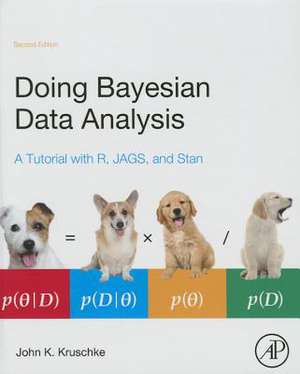
Doing Bayesian Data Analysis: A Tutorial with R, JAGS, and Stan
Autor John Kruschkeen Limba Engleză Hardback – 30 dec 2014
The book is divided into three parts and begins with the basics: models, probability, Bayes’ rule, and the R programming language. The discussion then moves to the fundamentals applied to inferring a binomial probability, before concluding with chapters on the generalized linear model. Topics include metric-predicted variable on one or two groups; metric-predicted variable with one metric predictor; metric-predicted variable with multiple metric predictors; metric-predicted variable with one nominal predictor; and metric-predicted variable with multiple nominal predictors. The exercises found in the text have explicit purposes and guidelines for accomplishment.
This book is intended for first-year graduate students or advanced undergraduates in statistics, data analysis, psychology, cognitive science, social sciences, clinical sciences, and consumer sciences in business.
- Accessible, including the basics of essential concepts of probability and random sampling
- Examples with R programming language and JAGS software
- Comprehensive coverage of all scenarios addressed by non-Bayesian textbooks: t-tests, analysis of variance (ANOVA) and comparisons in ANOVA, multiple regression, and chi-square (contingency table analysis)
- Coverage of experiment planning
- R and JAGS computer programming code on website
- Exercises have explicit purposes and guidelines for accomplishment
- Provides step-by-step instructions on how to conduct Bayesian data analyses in the popular and free software R and WinBugs
Preț: 496.05 lei
Preț vechi: 707.54 lei
-30%
Carte disponibilă
Livrare economică 28 octombrie-11 noiembrie
Livrare express 20-24 octombrie pentru 147.07 lei
Specificații
ISBN-10: 0124058884
Pagini: 776
Ilustrații: 20 illustrations
Dimensiuni: 191 x 235 x 43 mm
Greutate: 1.77 kg
Ediția:Revizuită
Editura: ELSEVIER SCIENCE
V-ar putea interesa
-
 Bayesian Analysis with Excel and RConrad CarlbergPreț: 358.50 lei
 -
 -29%Preț: 309.05 lei434.72 lei
 -
 An Introductory Handbook of Bayesian ThinkingStephen C. Loftus-32%Preț: 369.37 lei545.69 lei
 -
 Statistical Rethinking: A Bayesian Course with Examples in R and STANRichard McElreath-20%Preț: 660.25 lei825.31 lei
 -
 -9%Preț: 1388.37 lei1525.67 lei
 -
 The R BookMichael J. Crawley-19%Preț: 587.57 lei725.39 lei
 -
 R-ticulateMartin Bader-23%Preț: 646.35 lei839.43 lei
 -
 Probability and Bayesian ModelingJim Albert-11%Preț: 715.27 lei803.67 lei
 -
 Statistical Analysis with R Essentials For DummiesJoseph Schmuller-20%Preț: 78.75 lei98.45 lei
 -
 Statistical Analysis with R For DummiesJoseph Schmuller-20%Preț: 145.14 lei181.43 lei
 -
 Statistical Analysis with Python For DummiesJoseph SchmullerPreț: 197.44 lei
 -
 -26%Preț: 652.72 lei882.06 lei
 -
 -8%Preț: 508.48 lei552.69 lei
 -
 -9%Preț: 756.15 lei830.93 lei
 -
 -22%Preț: 875.15 lei1121.98 lei
 -
 The Art of R ProgrammingNorman Matloff-35%Preț: 253.50 lei392.87 lei
 -
 The Book of RTilman M. Davies-36%Preț: 299.90 lei466.11 lei
 -
 Statistics for ScientistsUmberto Michelucci-20%Preț: 275.88 lei344.84 lei
 -
 Bayesian Statistical Modeling with Stan, R, and PythonKentaro Matsuura-20%Preț: 1064.56 lei1330.69 lei
Public țintă
First-year Graduate Students and Advanced Undergraduate Students in Statistics, Data Analysis, Psychology, Cognitive Science, Social Sciences, Clinical Sciences and Consumer Sciences in Business.Cuprins
PART I The Basics: Models, Probability, Bayes’ Rule, and R
2. Introduction: Credibility, Models, and Parameters
3. The R Programming Language
4. What Is This Stuff Called Probability?
5. Bayes’ Rule
PART II All the Fundamentals Applied to Inferring a Binomial Probability
6. Inferring a Binomial Probability via Exact Mathematical Analysis
7. Markov Chain Monte Carlo
8. JAGS
9. Hierarchical Models
10. Model Comparison and Hierarchical Modeling
11. Null Hypothesis Significance Testing
12. Bayesian Approaches to Testing a Point ("Null") Hypothesis
13. Goals, Power, and Sample Size
14. Stan
PART III The Generalized Linear Model
15. Overview of the Generalized Linear Model
16. Metric-Predicted Variable on One or Two Groups
17. Metric Predicted Variable with One Metric Predictor
18. Metric Predicted Variable with Multiple Metric Predictors
19. Metric Predicted Variable with One Nominal Predictor
20. Metric Predicted Variable with Multiple Nominal Predictors
21. Dichotomous Predicted Variable
22. Nominal Predicted Variable
23. Ordinal Predicted Variable
24. Count Predicted Variable
25. Tools in the Trunk
Recenzii
"fills a gaping hole in what is currently available, and will serve to create its own market" --Prof. Michael Lee, U. of Cal., Irvine; pres. Society for Mathematical Psych
"has the potential to change the way most cognitive scientists and experimental psychologists approach the planning and analysis of their experiments" --Prof. Geoffrey Iverson, U. of Cal., Irvine; past pres. Society for Mathematical Psych.
"better than others for reasons stylistic.... buy it -- it’s truly amazin’!" --James L. (Jay) McClelland, Lucie Stern Prof. & Chair, Dept. of Psych., Stanford U.
"the best introductory textbook on Bayesian MCMC techniques" --J. of Mathematical Psych.
"potential to change the methodological toolbox of a new generation of social scientists" --J. of Economic Psych.
"revolutionary" --British J. of Mathematical and Statistical Psych.
"writing for real people with real data. From the very first chapter, the engaging writing style will get readers excited about this topic" --PsycCritiques
Notă biografică
After attending the Summer Science Program as a high school student and considering a career in astronomy, Kruschke earned a bachelor's degree in mathematics (with high distinction in general scholarship) from the University of California at Berkeley. As an undergraduate, Kruschke taught self-designed tutoring sessions for many math courses at the Student Learning Center. During graduate school he attended the 1988 Connectionist Models Summer School, and earned a doctorate in psychology also from U.C. Berkeley. He joined the faculty of Indiana University in 1989. Professor Kruschke's publications can be found at his Google Scholar page. His current research interests focus on moral psychology.
Professor Kruschke taught traditional statistical methods for many years until reaching a point, circa 2003, when he could no longer teach corrections for multiple comparisons with a clear conscience. The perils of p values provoked him to find a better way, and after only several thousand hours of relentless effort, the 1st and 2nd editions of Doing Bayesian Data Analysis emerged.