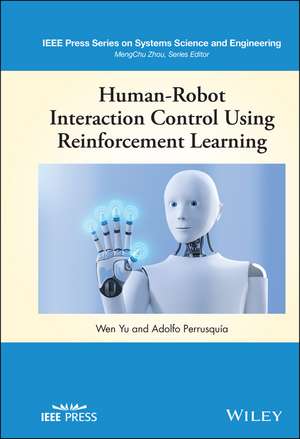
Human–Robot Interaction Control Using Reinforcemen t Learning: IEEE Press Series on Systems Science and Engineering
Autor W Yuen Limba Engleză Hardback – 4 noi 2021
ABORDAREA PRACTICĂ: Human–Robot Interaction Control Using Reinforcement Learning echilibrează rigoarea demonstrațiilor matematice cu implementarea algoritmilor de tip „model-free”. Reținem că, spre deosebire de manualele pur teoretice, această lucrare din IEEE Press Series on Systems Science and Engineering pune accentul pe tehnici de identificare pentru estimarea parametrilor și pe stabilitatea sistemelor în medii dinamice. Dacă Learning Control de Dan Zhang v-a oferit cadrul teoretic al controlului bazat pe inteligență artificială, această carte oferă instrumentele practice necesare pentru a gestiona incertitudinea în interacțiunea fizică dintre om și mașină.
Analizăm în detaliu scheme de control pentru roboți redundanți și utilizarea unghiurilor lui Euler în sistemele de tip „human-in-the-loop”. Autorul W Yu, deși a explorat anterior domenii precum Cold–Formed Steel Design sau Electromagnetic Simulation Techniques Based on the Fdtd Method, își demonstrează versatilitatea tehnică prin aplicarea metodelor de simulare și modelare matematică în robotică. Această lucrare continuă tradiția autorului de a construi punți între teorie și implementare, similar modului în care a ghidat cititorii pas cu pas în simulările electromagnetice.
Recomandăm atenția asupra secțiunilor dedicate controlului neural H2 și învățării prin recompensă în timp continuu. În timp ce AI based Robot Safe Learning and Control se concentrează pe siguranța manipulatoarelor prin rețele neurale dinamice, volumul de față extinde perspectiva către controlul forței și soluții cinematice complexe, fiind esențial pentru cei care proiectează sisteme robotice capabile să colaboreze activ cu operatorii umani.
Preț: 804.78 lei
Preț vechi: 884.38 lei
-9%
Carte tipărită la comandă
Livrare economică 28 mai-11 iunie
Specificații
ISBN-10: 1119782740
Pagini: 288
Dimensiuni: 162 x 233 x 20 mm
Greutate: 0.56 kg
Editura: Wiley
Seria IEEE Press Series on Systems Science and Engineering
Locul publicării:Hoboken, United States
V-ar putea interesa
-
 Reinforcement LearningRichard S. Sutton-30%Preț: 639.65 lei908.04 lei
 -
 Learning for Adaptive and Reactive Robot ControlAude Billard-14%Preț: 543.18 lei631.60 lei
 -
 Multi-Agent Reinforcement LearningFilippos Christianos-20%Preț: 464.38 lei580.47 lei
 -
 Robot EcologyMagnus Egerstedt-14%Preț: 503.86 lei585.89 lei
 -
 The Big Book of RobotsCampbell BooksPreț: 80.18 lei
 -
 Data-Driven Science and EngineeringSteven L. Brunton-19%Preț: 358.05 lei442.28 lei
 -
 Robot Modeling and ControlMark W Spong-23%Preț: 830.88 lei1079.06 lei
 -
 Introduction to Robotics, Global EditionJohn Craig-15%Preț: 549.34 lei646.29 lei
 -
 Motor Control and LearningCarolee Winstein-9%Preț: 718.82 lei789.92 lei
 -
 Morales, M: Grokking Deep Reinforcement LearningMiguel Morales-20%Preț: 355.91 lei444.89 lei
 -
 RobotsHenny Admoni-30%Preț: 65.22 lei93.46 lei
 -
 Human-Friendly Robotics 2022Pablo Borja-24%Preț: 1233.60 lei1623.15 lei
 -
 -18%Preț: 864.31 lei1054.04 lei
 -
 Robust and Adaptive ControlEugene LavretskyPreț: 516.65 lei
 -
 A Stable and Transparent Framework for Adaptive Shared Control of RobotsRibin Balachandran-24%Preț: 681.71 lei896.98 lei
 -
 -15%Preț: 626.67 lei737.26 lei
 -
 Robotics Goes MOOC: InteractionBruno SicilianoPreț: 409.58 lei
 -
 Frontiers in Robotics and ElectromechanicsAndrey Ronzhin-24%Preț: 981.82 lei1291.86 lei
 -
 Human Motion Awareness and Robot TeleoperationHonghao Lyu-18%Preț: 1068.90 lei1303.53 lei
 -
 -20%Preț: 524.77 lei655.97 lei
De ce să citești această carte
Recomandăm această carte cercetătorilor și inginerilor care doresc să implementeze algoritmi de „reinforcement learning” în sisteme robotice reale. Cititorul câștigă o înțelegere profundă a stabilității sistemelor de control și a metodelor de estimare a parametrilor. Este un instrument indispensabil pentru trecerea de la simulări teoretice la interacțiuni om-robot sigure și eficiente, oferind soluții concrete pentru roboți redundanți și controlul forței în timp real.
Descriere
A comprehensive exploration of the control schemes of human-robot interactions
In Human-Robot Interaction Control Using Reinforcement Learning, an expert team of authors delivers a concise overview of human-robot interaction control schemes and insightful presentations of novel, model-free and reinforcement learning controllers. The book begins with a brief introduction to state-of-the-art human-robot interaction control and reinforcement learning before moving on to describe the typical environment model. The authors also describe some of the most famous identification techniques for parameter estimation.
Human-Robot Interaction Control Using Reinforcement Learning offers rigorous mathematical treatments and demonstrations that facilitate the understanding of control schemes and algorithms. It also describes stability and convergence analysis of human-robot interaction control and reinforcement learning based control.
The authors also discuss advanced and cutting-edge topics, like inverse and velocity kinematics solutions, H2 neural control, and likely upcoming developments in the field of robotics.
Readers will also enjoy:
- A thorough introduction to model-based human-robot interaction control
- Comprehensive explorations of model-free human-robot interaction control and human-in-the-loop control using Euler angles
- Practical discussions of reinforcement learning for robot position and force control, as well as continuous time reinforcement learning for robot force control
- In-depth examinations of robot control in worst-case uncertainty using reinforcement learning and the control of redundant robots using multi-agent reinforcement learning
Perfect for senior undergraduate and graduate students, academic researchers, and industrial practitioners studying and working in the fields of robotics, learning control systems, neural networks, and computational intelligence, Human-Robot Interaction Control Using Reinforcement Learning is also an indispensable resource for students and professionals studying reinforcement learning.