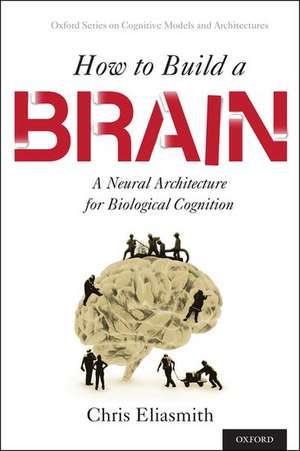
How to Build a Brain: A Neural Architecture for Biological Cognition: Oxford Series on Cognitive Models and Architectures
Autor Chris Eliasmithen Limba Engleză Hardback – 27 iun 2013













Preț: 1056.63 lei
Preț vechi: 1694.47 lei
-38%
Puncte Express: 1585
Carte tipărită la comandă
Livrare economică 19-25 noiembrie
Livrare prin curier în România Termenul estimat este afișat lângă disponibilitate.
Transport gratuit pentru acest produs Plată online sau ramburs, în funcție de opțiunile comenzii.
Retur gratuit în 14 zile Comandă securizată și suport în română.
Specificații
ISBN-13: 9780199794546
ISBN-10: 0199794545
Pagini: 480
Dimensiuni: 257 x 183 x 38 mm
Greutate: 1.17 kg
Editura: Oxford University Press
Colecția OUP USA
Seria Oxford Series on Cognitive Models and Architectures
Locul publicării:New York, United States
ISBN-10: 0199794545
Pagini: 480
Dimensiuni: 257 x 183 x 38 mm
Greutate: 1.17 kg
Editura: Oxford University Press
Colecția OUP USA
Seria Oxford Series on Cognitive Models and Architectures
Locul publicării:New York, United States
V-ar putea interesa
-
 Brain and BehaviorDavid Eagleman-23%Preț: 1047.63 lei1368.69 lei
 -
 The Computational Evolution of Cognitive ArchitecturesIuliia Kotseruba-30%Preț: 411.24 lei584.03 lei
 -
 The Brain: A Very Short IntroductionMichael O'Shea-32%Preț: 48.19 lei71.01 lei
 -
 The Brain from Inside OutGyorgy Buzsaki-14%Preț: 257.01 lei300.20 lei
 -
 The Neural Mind: How Brains ThinkProfessor George LakoffPreț: 218.61 lei
 -
 Natural NeuroscienceNachum Ulanovsky-14%Preț: 447.91 lei520.82 lei
 -
 ChatGPT and the Future of AITerrence J. Sejnowski-20%Preț: 107.12 lei133.89 lei
 -
 Theoretical NeuroscienceLaurence F. Abbott-17%Preț: 542.93 lei650.48 lei
 -
 Mind Design IIICarl F. Craver-16%Preț: 508.32 lei608.62 lei
 -
 Philosophy of Psychology: A Contemporary IntroductionJose Luis BermudezPreț: 374.29 lei
 -
 Godel, Escher, Bach: An Eternal Golden BraidDouglas Hofstadter-21%Preț: 130.28 lei165.21 lei
 -
 The Importance of Being EducableLeslie ValiantPreț: 187.73 lei
 -
 The Self-Assembling BrainPeter Robin HiesingerPreț: 176.41 lei
 -
 Tutorial on Neural Systems ModelingThomas J. Anastasio-25%Preț: 1086.08 lei1442.15 lei
 -
 Principles of Cognitive NeuroscienceDale Purves-27%Preț: 1350.46 lei1849.95 lei
 -
 Theoretical Neuroscience: Understanding CognitionXiao-Jing Wang-9%Preț: 798.27 lei877.22 lei
 -
 The Essential Book of AIAnne Rooney-20%Preț: 74.61 lei93.27 lei
 -
 One Hand ClappingNikolay KukushkinPreț: 156.39 lei
 -
 The Brain at RestJoseph JebelliPreț: 75.15 lei
 -
 The SignsTara SwartPreț: 120.93 lei
Notă biografică
Chris Eliasmith is Canada Research Chair in Theoretical Neuroscience at the University of Waterloo
Recenzii
How to Build a Brain takes on a daunting task, focusing on those parts that we think are important for memory, attention, and planning. Previous attempts at building a cognitive architecture have used symbols or connectionist networks, but Eliasmith uses spiking neurons and models specific brain regions. Categories and semantics emerge from the architecture. The way that all these moving parts work together provides insights into both the nature of cognition and brain function."
Eliasmith offers a unified theory of cognition that rests on the mechanism of a semantic pointer, namely, a compressed neural representation that can stand as a symbol for a more detailed semantic state or be decompressed to reproduce it, in compositional cognitive processes. Ambitious state-of-the-art modeling grounds the semantic pointer architecture in populations of spiking neurons, providing concrete neural accounts of high-level processes, including attention, learning, memory, syntax, semantics, and reasoning. Along with offering a powerful new approach for integrating cognition and neuroscience, Eliasmith provides detailed technical accounts of his system, with accompanying software that will serve both students and fellow modelers well."
Eliasmith offers a unified theory of cognition that rests on the mechanism of a semantic pointer, namely, a compressed neural representation that can stand as a symbol for a more detailed semantic state or be decompressed to reproduce it, in compositional cognitive processes. Ambitious state-of-the-art modeling grounds the semantic pointer architecture in populations of spiking neurons, providing concrete neural accounts of high-level processes, including attention, learning, memory, syntax, semantics, and reasoning. Along with offering a powerful new approach for integrating cognition and neuroscience, Eliasmith provides detailed technical accounts of his system, with accompanying software that will serve both students and fellow modelers well."
Cuprins
- 1 The science of cognition
- 1.1 The last 50 years
- 1.2 How we got here
- 1.3 Where we are
- 1.4 Questions and answers
- 1.5 Nengo: An introduction
- Part I. How to build a brain
- 2 An introduction to brain building
- 2.1 Brain parts
- 2.2 A framework for building a brain
- 2.2.1 Representation
- 2.2.2 Transformation
- 2.2.3 Dynamics
- 2.2.4 The three principles
- 2.3 Levels
- 2.4 Nengo: Neural representation
- 3 Biological cognition - Semantics
- 3.1 The semantic pointer hypothesis
- 3.2 What is a semantic pointer?
- 3.3 Semantics: An overview
- 3.4 Shallow semantics
- 3.5 Deep semantics for perception
- 3.6 Deep semantics for action
- 3.7 The semantics of perception and action
- 3.8 Nengo: Neural computations
- 4 Biological cognition - Syntax
- 4.1 Structured representations
- 4.2 Binding without neurons
- 4.3 Binding with neurons
- 4.4 Manipulating structured representations
- 4.5 Learning structural manipulations
- 4.6 Clean-up memory and scaling
- 4.7 Example: Fluid intelligence
- 4.8 Deep semantics for cognition
- 4.9 Nengo: Structured representations in neurons
- 5 Biological cognition - Control
- 5.1 The flow of information
- 5.2 The basal ganglia
- 5.3 Basal ganglia, cortex, and thalamus
- 5.4 Example: Fixed sequences of actions
- 5.5 Attention and the routing of information
- 5.6 Example: Flexible sequences of actions
- 5.7 Timing and control
- 5.8 Example: The Tower of Hanoi
- 5.9 Nengo: Question answering
- 6 Biological cognition - Memory and learning
- 6.1 Extending cognition through time
- 6.2 Working memory
- 6.3 Example: Serial list memory
- 6.4 Biological learning
- 6.5 Example: Learning new actions
- 6.6 Example: Learning new syntactic manipulations
- 6.7 Nengo: Learning
- 7 The Semantic Pointer Architecture (SPA)
- 7.1 A summary of the SPA
- 7.2 A SPA unified network
- 7.3 Tasks
- 7.3.1 Recognition
- 7.3.2 Copy drawing
- 7.3.3 Reinforcement learning
- 7.3.4 Serial working memory
- 7.3.5 Counting
- 7.3.6 Question answering
- 7.3.7 Rapid variable creation
- 7.3.8 Fluid reasoning
- 7.3.9 Discussion
- 7.4 A unified view: Symbols and probabilities
- 7.5 Nengo: Advanced modeling methods
- Part II. Is that how you build a brain?
- 8 Evaluating cognitive theories
- 8.1 Introduction
- 8.2 Core Cognitive Criteria (CCC)
- 8.2.1 Representational structure
- 8.2.1.1 Systematicity
- 8.2.1.2 Compositionality
- 8.2.1.3 Productivity
- 8.2.1.4 The massive binding problem
- 8.2.2 Performance concerns
- 8.2.2.1 Syntactic generalization
- 8.2.2.2 Robustness
- 8.2.2.3 Adaptability
- 8.2.2.4 Memory
- 8.2.2.5 Scalability
- 8.2.3 Scientific merit
- 8.2.3.1 Triangulation
- 8.2.3.2 Compactness
- 8.3 Conclusion
- 8.4 Nengo Bonus: How to build a brain - A practical guide
- 9 Theories of cognition
- 9.1 The state of the art
- 9.1.1 ACT-R
- 9.1.2 Synchrony-based approaches
- 9.1.3 Neural Blackboard Architecture (NBA)
- 9.1.4 The Integrated Connectionist/Symbolic Architecture (ICS)
- 9.1.5 Leabra
- 9.1.6 Dynamic Field Theory (DFT)
- 9.2 An evaluation
- 9.2.1 Representational structure
- 9.2.2 Performance concerns
- 9.2.3 Scientific merit
- 9.2.4 Summary
- 9.3 The same...
- 9.4 ...but different
- 9.5 The SPA versus the SOA
- 10 Consequences and challenges
- 10.1 Representation
- 10.2 Concepts
- 10.3 Inference
- 10.4 Dynamics
- 10.5 Challenges
- 10.6 Conclusion
- A Mathematical notation and overview
- A.1 Vectors
- A.2 Vector spaces
- A.3 The dot product
- A.4 Basis of a vector space
- A.5 Linear transformations on vectors
- A.6 Time derivatives for dynamics
- B Mathematical derivations for the NEF
- B.1 Representation
- B.1.1 Encoding
- B.1.2 Decoding
- B.2 Transformation
- B.3 Dynamics
- C Further details on deep semantic models
- C.1 The perceptual model
- C.2 The motor model
- D Mathematical derivations for the SPA
- D.1 Binding and unbinding HRRs
- D.2 Learning high-level transformations
- D.3 Ordinal serial encoding model
- D.4 Spike-timing dependent plasticity
- D.5 Number of neurons for representing structure
- E SPA model details
- E.1 Tower of Hanoi
- Bibliography
- Index