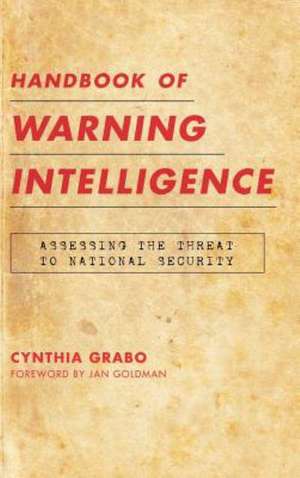
Handbook of Warning Intelligence: Assessing the Threat to National Security: Security and Professional Intelligence Education Series
Autor Cynthia Grabo Cuvânt înainte de Jan Goldmanen Limba Engleză Hardback – apr 2010
Much of what Grabo writes in her book seems to appear in many of the numerous commission reports that emerged after the 9/11 attacks. However, this book was written in response to the "surprise attack" of the Soviet Union's invasion of Czechoslovakia in 1968. According to the author, that event was no surprise. And while analysts have to take some of the blame for their failure to strenuously present their case that the threat was real and imminent, what occurred was a failure by policymakers to listen to the warning intelligence reports that were written at the time.
Din seria Security and Professional Intelligence Education Series
-
 Preț: 275.68 lei
 - 9%
 Preț: 255.69 lei
 - 18%
 Preț: 379.84 lei
 - 18%
 Preț: 378.03 lei
 - 24%
 Preț: 362.23 lei
 - 35%
 Preț: 593.12 lei
 - 23%
 Preț: 260.28 lei
 - 20%
 Preț: 367.53 lei
 - 31%
 Preț: 510.16 lei
 - 23%
 Preț: 365.80 lei
 - 28%
 Preț: 439.36 lei
 - 31%
 Preț: 393.18 lei
 - 25%
 Preț: 218.37 lei
 - 33%
 Preț: 711.44 lei
 - 27%
 Preț: 504.21 lei
 - 18%
 Preț: 259.91 lei
 - 27%
 Preț: 402.10 lei
 - 29%
 Preț: 362.40 lei
 - 24%
 Preț: 310.02 lei
 - 28%
 Preț: 365.13 lei
 - 24%
 Preț: 223.34 lei
 - 37%
 Preț: 785.57 lei
 - 18%
 Preț: 226.70 lei
 - 28%
 Preț: 397.65 lei
 - 34%
 Preț: 634.81 lei
 - 27%
 Preț: 228.69 lei
 - 28%
 Preț: 366.40 lei
 - 30%
 Preț: 448.84 lei
 - 28%
 Preț: 397.81 lei
 - 32%
 Preț: 345.17 lei
 - 27%
 Preț: 526.06 lei
 - 24%
 Preț: 255.50 lei
Preț: 579.34 lei
Preț vechi: 729.78 lei
-21%
Puncte Express: 869
Carte tipărită la comandă
Livrare economică 13-27 noiembrie
Livrare prin curier în România Termenul estimat este afișat lângă disponibilitate.
Transport gratuit pentru acest produs Plată online sau ramburs, în funcție de opțiunile comenzii.
Retur gratuit în 14 zile Comandă securizată și suport în română.
Specificații
ISBN-13: 9780810871908
ISBN-10: 0810871904
Pagini: 326
Dimensiuni: 163 x 240 x 26 mm
Greutate: 0.65 kg
Ediția:Prescurtată
Editura: Bloomsbury Publishing
Colecția Scarecrow Press
Seria Security and Professional Intelligence Education Series
Locul publicării:New York, United States
ISBN-10: 0810871904
Pagini: 326
Dimensiuni: 163 x 240 x 26 mm
Greutate: 0.65 kg
Ediția:Prescurtată
Editura: Bloomsbury Publishing
Colecția Scarecrow Press
Seria Security and Professional Intelligence Education Series
Locul publicării:New York, United States
V-ar putea interesa
-
 -18%Preț: 352.43 lei427.85 lei
 -
 Risk Analysis and the Security SurveyJames F. Broder-8%Preț: 366.86 lei398.76 lei
 -
 -16%Preț: 312.18 lei372.14 lei
 -
 Building an Intelligence-Led Security ProgramAllan Liska-35%Preț: 287.56 lei439.74 lei
 -
 Modern Competitive AnalysisSharon M. Oster-27%Preț: 1303.11 lei1785.08 lei
 -
 -28%Preț: 423.31 lei584.10 lei
 -
 Strategic Intelligence for the 21st Century: The Mosaic MethodAlfred Rolington-14%Preț: 296.74 lei346.45 lei
 -
 Intelligence AnalysisWayne Michael Hall-28%Preț: 381.72 lei531.27 lei
 -
 Proven Strategies in Competitive IntelligenceJohn E Prescott-8%Preț: 391.62 lei425.67 lei
 -
 Reshaping National Intelligence for an Age of InformationGregory F. TrevertonPreț: 259.88 lei
 -
 -34%Preț: 97.82 lei147.59 lei
 -
 -15%Preț: 505.95 lei595.24 lei
 -
 RiskDan Gardner-36%Preț: 85.69 lei133.44 lei
 -
 Preț: 135.61 lei
 -
 -20%Preț: 939.96 lei1174.95 lei
 -
 Big Data, Big AnalyticsMinelliPreț: 293.28 lei
 -
 -18%Preț: 1308.33 lei1595.54 lei
 -
 IntelligenceAnna T CiancioloPreț: 270.38 lei
 -
 Scripting IntelligenceMark Watson-20%Preț: 228.93 lei286.16 lei
 -
 Open Source Data Warehousing and Business IntelligenceLakshman Bulusu-20%Preț: 1123.60 lei1404.49 lei
 -
 Open Source Intelligence in a Networked WorldDr. Anthony OlcottPreț: 259.32 lei
 -
 -20%Preț: 1185.41 lei1481.77 lei
 -
 -20%Preț: 488.40 lei610.50 lei
Recenzii
The foreword provides interesting background on the hurtles to getting the still-relevant handbook declassified.
Cuprins
Foreword to the new edition
Foreword to the previous edition
Author's note to the original edition
Part I: Why Warning Intelligence And What Is It? Some Fundamentals
Chapter 1: General Nature of the Problem
Chapter 2: Definitions of Terms and Their Usage
Chapter 3: What Warning Is and Is Not
Chapter 4: Warning and Collection
Chapter 5: Intentions versus Capabilities
Part II: Organization and Tools of the Trade
Chapter 6: Problems of Organization and Management
Chapter 7: Indicator lists
Chapter 8: The Compiling of Indications
Chapter 9: Can Computers 'Hel p?
Part III: Introduction to the Analytical Method
Chapter 10: Some Fundamentals of Indications Analysis
Chapter 11: Some Specifics of the Analytical Method.
Chapter 12: What Makes a Good Warning Analyst?
Part IV: Specific Problems of Military Analysis
Chapter 13: Importance of Military Indications
Chapter 14: Order of Bottle Analysis in Crisis Situations
Chapter 15: Analysis of Mobilization
Chapter 16: Logistics is the Queen of Battles
Chapter 17: Other Factors in Combat Preparations
Chapter 18: Coping with Extraordinary Military Developments
Part V: Specific Problems of Political, Civil and Economic Analysis
Chapter 19: Importance of Political Factors for Warning
Chapter 20: Basic Political Warning -- A Problem of Perception
Chapter 21: Some Specific Factors in Political Warning
Chapter 22: Economic Indicators
Chapter 23: Civil Defense
Chapter 24: Security, Counter-Intelligence and Agent Preparations
Part VI: Some Major Analytical Problems
Chapter 25: Warning from the Totality of Evidence
Chapter 26: The Impact on Warning of Circumstances Leading to War
Chapter 27: Reconstructing the Enemy's Decision Making Process
Chapter 28: Assessing the Timing of Attack Chapter 29: Deception: Can We Cope With It?
The following chapters are new to this edition.
Part VII: Problems of Particular Types Of Warfare
Chapter 30: Analysis with Hostilities Already in Progress
Chapter 31: Problems Peculiar to Guerrilla Warfare and "Wars of Liberation"
Chapter 32: Hypothetical Problems of the Coming of World War III
Part VIII: Reaching And Reporting The Warning Judgment
Chapter 33: Vital Importance of the Judgment
Chapter 34: What Does the Policy Maker Need, and Want to Know?
Chapter 35: How to Write Indications or Warning Items
Chapter 36: Assessing Probabilities
Chapter 37: Some Major Factors Influencing Judgments and Reporting
Chapter 38: Most Frequent Errors in the Judgment and Reporting Process
Part IX: Conclusions
Chapter 39: A Summing Up, With Some Do's and Don'ts for Analysts and Supervisors
About the Authors
Foreword to the previous edition
Author's note to the original edition
Part I: Why Warning Intelligence And What Is It? Some Fundamentals
Chapter 1: General Nature of the Problem
Chapter 2: Definitions of Terms and Their Usage
Chapter 3: What Warning Is and Is Not
Chapter 4: Warning and Collection
Chapter 5: Intentions versus Capabilities
Part II: Organization and Tools of the Trade
Chapter 6: Problems of Organization and Management
Chapter 7: Indicator lists
Chapter 8: The Compiling of Indications
Chapter 9: Can Computers 'Hel p?
Part III: Introduction to the Analytical Method
Chapter 10: Some Fundamentals of Indications Analysis
Chapter 11: Some Specifics of the Analytical Method.
Chapter 12: What Makes a Good Warning Analyst?
Part IV: Specific Problems of Military Analysis
Chapter 13: Importance of Military Indications
Chapter 14: Order of Bottle Analysis in Crisis Situations
Chapter 15: Analysis of Mobilization
Chapter 16: Logistics is the Queen of Battles
Chapter 17: Other Factors in Combat Preparations
Chapter 18: Coping with Extraordinary Military Developments
Part V: Specific Problems of Political, Civil and Economic Analysis
Chapter 19: Importance of Political Factors for Warning
Chapter 20: Basic Political Warning -- A Problem of Perception
Chapter 21: Some Specific Factors in Political Warning
Chapter 22: Economic Indicators
Chapter 23: Civil Defense
Chapter 24: Security, Counter-Intelligence and Agent Preparations
Part VI: Some Major Analytical Problems
Chapter 25: Warning from the Totality of Evidence
Chapter 26: The Impact on Warning of Circumstances Leading to War
Chapter 27: Reconstructing the Enemy's Decision Making Process
Chapter 28: Assessing the Timing of Attack Chapter 29: Deception: Can We Cope With It?
The following chapters are new to this edition.
Part VII: Problems of Particular Types Of Warfare
Chapter 30: Analysis with Hostilities Already in Progress
Chapter 31: Problems Peculiar to Guerrilla Warfare and "Wars of Liberation"
Chapter 32: Hypothetical Problems of the Coming of World War III
Part VIII: Reaching And Reporting The Warning Judgment
Chapter 33: Vital Importance of the Judgment
Chapter 34: What Does the Policy Maker Need, and Want to Know?
Chapter 35: How to Write Indications or Warning Items
Chapter 36: Assessing Probabilities
Chapter 37: Some Major Factors Influencing Judgments and Reporting
Chapter 38: Most Frequent Errors in the Judgment and Reporting Process
Part IX: Conclusions
Chapter 39: A Summing Up, With Some Do's and Don'ts for Analysts and Supervisors
About the Authors