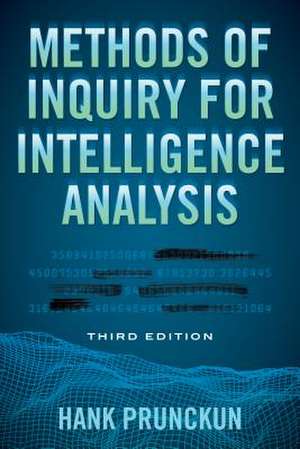
Methods of Inquiry for Intelligence Analysis: Security and Professional Intelligence Education Series
Autor Hank Prunckunen Limba Engleză Paperback – 10 apr 2019
Evoluția domeniului informațiilor după evenimentele din 11 septembrie a impus o transformare radicală a metodologiilor de lucru, trecând de la intuiție la procese riguroase de cercetare aplicată. Observăm cum Methods of Inquiry for Intelligence Analysis răspunde acestei nevoi de profesionalizare, oferind un cadru academic solid pentru viitorii analiști din sectoarele guvernamentale și private. Ajunsă la a treia ediție, lucrarea reflectă complexitatea actuală a volumului uriaș de date brute care necesită procesare strategică.
Apreciem rigoarea cu care Hank Prunckun organizează materialul, ghidând cititorul de la teoria informațiilor și structuri organizaționale către tehnici specifice de analiză. Volumul echilibrează capitolele dedicate surselor clandestine cu cele despre sursele deschise, culminând cu metode avansate de analiză cantitativă și geointeligență. Această abordare metodologică este o extensie firească a temelor explorate de autor în Counterintelligence Theory and Practice, unde accentul cădea pe operațiunile de contraspionaj, și în Scientific Methods of Inquiry for Intelligence Analysis, consolidând aici o viziune integrată asupra cercetării.
În contextul literaturii de specialitate, acest titlu completează perspectiva oferită de Intelligence Analysis Fundamentals de Patrick McGlynn. În timp ce lucrarea lui McGlynn se concentrează pe terminologia militară și concepte introductive pentru forțele de ordine, volumul de față adaugă o profunzime analitică superioară prin cele 33 de tabele și 15 grafice, oferind instrumente concrete pentru evaluarea riscurilor și a amenințărilor. Structura didactică este susținută de exemple practice, ceea ce face ca tranziția de la teorie la rapoartele de securitate (precum cele pentru rutele vehiculelor) să fie extrem de intuitivă pentru studenți.
Din seria Security and Professional Intelligence Education Series
-
 Preț: 275.68 lei
 - 8%
 Preț: 262.15 lei
 - 17%
 Preț: 386.98 lei
 - 24%
 Preț: 362.23 lei
 - 35%
 Preț: 593.12 lei
 - 23%
 Preț: 260.28 lei
 - 20%
 Preț: 367.53 lei
 - 31%
 Preț: 510.16 lei
 - 23%
 Preț: 365.80 lei
 - 28%
 Preț: 439.36 lei
 - 31%
 Preț: 393.18 lei
 - 24%
 Preț: 225.25 lei
 - 33%
 Preț: 728.81 lei
 - 27%
 Preț: 504.21 lei
 - 18%
 Preț: 259.91 lei
 - 27%
 Preț: 402.10 lei
 - 29%
 Preț: 362.40 lei
 - 24%
 Preț: 310.02 lei
 - 28%
 Preț: 365.13 lei
 - 24%
 Preț: 223.34 lei
 - 37%
 Preț: 785.57 lei
 - 18%
 Preț: 226.70 lei
 - 28%
 Preț: 397.65 lei
 - 34%
 Preț: 634.81 lei
 - 27%
 Preț: 228.69 lei
 - 28%
 Preț: 366.40 lei
 - 30%
 Preț: 448.84 lei
 - 28%
 Preț: 397.81 lei
 - 32%
 Preț: 345.17 lei
 - 27%
 Preț: 526.06 lei
 - 24%
 Preț: 255.50 lei
Preț: 379.84 lei
Preț vechi: 460.76 lei
-18%
Carte disponibilă
Livrare economică 12-26 noiembrie
Specificații
ISBN-10: 1538125870
Pagini: 256
Ilustrații: 18 b/w photos; 33 tables; 15 graphs; 15 textboxes
Dimensiuni: 150 x 228 x 12 mm
Greutate: 0.32 kg
Ediția:3
Editura: Bloomsbury Publishing
Colecția Rowman & Littlefield
Seria Security and Professional Intelligence Education Series
Locul publicării:New York, United States
De ce să citești această carte
Această lucrare este esențială pentru studenții și profesioniștii aflați la început de carieră în serviciile de informații sau securitate privată. Cititorul câștigă o metodologie clară de transformare a datelor brute în produse de intelligence acționabile. Ediția a treia aduce un suport vizual bogat și studii de caz care facilitează înțelegerea proceselor complexe de analiză cantitativă și evaluare a vulnerabilităților naționale.
Descriere
Cuprins
, Intelligence Theory
,
Chapter 2
, Intelligence Organizational Structures
,
Chapter 3
, The Intelligence Research Process
,
Chapter 4
, Clandestine and Covert Sources of Information
,
Chapter 5
, Open Sources of Information
,
Chapter 6
, Qualitative Analytics
,
Chapter 7
, Quantitative Analytics
,
Chapter 8
, Geointelligence
,
Chapter 9
, Target Profiles
,
Chapter 10
, Operational Assessments
,
Chapter 11
, Vehicle Route Security Report
,
Chapter 12
, Threat Assessments
,
Chapter 13
, Vulnerability Assessments
,
Chapter 14
, Risk Assessments
,
Chapter 15
, National Security Policy Assessments
,
Chapter 16
, Appendix-Critical Values of Chi-Square Distribution
,
Chapter 17
, About the Author
,
Chapter 18
, Index
,
Recenzii
Methods of Inquiry for Intelligence Analysis presents a strong discussion of the subject from a perspective grounded in the scientific method, while providing a comprehensive and well-organized overview of how various intelligence products are developed and disseminated.
Having examples of the types of analysis makes the book extremely strong and useful in the classroom; students need to see concrete examples of theories in practice.