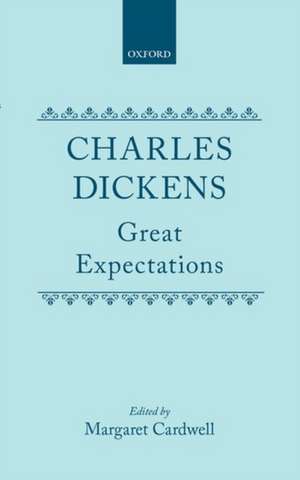
Great Expectations: Clarendon Dickens
Autor Charles Dickens Editat de Margaret Cardwellen Limba Engleză Hardback – 5 aug 1993
Găsim în Great Expectations forța narativă a lui Charles Dickens combinată cu o sensibilitate introspectivă ce amintește de Oliver Twist — dar cu un glas propriu, mult mai matur și melancolic. Dacă în Oliver Twist miza era supraviețuirea fizică într-un Londra ostil, aici Charles Dickens sondează profunzimile psihologice ale ambiției și ale dezamăgirii. Considerăm că acest roman reprezintă apogeul tehnicii sale literare, fiind o punte între idealismul din David Copperfield și critica socială acidă din A Tale of Two Cities.
Structura narativă, organizată riguros în trei volume, urmărește transformarea lui Pip de la un orfan înfricoșat în mlaștinile cețoase, la un tânăr cu „mari speranțe” în metropola londoneză, terminând cu o revenire amară la realitate. Această ediție de la Wordsworth Classics îmbogățește experiența lecturii prin includerea ilustrațiilor semnate de F. W. Pailthrope, care capturează vizual atmosfera gotică a casei Satis și siluetele amenințătoare ale mlaștinilor.
Ceea ce diferențiază acest titlu de alte scrieri dickensiene este onestitatea brutală a vocii narative. Pip nu este un erou fără pată; el este vulnerabil, adesea snob și chinuit de o dragoste neîmplinită pentru Estella. Credem că valoarea adăugată a acestui volum rezidă în secțiunea de anexe, unde regăsim memorandile de lucru ale lui Charles Dickens și reacțiile presei din 1861, oferind o perspectivă rară asupra modului în care romanul a fost construit și recepționat în epoca victoriană. Este o explorare profundă a modului în care trauma și norocul ne modelează caracterul, dincolo de aparențele clasei sociale.
Preț: 2705.91 lei
Preț vechi: 4040.93 lei
-33%
Carte tipărită la comandă
Livrare economică 27 noiembrie-08 decembrie
Specificații
ISBN-10: 019818591X
Pagini: 584
Ilustrații: facsimiles and original illustrations
Dimensiuni: 144 x 223 x 39 mm
Greutate: 0.89 kg
Editura: Clarendon Press
Colecția Clarendon Press
Seria Clarendon Dickens
Locul publicării:Oxford, United Kingdom
V-ar putea interesa
-
 Pride and PrejudiceJane AustenPreț: 28.01 lei
 -
 Robinson CrusoeDaniel DefoePreț: 28.01 lei
 -
 Tess of the D'UrbervillesThomas HardyPreț: 28.01 lei
 -
 The Picture of Dorian GrayOscar WildePreț: 28.01 lei
 -
 The Railway ChildrenE. NesbitPreț: 28.01 lei
 -
 Preț: 28.01 lei
 -
 UlyssesJames Joyce-39%Preț: 69.49 lei113.40 lei
 -
 Vanity FairWilliam Makepeace Thackeray-20%Preț: 68.02 lei84.52 lei
 -
 Sense and SensibilityJane Austen-25%Preț: 49.62 lei66.16 lei
 -
 MiddlemarchGeorge Eliot-19%Preț: 68.34 lei84.69 lei
 -
 The Enormous CrocodileRoald Dahl-32%Preț: 42.76 lei62.50 lei
 -
 AntigoneSophocles-39%Preț: 17.44 lei28.47 lei
 -
 Pride and PrejudiceJane Austen-32%Preț: 50.29 lei73.48 lei
 -
 Hokey PokeyJerry SpinelliPreț: 60.35 lei
 -
 Classic Starts®: Moby-DickArthur Pober-27%Preț: 41.03 lei56.23 lei
 -
 A Monster CallsPatrick NessPreț: 65.26 lei
 -
 North of NowhereLiz Kessler-24%Preț: 38.73 lei51.27 lei
 -
 -24%Preț: 62.03 lei81.29 lei
 -
 Preț: 89.12 lei
 -
 Vampire Academy: The Graphic NovelEmma ViecieliPreț: 89.78 lei
 -
 Oliver TwistCharles DickensPreț: 37.41 lei
 -
 David CopperfieldCharles DickensPreț: 40.99 lei
 -
 Far from the Madding CrowdThomas HardyPreț: 28.01 lei
De ce să citești această carte
Recomandăm această carte cititorilor care doresc să descopere esența literaturii victoriene printr-o poveste despre maturizare, vinovăție și mântuire. Veți câștiga nu doar plăcerea unei intrigi magistral construite, ci și o înțelegere profundă a condiției umane. Este lectura ideală pentru cei care au apreciat introspecția din David Copperfield, oferind un ton mai întunecat și o structură narativă mult mai densă și rafinată.
Despre autor
Charles Dickens (1812–1870) a fost cel mai influent romancier al erei victoriene, un fin observator al contrastelor sociale din Anglia secolului al XIX-lea. Marcat de propria experiență traumatică — munca într-o fabrică de cremă de ghete la doar 12 ani, în timp ce tatăl său era închis pentru datorii — Dickens a transformat aceste dificultăți în teme centrale ale operei sale. Autor prolific, a scris 15 romane, inclusiv A Tale of Two Cities și A Christmas Carol, militând constant pentru drepturile copiilor și reforme educaționale. Succesul său a început cu The Pickwick Papers, devenind rapid o celebritate internațională prin umorul și satira sa inconfundabile.
Descriere
Recenzii
Notă biografică
Extras
My father's family name being Pirrip, and my christian name Philip, my
infant tongue could make of both names nothing longer or more explicit than
Pip. So, I called myself Pip, and came to be called Pip.
I give Pirrip as my father's family name, on the authority of his tombstone
and my sister – Mrs. Joe Gargery, who married the blacksmith. As I never saw
my father or my mother, and never saw any likeness of either of them (for
their days were long before the days of photographs), my first fancies
regarding what they were like, were unreasonably derived from their
tombstones. The shape of the letters on my father's, gave me an odd idea
that he was a square, stout, dark man, with curly black hair. From the
character and turn of the inscription, "Also Georgiana Wife of the Above,"
I drew a childish conclusion that my mother was freckled and sickly. To
five little stone lozenges, each about a foot and a half long, which were
arranged in a neat row beside their grave, and were sacred to the memory of
five little brothers of mine – who gave up trying to get a living exceedingly
early in that universal struggle – I am indebted for a belief I religiously
entertained that they had all been born on their backs with their hands in
their trousers-pockets, and had never taken them out in this state of
existence.
Ours was the marsh country, down by the river, within as the river wound,
twenty miles of the sea. My first most vivid and broad impression of the
identity of things, seems to me to have been gained on a memorable raw
afternoon towards evening. At such a time I found out for certain, that
this bleak place overgrown with nettles was the churchyard; and that Philip
Pirrip, late of this parish, and also Georgiana wife of the above, were
dead and buried; and that Alexander, Bartholomew, Abraham, Tobias, and
Roger, infant children of the aforesaid, were also dead and buried; and
that the dark flat wilderness beyond the churchyard, intersected with dykes
and mounds and gates, with scattered cattle feeding on it, was the marshes;
and that the low leaden line beyond was the river; and that the distant
savage lair from which the wind was rushing, was the sea; and that the
small bundle of shivers growing afraid of it all and beginning to cry, was
Pip.
"Hold your noise!" cried a terrible voice, as a man started up from among
the graves at the side of the church porch. "Keep still, you little devil,
or I'll cut your throat!"
A fearful man, all in coarse grey, with a great iron on his leg. A man with
no hat, and with broken shoes, and with an old rag tied round his head. A
man who had been soaked in water, and smothered in mud, and lamed by
stones, and cut by flints, and stung by nettles, and torn by briars; who
limped, and shivered, and glared and growled; and whose teeth chattered in
his head as he seized me by the chin.
"Oh! Don't cut my throat, sir," I pleaded in terror. "Pray don't do it,
sir."
"Tell us your name!" said the man. "Quick!"
"Pip, sir."
"Once more," said the man, staring at me. "Give it mouth!"
From the Trade Paperback edition.
Textul de pe ultima copertă
Written in the last decade of Dickens' life, "Great Expectations" was praised widely and universally admired. It was his last great novel, and many critics believe it to be his finest. Readers and critics alike praised it for its masterful plot, which rises above the melodrama of some of his earlier works, and for its three-dimensional, psychologically realistic characters characters much deeper and more interesting than the one-note caricatures of earlier novels."
Cuprins
Acknowledgements
A Note on the Text
Charles Dickens: A Brief Chronology
GREAT EXPECTATIONS
- Volume I
- Volume II
- Volume III
Appendices: Contemporary Documents
Appendix A. The Composition of the Novel
- Dickens’s Working Memoranda
- Dickens’s Letters
- Athenaeum (13 July 1861)
- Examiner (20 July 1861)
- Saturday Review (20 July 1861)
- Atlantic Monday (September 1861)
- The Times (17 October 1861)
- British Quarterly Review (January 1862)
- Rambler (January 1862)
- Blackwood’s Magazine (May 1862)
- Temple Bar (September 1862)
- Charles Dickens, “Hard Experiences in Boyhood” in John Forster, The Life of Charles Dickens (1872-74)
- Charles Dickens, “Travelling Abroad” The Uncommercial Traveller (1861)
- Alexis deTocqueville, The Old Regime and the French Revolution (1856)
- Sir James Fitzjames Stephen, “Gentlemen” Cornhill Magazine (1862)
- William Sewell, “Gentlemanly Manners” Sermons to Boys at Radley School (1854-69)
- John Ruskin, “Of Vulgarity,” Modern Painters (1860)
- J.H. Newman, “Liberal Knowledge Viewed in Relation to Religion,” The Scope and Nature of University Education (1859)
- Thomas Carlyle, “Labour,” Past and Present (1843)
- Samuel Smiles, “Character: The True Gentleman,” Self Help (1859)
- Mrs. Craik, John Halifax, Gentleman (1856)
- Thomas Hughes, Tom Brown’s Schooldays (1857)
- Reports on the State of Popular Education in England (1861)
- Mrs. Trimmer, The Charity School Spelling Book (1818)
- Charles Dickens, “Criminal Courts,” Sketches by Boz (1839)
- Charles Dickens, “A Visit to Newgate,” Sketches by Boz (1839)
- Report from the Select Committee on Transportation (1838)
- Henry Savery, Quintus Servinton (1830-31)
- Marcus Clarke, His Natural Life (1870-72)
- “The Autobiography of a Convict,” The Voices of Our Exiles (1854)
- John Binny, “Thieves and Swindlers,” in London Labour and the London Poor (1861)
- Thomas Carlyle, Model Prisons (1850)
- Thomas Beard, “A Dialogue Concerning Convicts,” All the Year Round (1861)
- Charles Dickens, “The Ruffian,” The Uncommercial Traveller (1868)
Map A: Estuaries of the Thames and Medway
Map B: City of London
Map C: Pip’s London
Illustration A. Smithfield Market
Illustration B. Barnard’s Inn
Illustration C. The River Front at Hammersmith
Illustration D. Covent Garden Market
Illustration E. The Royal Exchange
Illustration F. The Temple Stairs
Illustration G. London Bridge
Illustration H. Billingsgate Market
Select Bibliography