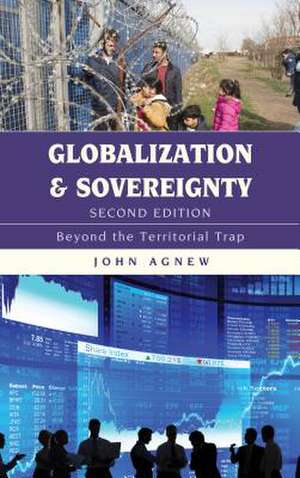
Globalization and Sovereignty: Beyond the Territorial Trap: Globalization
Autor John Agnewen Limba Engleză Paperback – 15 dec 2017
Din seria Globalization
- 25%
 Preț: 220.55 lei
 - 53%
 Preț: 175.09 lei
 - 24%
 Preț: 224.01 lei
 - 25%
 Preț: 219.74 lei
 - 23%
 Preț: 255.81 lei
 -
 Preț: 329.34 lei
 - 23%
 Preț: 257.89 lei
 - 23%
 Preț: 258.70 lei
 - 23%
 Preț: 257.70 lei
 - 16%
 Preț: 224.82 lei
 - 27%
 Preț: 221.03 lei
 - 24%
 Preț: 257.28 lei
 - 23%
 Preț: 256.79 lei
 - 24%
 Preț: 254.41 lei
 - 23%
 Preț: 256.41 lei
 - 23%
 Preț: 257.72 lei
 - 26%
 Preț: 171.25 lei
 - 23%
 Preț: 256.41 lei
 - 25%
 Preț: 221.62 lei
 - 23%
 Preț: 256.31 lei
 -
 Preț: 313.40 lei
 -
 Preț: 332.87 lei
 - 24%
 Preț: 255.50 lei
 - 24%
 Preț: 255.53 lei
 - 30%
 Preț: 576.90 lei
 -
 Preț: 293.54 lei
Preț: 258.39 lei
Preț vechi: 335.97 lei
-23%
Puncte Express: 388
Carte tipărită la comandă
Livrare economică 04-18 decembrie
Livrare prin curier în România Termenul estimat este afișat lângă disponibilitate.
Transport gratuit de la 400.00 lei Plată online sau ramburs, în funcție de opțiunile comenzii.
Retur gratuit în 14 zile Comandă securizată și suport în română.
Specificații
ISBN-13: 9781538105191
ISBN-10: 1538105195
Pagini: 256
Ilustrații: 2 b/w illustrations; 10 maps; 7 tables
Dimensiuni: 150 x 228 x 17 mm
Greutate: 0.43 kg
Ediția:2
Editura: Bloomsbury Publishing
Colecția Rowman & Littlefield
Seria Globalization
Locul publicării:New York, United States
ISBN-10: 1538105195
Pagini: 256
Ilustrații: 2 b/w illustrations; 10 maps; 7 tables
Dimensiuni: 150 x 228 x 17 mm
Greutate: 0.43 kg
Ediția:2
Editura: Bloomsbury Publishing
Colecția Rowman & Littlefield
Seria Globalization
Locul publicării:New York, United States
Cuprins
Preface
Chapter 1: Globalization and State Sovereignty
Chapter 2: Sovereignty Myths and Territorial States
Chapter 3: Sovereignty Regimes
Chapter 4: Sovereignty Regimes at Work
Chapter 5: Conclusion
Index
Chapter 1: Globalization and State Sovereignty
Chapter 2: Sovereignty Myths and Territorial States
Chapter 3: Sovereignty Regimes
Chapter 4: Sovereignty Regimes at Work
Chapter 5: Conclusion
Index
Recenzii
In this wide-ranging, erudite book, one of America's leading geographers has made a signal contribution to the study of sovereignty. . . . An absolute must read for anyone interested in international relations, comparative politics, or political geography. (Previous Edition Praise)
Take back control! Read and digest John Agnew's Globalization and Sovereignty. In this second edition, the pioneer of political geography provides an indispensable guide to the contested contours of both of these slippery terms. If only we can place it in the hands of those who really need it.
John Agnew is among the most important and lucid voices in studies of globalization and the reconfiguration of political space in our twenty-first century. Revealing the limits of our geographical imagination, he frees the discussion of sovereignty from the cage of the nation-state. Globalization and Sovereignty thus provides invaluable insights into the fundamental questions of governance in our contemporary world.
The prominent geographer John Agnew in his new book addresses the old and persistent theme of states versus markets by arguing that state sovereignty has become more complicated rather than being eroded by globalization. . . . This book offers some useful and interesting thoughts about globalization processes.
A persuasive critique of wide-ranging literature on the subject that stands alone for its scholarly sweep and theoretical originality.
Agnew does not give himself to overstatement but proceeds systematically in both synthesizing key elements of the massive bibliography on the two subjects adjoined in his title and launching new paths in the debates on sovereignty and territory in the current phase of globalization. Agnew has emerged as one of the most lucid voices in political geography, globalization, and the reconfiguration of political space in our twenty-first century. By driving home his essential argument that globalization does not mean the end of states, space, or sovereignty but rather a continuity in the overlapping of multiple sovereign spaces, he provides yet another reasoned voice in what appears at times a millenarist frenzy in global studies.
In his book, Globalization and Sovereignty, John Agnew counters [the] notion of the end of geography and proclaims geography's continued significance. . . . Agnew's book most definitely thoroughly and thoughtfully exposes the highly problematic and fairly popular simplistic categorizations of the effect of globalization on state sovereignty.
Exposing the 'myths' that have obscured discussions of states and the relations between them, Agnew is able to offer a fundamental challenge to some of the more problematic diagnoses of the current global condition. Through a historical and political interrogation of the limits of political power, Globalization and Sovereignty provides a powerful account of just what is, and what is not, novel about the age we live in.
This book provides useful, broader context for thinking about how varying regimes of globalization, sovereignty, and state control manifest though divergent bordering policies and practices. It is a very readable and accessible work that helps bridge the theoretical and methodological approaches of political geography and international relations.
John Agnew is among those scholars who have cut a sharp original path across histories and geographies, giving us novel interpretations. This second edition of his influential book is must reading.
The preeminent political geographer John Agnew speaks to historians and social scientists alike. His Globalization and Sovereignty demonstrates how even as global processes intensify, states and nations renew their historic importance.
Take back control! Read and digest John Agnew's Globalization and Sovereignty. In this second edition, the pioneer of political geography provides an indispensable guide to the contested contours of both of these slippery terms. If only we can place it in the hands of those who really need it.
John Agnew is among the most important and lucid voices in studies of globalization and the reconfiguration of political space in our twenty-first century. Revealing the limits of our geographical imagination, he frees the discussion of sovereignty from the cage of the nation-state. Globalization and Sovereignty thus provides invaluable insights into the fundamental questions of governance in our contemporary world.
The prominent geographer John Agnew in his new book addresses the old and persistent theme of states versus markets by arguing that state sovereignty has become more complicated rather than being eroded by globalization. . . . This book offers some useful and interesting thoughts about globalization processes.
A persuasive critique of wide-ranging literature on the subject that stands alone for its scholarly sweep and theoretical originality.
Agnew does not give himself to overstatement but proceeds systematically in both synthesizing key elements of the massive bibliography on the two subjects adjoined in his title and launching new paths in the debates on sovereignty and territory in the current phase of globalization. Agnew has emerged as one of the most lucid voices in political geography, globalization, and the reconfiguration of political space in our twenty-first century. By driving home his essential argument that globalization does not mean the end of states, space, or sovereignty but rather a continuity in the overlapping of multiple sovereign spaces, he provides yet another reasoned voice in what appears at times a millenarist frenzy in global studies.
In his book, Globalization and Sovereignty, John Agnew counters [the] notion of the end of geography and proclaims geography's continued significance. . . . Agnew's book most definitely thoroughly and thoughtfully exposes the highly problematic and fairly popular simplistic categorizations of the effect of globalization on state sovereignty.
Exposing the 'myths' that have obscured discussions of states and the relations between them, Agnew is able to offer a fundamental challenge to some of the more problematic diagnoses of the current global condition. Through a historical and political interrogation of the limits of political power, Globalization and Sovereignty provides a powerful account of just what is, and what is not, novel about the age we live in.
This book provides useful, broader context for thinking about how varying regimes of globalization, sovereignty, and state control manifest though divergent bordering policies and practices. It is a very readable and accessible work that helps bridge the theoretical and methodological approaches of political geography and international relations.
John Agnew is among those scholars who have cut a sharp original path across histories and geographies, giving us novel interpretations. This second edition of his influential book is must reading.
The preeminent political geographer John Agnew speaks to historians and social scientists alike. His Globalization and Sovereignty demonstrates how even as global processes intensify, states and nations renew their historic importance.