Globalization and War: Globalization
Autor Tarak Barkawien Limba Engleză Paperback – 28 iul 2005
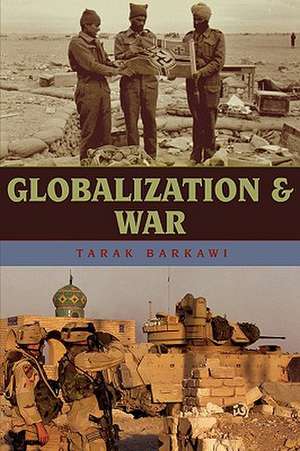
Speaking from the heart of old and new imperial orders, Tarak Barkawi exposes the Eurocentric limitations of military history and highlights the imperial dimensions of modern warfare. Britain, India, and the colonial Indian army exemplify the intertwined, global histories illuminated by attention to globalization and war. Around the world, geographies and wars are imagined differently. Cultural approaches to globalization show how popular consciousness of the world often takes military and warlike form, and how militaries spawn hybrid "traveling cultures" wherever they go.
Finally, Barkawi examines the contemporary "war on terror" using historical and non-Eurocentric globalizations to clarify the politics and strategies involved in the purported 'clash of civilizations'. Adding a new layer of understanding, he looks at the globalization of the Israeli-Palestinian conflict and the intensifying "Israelization" of the United States.
Din seria Globalization
- 25%
 Preț: 220.55 lei
 - 53%
 Preț: 174.99 lei
 - 24%
 Preț: 224.01 lei
 - 25%
 Preț: 219.74 lei
 - 23%
 Preț: 255.81 lei
 -
 Preț: 329.34 lei
 - 23%
 Preț: 257.89 lei
 - 23%
 Preț: 258.39 lei
 - 23%
 Preț: 258.70 lei
 - 23%
 Preț: 257.70 lei
 - 16%
 Preț: 224.82 lei
 - 27%
 Preț: 221.03 lei
 - 24%
 Preț: 257.28 lei
 - 23%
 Preț: 256.79 lei
 - 24%
 Preț: 254.41 lei
 - 23%
 Preț: 256.41 lei
 - 23%
 Preț: 257.72 lei
 - 26%
 Preț: 171.25 lei
 - 23%
 Preț: 256.41 lei
 - 25%
 Preț: 221.62 lei
 - 23%
 Preț: 256.31 lei
 -
 Preț: 313.40 lei
 -
 Preț: 332.87 lei
 - 24%
 Preț: 255.53 lei
 - 30%
 Preț: 576.90 lei
 -
 Preț: 293.54 lei
Preț: 255.50 lei
Preț vechi: 334.20 lei
-24%
Puncte Express: 383
Carte tipărită la comandă
Livrare economică 21 noiembrie-05 decembrie
Livrare prin curier în România Termenul estimat este afișat lângă disponibilitate.
Transport gratuit de la 400.00 lei Plată online sau ramburs, în funcție de opțiunile comenzii.
Retur gratuit în 14 zile Comandă securizată și suport în română.
Specificații
ISBN-13: 9780742537019
ISBN-10: 0742537013
Pagini: 199
Dimensiuni: 190 x 227 x 12 mm
Greutate: 0.3 kg
Editura: Bloomsbury Publishing
Colecția Rowman & Littlefield
Seria Globalization
Locul publicării:New York, United States
ISBN-10: 0742537013
Pagini: 199
Dimensiuni: 190 x 227 x 12 mm
Greutate: 0.3 kg
Editura: Bloomsbury Publishing
Colecția Rowman & Littlefield
Seria Globalization
Locul publicării:New York, United States
V-ar putea interesa
-
 Regarding the Pain of OthersSusan Sontag-27%Preț: 61.36 lei84.37 lei
 -
 SlaveryStanley Engerman-18%Preț: 345.22 lei421.59 lei
 -
 -24%Preț: 565.07 lei746.00 lei
 -
 The Slave's Cause: A History of AbolitionManisha SinhaPreț: 178.71 lei
 -
 Ill Effects: The Media Violence DebateMartin BarkerPreț: 397.12 lei
 -
 Fieldwork Under FireCarolyn NordstromPreț: 272.06 lei
 -
 Life and WordsVeena DasPreț: 251.87 lei
 -
 Bullying at SchoolDan Olweus-5%Preț: 200.38 lei210.92 lei
 -
 From God's Monster To The Devil's AngelPacc ButlerPreț: 79.43 lei
 -
 Preț: 420.32 lei
 -
 States of DenialStanley CohenPreț: 170.01 lei
 -
 -64%Preț: 36.67 lei102.04 lei
 -
 The Deepest SouthGerald HornePreț: 294.46 lei
 -
 GuvnorsMichael Francis-19%Preț: 40.53 lei49.96 lei
 -
 The Insanity of NormalityArno GruenPreț: 96.19 lei
 -
 -27%Preț: 68.39 lei93.16 lei
 -
 Born Fi' DeadLaurie GunstPreț: 77.24 lei
 -
 Desert ChildrenWaris Dirie-28%Preț: 65.67 lei91.20 lei
Cuprins
Chapter 1 The False Dawn of 'Globalization' Chapter 2 Behind 'Globalization:' Nation-States, Empires, and Democracies at War Chapter 3 Globalization and War: Britian, India, and the Indian Army Chapter 4 War and Culture in Global Context Chapter 5 'Terror' and the Politics of Global War Chapter 6 Afterword
Recenzii
Tarak Barkawi's rewarding study brings together two usually separate lines of investigation, enabling us to think differently about both war and globalization. This book shows how much historical sociology and international relations have to offer each other.
If globalization is about the circulation of people, goods, and ideas, then warfare, not trade, has been its principal vehicle. Starting from this assumption, Barkawi examines India's participation in two world wars to shed important light on this neglected but critically important dimension of globalization. His case studies form the basis of a 'war and society' approach to globalization that has a lot to tell us about current dilemmas and choices, including the problem of terrorism.
Barkawi's brilliant analysis upends conventional ways of thinking about the relationship between 'war' and 'globalization'-of war as a historically important globalizing force, and globalization as a violent process that often is implemented through war. Lucidly written and compellingly argued, this book is a call for sanity in the conceptual murkiness and Orwellian doublespeak of the 'war on terror.'
Luminous in its sweep and fascinating in the range of its historical detail, this book exposes the deepest shibboleths about globalization and war. If you thought that globalization led away from war or that liberals have traditionally been antiwar, you will learn a lot from Tarak Barkawi. Globalization, he tells us, is war.
Accessibly written, the book is full of historical examples which are used to problematise popular and academic images of social reality. . . . It makes a vital ontological assertion about the importance of inter-societal relations for understanding socio-historical phenomena and it provides many empirical examples to illustrate the point.
Tarak Barkawi's important book on globalization situates the discourse of the past fifteen years in an historically informed framework that illustrates how often conflict and war have been handmaidens of the spread of global capital. His fine book is a cogent critique of the widespread assumption that the more free trade and democracy we have, the more peace we will have in the world. Instead, he argues that war itself is a globalizing force. One need go no further than the American war in Iraq to see that premise in action.
If globalization is about the circulation of people, goods, and ideas, then warfare, not trade, has been its principal vehicle. Starting from this assumption, Barkawi examines India's participation in two world wars to shed important light on this neglected but critically important dimension of globalization. His case studies form the basis of a 'war and society' approach to globalization that has a lot to tell us about current dilemmas and choices, including the problem of terrorism.
Barkawi's brilliant analysis upends conventional ways of thinking about the relationship between 'war' and 'globalization'-of war as a historically important globalizing force, and globalization as a violent process that often is implemented through war. Lucidly written and compellingly argued, this book is a call for sanity in the conceptual murkiness and Orwellian doublespeak of the 'war on terror.'
Luminous in its sweep and fascinating in the range of its historical detail, this book exposes the deepest shibboleths about globalization and war. If you thought that globalization led away from war or that liberals have traditionally been antiwar, you will learn a lot from Tarak Barkawi. Globalization, he tells us, is war.
Accessibly written, the book is full of historical examples which are used to problematise popular and academic images of social reality. . . . It makes a vital ontological assertion about the importance of inter-societal relations for understanding socio-historical phenomena and it provides many empirical examples to illustrate the point.
Tarak Barkawi's important book on globalization situates the discourse of the past fifteen years in an historically informed framework that illustrates how often conflict and war have been handmaidens of the spread of global capital. His fine book is a cogent critique of the widespread assumption that the more free trade and democracy we have, the more peace we will have in the world. Instead, he argues that war itself is a globalizing force. One need go no further than the American war in Iraq to see that premise in action.