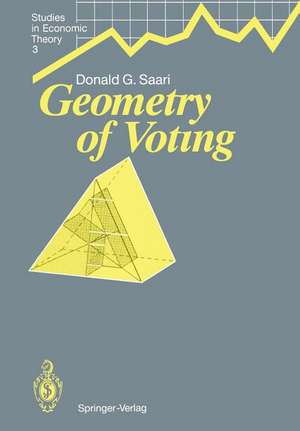
Geometry of Voting: Studies in Economic Theory, cartea 3
Autor Donald G. Saarien Limba Engleză Paperback – 18 apr 2012
Din seria Studies in Economic Theory
- 18%
 Preț: 920.88 lei
 -
 Preț: 379.71 lei
 - 18%
 Preț: 915.58 lei
 -
 Preț: 374.30 lei
 - 15%
 Preț: 612.60 lei
 - 15%
 Preț: 629.48 lei
 -
 Preț: 371.73 lei
 - 18%
 Preț: 1210.53 lei
 - 18%
 Preț: 1192.79 lei
 - 15%
 Preț: 619.12 lei
 - 15%
 Preț: 619.61 lei
 - 15%
 Preț: 622.78 lei
 - 15%
 Preț: 619.09 lei
 - 15%
 Preț: 619.91 lei
 - 15%
 Preț: 620.86 lei
 - 18%
 Preț: 918.30 lei
 - 15%
 Preț: 618.19 lei
 - 18%
 Preț: 914.06 lei
 - 15%
 Preț: 615.02 lei
 - 18%
 Preț: 994.55 lei
 - 15%
 Preț: 616.45 lei
 - 15%
 Preț: 630.92 lei
 -
 Preț: 386.89 lei
 - 18%
 Preț: 917.56 lei
 - 15%
 Preț: 612.36 lei
 - 18%
 Preț: 925.75 lei
 - 15%
 Preț: 627.14 lei
Preț: 623.05 lei
Preț vechi: 733.00 lei
-15%
Puncte Express: 935
Carte tipărită la comandă
Livrare economică 21 iulie-04 august
Livrare prin curier în România Termenul estimat este afișat lângă disponibilitate.
Transport gratuit pentru acest produs Plată online sau ramburs, în funcție de opțiunile comenzii.
Retur gratuit în 14 zile Comandă securizată și suport în română.
Specificații
ISBN-13: 9783642486463
ISBN-10: 3642486460
Pagini: 396
Ilustrații: XVII, 372 p.
Dimensiuni: 170 x 244 x 21 mm
Greutate: 0.63 kg
Ediția:Softcover reprint of the original 1st ed. 1994
Editura: Springer Berlin, Heidelberg
Colecția Springer
Seria Studies in Economic Theory
Locul publicării:Berlin, Heidelberg, Germany
ISBN-10: 3642486460
Pagini: 396
Ilustrații: XVII, 372 p.
Dimensiuni: 170 x 244 x 21 mm
Greutate: 0.63 kg
Ediția:Softcover reprint of the original 1st ed. 1994
Editura: Springer Berlin, Heidelberg
Colecția Springer
Seria Studies in Economic Theory
Locul publicării:Berlin, Heidelberg, Germany
V-ar putea interesa
-
 An Introduction to Auction TheoryFlavio M. Menezes-14%Preț: 378.68 lei441.57 lei
 -
 Principled Agents?: The Political Economy of Good GovernmentTimothy Besley-14%Preț: 285.19 lei331.77 lei
 -
 Capabilities and HappinessLuigino Bruni-27%Preț: 889.11 lei1218.29 lei
 -
 -17%Preț: 67.23 lei81.04 lei
 -
 A Course in Behavioral EconomicsErik AngnerPreț: 228.44 lei
 -
 Handbook of Antitrust EconomicsPaolo BuccirossiPreț: 555.58 lei
 -
 The Philosophy of EconomicsDaniel M. HausmanPreț: 380.26 lei
 -
 Theory of Decision Under UncertaintyItzhak GilboaPreț: 273.97 lei
 -
 Let Them Eat Junk: How Capitalism Creates Hunger and ObesityRobert AlbrittonPreț: 221.23 lei
 -
 Essays on Capital & Interest: An Austrian PerspectiveIsreal M KirznerPreț: 104.88 lei
 -
 On CompetitionMichael E. PorterPreț: 266.98 lei
 -
 False DawnJohn GrayPreț: 78.67 lei
 -
 The Reformation in EconomicsPhilip PilkingtonPreț: 346.04 lei
 -
 Handbook of New Institutional EconomicsClaude Ménard-18%Preț: 728.59 lei888.52 lei
 -
 Economic DynamicsGiancarlo Gandolfo-18%Preț: 951.31 lei1160.14 lei
Public țintă
ResearchCuprins
I. From an Election Fable to Election Procedures.- 1.1 An Electoral Fable.- 1.2 The Moral of the Tale.- 1.3 From Aristotle to “Fast Eddie”.- 1.4 What Kind of Geometry.- II. Geometry for Positional and Pairwise Voting.- 2.1 Ranking Regions.- 2.2 Profiles and Election Mappings.- 2.3 Positional Voting Methods.- 2.4 What a Difference a Procedure Makes; Several Different Outcomes.- 2.5 Why Can’t an Organization Be More Like a Person?.- 2.6 Positional Versus Pairwise Voting.- III. From Symmetry to the Borda Count and Other Procedures.- 3.1 Symmetry.- 3.2 From Aggregating Pairwise Votes to the Borda Count.- 3.3 The Other Positional Voting Methods.- 3.4 Multiple Voting Schemes.- 3.5 Other Election Procedures.- IV. Many Profiles; Many New Paradoxes.- 4.1 Weak Consistency: The Sum of the Parts.- 4.2 From Involvement and Monotonicity to Manipulation.- 4.3 Proportional Representation.- 4.4 Arrow’s Theorem.- 4.5 Characterizations of Scoring, Positional and Borda.- Notes.- References.