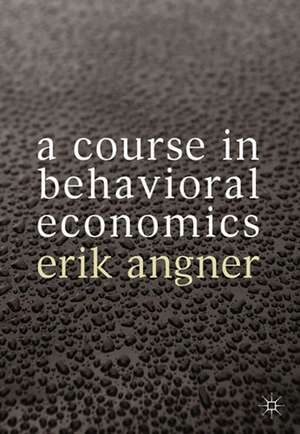
A Course in Behavioral Economics
Autor Erik Angneren Limba Engleză Paperback – 31 mar 2012
Recomandăm A Course in Behavioral Economics studenților MBA, economiștilor și consultanților care doresc să înțeleagă mecanismele psihologice din spatele deciziilor umane. Putem afirma că lucrarea lui Erik Angner reușește o performanță rară: transformarea unei discipline academice complexe într-un set de instrumente pragmatice pentru mediul de afaceri și politici publice. Ca și Nick Wilkinson în An Introduction to Behavioral Economics, autorul distilează experiență reală în principii acționabile, însă Erik Angner pune un accent deosebit pe claritatea intuitivă, eliminând bariera matematicii avansate.
Ne-a atras atenția structura riguroasă a cursului, care ghidează cititorul de la fundamentele alegerii raționale și utilității, către complexitatea erorilor cognitive. Primele capitole stabilesc cadrul teoretic al preferințelor, pentru ca ulterior textul să exploreze fenomene precum aversiunea față de pierdere, efectul de ancorare și costurile nerecuperabile (sunk costs). Această ediție aduce în plus o analiză actualizată a politicilor de tip „nudge” și, în premieră, o secțiune dedicată economiei fericirii. Spre deosebire de lucrarea sa anterioară, Hayek and Natural Law, unde Erik Angner explora filosofia politică și istoria gândirii economice, acest volum este orientat decisiv spre aplicabilitate imediată. Este un parcurs metodic care explică nu doar cum decidem, ci și ce anume transformă o decizie într-una eficientă sau, dimpotrivă, deficitară în contextul pieței actuale.
Preț: 228.44 lei
Carte disponibilă
Livrare economică 13-18 noiembrie
Specificații
ISBN-10: 0230304540
Pagini: 272
Dimensiuni: 171 x 246 x 17 mm
Greutate: 0.54 kg
Editura: MACMILLAN EDUCATION
Locul publicării:Basingstoke, United Kingdom
V-ar putea interesa
-
 Predictably IrrationalDan ArielyPreț: 79.92 lei
 -
 Thinking, Fast and SlowDaniel Kahneman-27%Preț: 90.79 lei123.57 leiRecomandat
 -
 On the EdgeNate SilverPreț: 109.29 lei
 -
 Choice Theory: A Very Short IntroductionMichael Allingham-20%Preț: 57.15 lei71.12 lei
 -
 Microeconomic TheoryAndreu Mas-Colell-27%Preț: 1005.20 lei1376.99 lei
 -
 Behavioural Economics: A Very Short IntroductionMichelle Baddeley-19%Preț: 57.43 lei71.28 lei
 -
 -16%Preț: 180.62 lei215.17 lei
 -
 You Already KnowLaura HuangPreț: 122.17 lei
 -
 The Winner's CurseRichard H. ThalerPreț: 224.87 lei
 -
 MisbehavingRichard H. Thaler-29%Preț: 66.89 lei94.27 lei
 -
 Misbehaving : The Making of Behavioral EconomicsRichard H ThalerPreț: 215.85 lei
 -
 An Introduction to Behavioral EconomicsNick Wilkinson-21%Preț: 402.43 lei510.27 lei
 -
 Rational Choice in an Uncertain WorldReid Hastie-23%Preț: 924.66 lei1200.86 lei
 -
 Games, Strategies, and Decision MakingJoseph Harrington-40%Preț: 535.43 lei890.43 lei
 -
 Microeconomics and Behaviour, 4eRobert Frank-26%Preț: 431.05 lei586.35 lei
 -
 10 to 25David YeagerPreț: 94.46 lei
 -
 -14%Preț: 60.74 lei70.27 lei
 -
 The Winner's CurseRichard H ThalerPreț: 178.78 lei
 -
 An Introduction to Cognitive EconomicsAndrew CaplinPreț: 240.61 lei
De ce să citești această carte
Această carte este esențială pentru profesioniștii care vor să înțeleagă de ce clienții sau partenerii de afaceri iau decizii aparent iraționale. Cititorul va câștiga un avantaj competitiv învățând să identifice erorile cognitive și să aplice principiile economiei comportamentale pentru a optimiza strategiile de marketing, management și politici organizaționale. Este un ghid practic care transformă teoria în rezultate concrete.
Despre autor
Erik Angner este profesor de filosofie practică la Universitatea din Stockholm, unde coordonează programul de Filosofie, Politică și Economie (PPE). Cu o pregătire academică de excepție, acesta deține două titluri de doctor, în Economie și în Istoria și Filosofia Științei, ambele obținute la Universitatea din Pittsburgh. Expertiza sa vastă se reflectă în numeroase articole de specialitate despre economia experimentală și fericire. Locuiește în Stockholm și este recunoscut la nivel internațional pentru capacitatea de a face legătura între rigoarea științifică și aplicabilitatea practică a economiei în viața de zi cu zi.
Descriere
Available to lecturers: access to an Instructor's Manual at www.palgrave.com/economics/angner, containing sample syllabi, an instructor guide, sample handouts and examinations, and PowerPoint slides.
Cuprins
INTRODUCTION
1 Introduction
1.1 What is this book?
1.2 The origins of behavioral economics
1.3 Methods
1.4 Looking ahead
I CHOICE UNDER CERTAINTY
2 Rational Choice Under Certainty
2.1 Introduction
2.2 Preferences
2.3 Rational preferences
Box: Logical symbols
2.4 Indifference and strict preference
Box: How to do proofs
2.5 Preference orderings
2.6 Choice under certainty
2.7 Utility
Box: A final word about proofs
2.8 Discussion
3 Decision-making Under Certainty
3.1 Introduction
3.2 Opportunity costs
3.3 Sunk costs
3.4 Menu dependence and the decoy effect
3.5 Loss aversion and the endowment effect
3.6 Anchoring and adjustment
3.7 Discussion
II JUDGMENT UNDER RISK AND UNCERTAINTY
4 Probability Judgment
4.1 Introduction
4.2 Fundamentals of probability theory
4.3 Unconditional probability
Box: Odds
4.4 Conditional probability
4.5 Total probability and Bayes's rule
4.6 Bayesian updating
4.7 Discussion
5 Judgment Under Risk and Uncertainty
5.1 Introduction
5.2 The gambler's fallacy
5.3 Conjunction and disjunction fallacies
5.4 Base-rate neglect
5.5 Confirmation bias
5.6 Availability
5.7 Discussion
III CHOICE UNDER RISK AND UNCERTAINTY
6 Rational Choice Under Risk and Uncertainty
6.1 Introduction
6.2 Uncertainty
6.3 Expected value
6.4 Expected utility
6.5 Attitudes toward risk
6.6 Discussion
7 Decision-Making under Risk and Uncertainty
7.1 Introduction
7.2 Framing effects in decision-making under risk
7.3 Bundling and mental accounting
7.4 The Allais problem and the sure-thing principle
7.5 The Ellsberg problem and ambiguity aversion
7.6 Probability weighting
7.7 Discussion
IV INTERTEMPORAL CHOICE
8 The Discounted Utility Model
8.1 Introduction
8.2 Interest rates
8.3 Exponential discounting
Box: Discount rates
8.4 Discussion
9 Intertemporal Choice
9.1 Introduction
9.2 Hyperbolic discounting
9.3 Choosing not to choose
9.4 Preferences over profiles
9.5 Discussion
V STRATEGIC INTERACTION
10 Analytical Game Theory
10.1 Introduction
10.2 Nash equilibrium in pure strategies
10.3 Nash equilibrium in mixed strategies
10.4 Equilibrium refinements
10.5 Discussion
11 Behavioral Game Theory
11.1 Introduction
11.2 Social preferences: altruism, envy, fairness, and justice
11.3 Intentions, reciprocity, and trust
11.4 Limited strategic thinking
11.5 Discussion
VI CONCLUDING REMARKS
12 General Discussion
12.1 Introduction
12.2 Behavioral welfare economics
12.3 Assessing behavioral economics
12.4 Conclusion
Answer Key
Bibliography
Index
Recenzii
'''A course in Behavioral Economics' guides the reader to develop their own understanding of behavioral economics through contrasting it against the foundations of neoclassical theory. The textbook will appeal to all: the instructor will appreciate the cohesion and brevity of explanations, the critical reader will be rewarded by the thought-provoking exercises embedded into the text, the interested researcher will be delighted to find the 'Further reading' section – a significant upgrade from the traditional reference list.'' Natalia V. Czap, Department of Social Sciences, University of Michigan-Dearborn, USA
"The author did an excellent job by writing a highly-needed comprehensive textbook on behavioral economics that can very well be used for teaching undergraduates. The book covers individual decision-making as well as strategic decision-making, is well-structured, and contains many exercises." Kirsten I.M. Rohde, Erasmus School of Economics, Erasmus University Rotterdam, The Netherlands
"Angner has done an outstanding job of introducing the field of behavioral economics with this very well-written and extremely fun-to-read book. With its compare-and-contrast approach, this book will appeal not only to students interested in exploring behavioral economics, but also to the devout followers of mainstream economics." Elif Incekara-Hafalir, Tepper School of Business, Carnegie Mellon University, USA
"One of the very first textbooks on behavioral economics! An excellent introduction that is accessible to economics and non-economics undergraduates alike. Covers all major topics in this increasingly influential field." Dan Benjamin, Economics Department, Cornell University, USA
''This is a superb introduction to behavioral economics. Angner skillfully balances rigor, accessibility and humor to produce a book that is as enjoyable to teach from as it is to read.'' Jonathan Lafky, Economics Department, Lafayette College, USA
'Erik Angner has provided the ideal textbook for an introductory course in behavioral economics. It is comprehensive, rigourous, and accessible. It is rich with examples and exercises and it conveys the essence of behavioral economics by contrasting it with standard economic theory. This book makes behavioral economics more easy to teach and more fun to learn.' Jan Potters, Department of Economics, Tilburg University, The Netherlands
"Erik Angner's textbook is both exact and entertaining. Not compromising on properly introducing mainstream decision theory, the author demonstrates how certain behavioral regularities pose a serious challenge to it. Importantly, the reader is left with a good basis for solving their own behavioral puzzles rather than merely with a collection offered by the author. The text is suitable both as a starting point for a behaviorally-minded microeconomics course, as well as an introduction into the field of behavioral economics." Jana Vyrastekova, Economics Department, Nijmegen School of Management, University of Nijmegen, The Netherlands
"This is an excellent introductory textbook that fills an important niche. It discusses the history and methodology of behavioral economics and covers the most important research topics in an engaging way. To illustrate challenging concepts and ideas, the text includes intuitive examples ranging from the importance of your wingman's attractiveness through reasons for becoming a drug addict or curiosity about your colleague's salary. In the preface, Erik Angner writes: '[This is] the book I wish I had had as a student and the book that I want to use as a teacher.' I could not agree more!" Maroš Servátka, New Zealand Experimental Economics Laboratory, Department of Economics and Finance, University of Canterbury, New Zealand
Notă biografică
Caracteristici
Explains orthodox neoclassical theory in each section andexpandsby discussingbehavioral models
Works from a very basic understanding of microeconomics fundamentals and does not assume any knowledge of calculus or statistics
Uses many illustrations, examples, and exercises to illustrate the theory