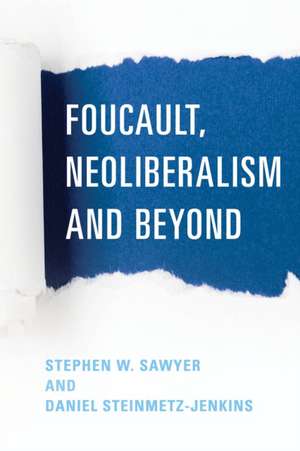
Foucault, Neoliberalism, and Beyond: Rowman & Littlefield Publishers
Editat de Stephen W. Sawyer, Daniel Steinmetz-Jenkinsen Limba Engleză Hardback – 30 apr 2019
Din seria Rowman & Littlefield Publishers
-
 Preț: 113.82 lei
 - 13%
 Preț: 155.38 lei
 -
 Preț: 109.93 lei
 - 20%
 Preț: 370.93 lei
 - 19%
 Preț: 323.76 lei
 - 26%
 Preț: 223.03 lei
 - 19%
 Preț: 321.01 lei
 - 21%
 Preț: 307.35 lei
 - 21%
 Preț: 186.50 lei
 - 24%
 Preț: 255.02 lei
 - 16%
 Preț: 109.26 lei
 - 31%
 Preț: 351.69 lei
 - 15%
 Preț: 127.13 lei
 - 23%
 Preț: 320.61 lei
 - 19%
 Preț: 324.21 lei
 - 30%
 Preț: 355.24 lei
 - 23%
 Preț: 258.39 lei
 -
 Preț: 400.51 lei
 - 23%
 Preț: 275.97 lei
 - 24%
 Preț: 275.28 lei
 - 31%
 Preț: 351.50 lei
 - 22%
 Preț: 323.28 lei
 - 32%
 Preț: 373.39 lei
 - 34%
 Preț: 842.33 lei
 - 19%
 Preț: 314.30 lei
 - 23%
 Preț: 354.68 lei
 - 21%
 Preț: 128.84 lei
 - 30%
 Preț: 774.75 lei
 - 23%
 Preț: 278.65 lei
 - 23%
 Preț: 259.97 lei
 - 19%
 Preț: 344.02 lei
 - 32%
 Preț: 594.45 lei
 - 31%
 Preț: 566.85 lei
 - 22%
 Preț: 358.54 lei
 - 19%
 Preț: 322.03 lei
 - 16%
 Preț: 148.06 lei
 - 22%
 Preț: 360.79 lei
 - 19%
 Preț: 323.37 lei
 - 31%
 Preț: 414.61 lei
 - 25%
 Preț: 344.18 lei
 - 30%
 Preț: 703.64 lei
 - 14%
 Preț: 152.49 lei
 - 30%
 Preț: 827.47 lei
 - 19%
 Preț: 316.66 lei
 - 23%
 Preț: 276.77 lei
 - 29%
 Preț: 709.89 lei
 - 23%
 Preț: 262.16 lei
 - 19%
 Preț: 335.82 lei
Preț: 721.80 lei
Preț vechi: 1094.57 lei
-34%
Puncte Express: 1083
Carte tipărită la comandă
Livrare economică 20 noiembrie-04 decembrie
Livrare prin curier în România Termenul estimat este afișat lângă disponibilitate.
Transport gratuit pentru acest produs Plată online sau ramburs, în funcție de opțiunile comenzii.
Retur gratuit în 14 zile Comandă securizată și suport în română.
Specificații
ISBN-13: 9781786603760
ISBN-10: 1786603764
Pagini: 240
Ilustrații: 1 tables;
Dimensiuni: 154 x 232 x 20 mm
Greutate: 0.5 kg
Editura: Bloomsbury Publishing
Colecția Rowman & Littlefield
Seria Rowman & Littlefield Publishers
Locul publicării:New York, United States
ISBN-10: 1786603764
Pagini: 240
Ilustrații: 1 tables;
Dimensiuni: 154 x 232 x 20 mm
Greutate: 0.5 kg
Editura: Bloomsbury Publishing
Colecția Rowman & Littlefield
Seria Rowman & Littlefield Publishers
Locul publicării:New York, United States
V-ar putea interesa
-
 -27%Preț: 498.21 lei679.45 lei
 -
 Preț: 298.99 lei
 -
 Dismantling America: and other controversial essaysThomas Sowell-27%Preț: 165.56 lei226.81 lei
 -
 BlasphemyAlan DershowitzPreț: 91.61 lei
 -
 Intellectual Life of Edmund BurkeDavid BromwichPreț: 301.61 lei
 -
 Preț: 71.33 lei
 -
 Conservatism Revisited: The Revolt Against IdeologyPeter ViereckPreț: 473.71 lei
 -
 Men Versus the Man: Socialism Versus IndividualismH. L. MenckenPreț: 104.31 lei
 -
 -14%Preț: 104.65 lei121.57 lei
 -
 Preț: 98.08 lei
 -
 Russell Kirk's Concise Guide to ConservatismRussell KirkPreț: 87.01 lei
 -
 The History of European Conservative ThoughtFrancesco Giubilei-19%Preț: 137.94 lei170.45 lei
 -
 HOW?: No Labels Answers The Most Important Question Of the 2016 ElectionNo Labels FoundationPreț: 69.74 lei
 -
 Egypt and the Contradictions of LiberalismDalia F Fahmy-11%Preț: 207.20 lei231.97 lei
 -
 Alt-AmericaDavid NeiwertPreț: 87.11 lei
 -
 Political RacismMartin ShawPreț: 174.60 lei
 -
 -8%Preț: 151.86 lei165.71 lei
 -
 -15%Preț: 567.13 lei667.21 lei
Descriere
Few philosophers have garnered as much attention globally as Michel Foucault. But even within this wide reception, the consideration given to his relationship to neoliberalism has been noteworthy. However, the debate over this relationship has given rise to a great deal of polemics and confusion.
This volume brings together leading figures in the field to provide a reliable guide to one of the most controversial subjects in recent continental thought. It puts across the case for Foucault's importance for post-colonial, race, queer and feminist studies, among other areas, and opens up his relationship to neoliberalism to offer a broader picture of tensions brewing within the left more generally.
This volume brings together leading figures in the field to provide a reliable guide to one of the most controversial subjects in recent continental thought. It puts across the case for Foucault's importance for post-colonial, race, queer and feminist studies, among other areas, and opens up his relationship to neoliberalism to offer a broader picture of tensions brewing within the left more generally.
Cuprins
Introduction: Stephen Sawyer and Daniel Steinmetz-Jenkins
Chapter 1: Michael C. Behrent, Neoliberalism: The Highest Stage of Anti-Humanism?
Chapter 2: Serge Audier, Is Foucault a Good Guide for Understanding, Critiquing and Combatting Neoliberalism?
Chapter 3: Daniel Zamora, Finding a "Left Governmentality": Foucault's Last Decade
Chapter 4: Aner Barzilay, Rereading the Birth of Biopolitics in Light of Foucault's Early Reading of Marx
Chapter 5: Dotan Leshem, Foucault, Genealogy, Critique
Chapter 6: Duncan Kelly, Michel Foucault on Phobie d'État and Neoliberalism
Chapter 7: Claudia Castiglioni, Foucault, Neoliberalism, and the Iranian Revolution
Chapter 8: Luca Paltrinieri, Neoliberal Selves: Human Capital Between Bourdieu and Foucault
Chapter 9: Judith Revel, Not Fostering Life, and Leaving to Die
Index
Chapter 1: Michael C. Behrent, Neoliberalism: The Highest Stage of Anti-Humanism?
Chapter 2: Serge Audier, Is Foucault a Good Guide for Understanding, Critiquing and Combatting Neoliberalism?
Chapter 3: Daniel Zamora, Finding a "Left Governmentality": Foucault's Last Decade
Chapter 4: Aner Barzilay, Rereading the Birth of Biopolitics in Light of Foucault's Early Reading of Marx
Chapter 5: Dotan Leshem, Foucault, Genealogy, Critique
Chapter 6: Duncan Kelly, Michel Foucault on Phobie d'État and Neoliberalism
Chapter 7: Claudia Castiglioni, Foucault, Neoliberalism, and the Iranian Revolution
Chapter 8: Luca Paltrinieri, Neoliberal Selves: Human Capital Between Bourdieu and Foucault
Chapter 9: Judith Revel, Not Fostering Life, and Leaving to Die
Index
Recenzii
This collection of nine essays examines Michel Foucault's "neoliberalism" as expressed in his late 1970s Collège de France Birth of Biopolitics lectures. The contributing scholars offer various interpretations regarding Foucault's critical consideration of neoliberalism, and their essays illustrate Foucault's analytical, thought-provoking ambiguity. Claudia Castiglione reminds readers that Foucault "never hid his discomfort toward conventional answers and never ceased to search for alternative ones." Michael Behrent writes, "If Foucault was a liberal, it was despite himself: his liberalism was not one of self-identification or political affiliation; it was, rather, an élan implicit in his concepts and arguments." Daniel Zamora views Foucault's neoliberal study as a means to "rethink resistance" and be "less governed." "Pushing beyond" (editors' italics) whether Foucault was a neoliberal, the volume presents "two key ambitions: to provide a more nuanced perspective on this key movement in the history of ideas and in so doing, uncover new interpretations, analyses, or applications of Foucault's work." The contributors impressively pursue those ambitions. Readers well-versed in Foucault's evolving thought will find the collection particularly accessible and valuable. This book deserves inclusion in university libraries.
Summing Up: Recommended. Upper-division undergraduates through faculty.
This volume dismantles any simple link between Foucault and neoliberalism, leaving us with parts for reassembly into politics of our own.
Foucault's lectures on liberal and neoliberal governmentality at the end of the 1970s have provoked multiple controversies over the evolution of his thought and politics. This excellent collection of essays provides a wealth of historical detail and analysis that helps to situate these lectures in relation to their time and to the trajectory and sources of his thought. This book is indispensable for an informed appreciation of Foucault's work during this period and its relation to a key moment in French and global history.
In recent political debate, the question of Michel Foucault's notoriously ambiguous relationship to neoliberalism has become a cypher for all kinds of contemporary preoccupations on the left. But do we really know what Foucault was responding to? This volume performs the immensely valuable work of historicizing Foucault's relationship to Marxism, neoliberalism and the so-called second left. Making no attempt to definitively resolve the question of Foucault's political sympathies, the papers in this volume meticulously document the unique political challenges of the late 1970s and manage to be all the more illuminating about our contemporary predicament. This brilliant volume will transform the tenor of contemporary debate around Foucault, neoliberalism, and the revolutionary left.
Summing Up: Recommended. Upper-division undergraduates through faculty.
This volume dismantles any simple link between Foucault and neoliberalism, leaving us with parts for reassembly into politics of our own.
Foucault's lectures on liberal and neoliberal governmentality at the end of the 1970s have provoked multiple controversies over the evolution of his thought and politics. This excellent collection of essays provides a wealth of historical detail and analysis that helps to situate these lectures in relation to their time and to the trajectory and sources of his thought. This book is indispensable for an informed appreciation of Foucault's work during this period and its relation to a key moment in French and global history.
In recent political debate, the question of Michel Foucault's notoriously ambiguous relationship to neoliberalism has become a cypher for all kinds of contemporary preoccupations on the left. But do we really know what Foucault was responding to? This volume performs the immensely valuable work of historicizing Foucault's relationship to Marxism, neoliberalism and the so-called second left. Making no attempt to definitively resolve the question of Foucault's political sympathies, the papers in this volume meticulously document the unique political challenges of the late 1970s and manage to be all the more illuminating about our contemporary predicament. This brilliant volume will transform the tenor of contemporary debate around Foucault, neoliberalism, and the revolutionary left.