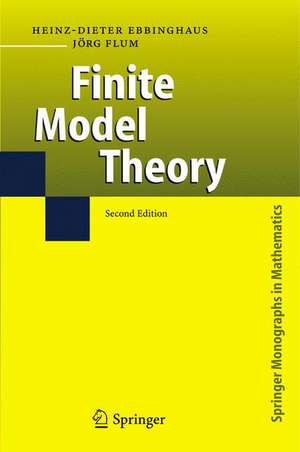
Finite Model Theory: Second Edition: Springer Monographs in Mathematics
Autor Heinz-Dieter Ebbinghaus, Jörg Flumen Limba Engleză Hardback – 6 oct 2005
Remarcăm în această a doua ediție a volumului Finite Model Theory o abordare riguroasă a interdependenței dintre logica matematică, informatica teoretică și combinatorică. Spre deosebire de model teoria clasică, ce operează predilect în domeniul infinitului, lucrarea de față se concentrează pe semantica limbajelor formalizate aplicate structurilor finite, un domeniu a cărui dezvoltare a fost accelerată de întrebările fundamentale din teoria bazelor de date și complexitatea computațională.
Autorii Heinz-Dieter Ebbinghaus și Jörg Flum propun o structură progresivă, începând cu instrumente fundamentale precum jocurile Ehrenfeucht-Fraïssé, esențiale pentru a demonstra inexpresivitatea anumitor proprietăți în logica de ordinul întâi. Progresia narativă a volumului ne conduce prin analiza legilor 0-1 și a satisfiabilității, culminând cu o examinare detaliată a complexității descriptive și a programelor logice. Această ediție extinsă rafinează conceptele prezentate anterior, menținând un echilibru între fundamentul teoretic și aplicațiile practice în optimizare și PTIME.
Considerăm că această lucrare acoperă aceeași arie tematică precum Elements of Finite Model Theory de Leonid Libkin, însă Heinz-Dieter Ebbinghaus și Jörg Flum adoptă o perspectivă ancorată mai profund în tradiția logicii matematice pure. În timp ce Libkin pune accent pe aplicațiile imediate în informatică, volumul de față servește ca o punte teoretică între logica de ordinul întâi, explorată de autori în Mathematical Logic, și sistemele de axiomatizare tratate în Einführung in die Mengenlehre. Este o resursă indispensabilă pentru cercetătorii care doresc să înțeleagă de ce instrumente clasice, precum teorema de compactitate, devin inoperante în universul finit și ce mecanisme logice le pot înlocui.
Din seria Springer Monographs in Mathematics
- 18%
 Preț: 947.92 lei
 - 20%
 Preț: 652.66 lei
 - 17%
 Preț: 591.81 lei
 - 18%
 Preț: 1008.68 lei
 - 18%
 Preț: 1004.09 lei
 - 15%
 Preț: 670.80 lei
 -
 Preț: 437.04 lei
 - 18%
 Preț: 1451.24 lei
 -
 Preț: 408.29 lei
 - 15%
 Preț: 667.74 lei
 -
 Preț: 411.61 lei
 -
 Preț: 405.36 lei
 -
 Preț: 407.89 lei
 - 18%
 Preț: 817.79 lei
 - 18%
 Preț: 1280.82 lei
 - 15%
 Preț: 514.29 lei
 - 18%
 Preț: 828.30 lei
 - 18%
 Preț: 950.75 lei
 - 15%
 Preț: 677.75 lei
 - 15%
 Preț: 486.27 lei
 - 15%
 Preț: 667.47 lei
 - 15%
 Preț: 659.45 lei
 - 18%
 Preț: 824.96 lei
 -
 Preț: 399.46 lei
 - 18%
 Preț: 996.04 lei
 - 15%
 Preț: 668.60 lei
 - 15%
 Preț: 671.43 lei
 - 15%
 Preț: 669.50 lei
 - 15%
 Preț: 599.00 lei
 - 15%
 Preț: 667.47 lei
 - 15%
 Preț: 671.56 lei
 - 18%
 Preț: 939.80 lei
 - 15%
 Preț: 673.39 lei
 - 18%
 Preț: 937.71 lei
 - 18%
 Preț: 935.01 lei
 - 18%
 Preț: 920.90 lei
 - 15%
 Preț: 679.94 lei
 - 18%
 Preț: 827.90 lei
 - 15%
 Preț: 687.80 lei
 - 15%
 Preț: 671.39 lei
 -
 Preț: 399.14 lei
 - 15%
 Preț: 729.48 lei
 - 18%
 Preț: 1288.17 lei
 - 18%
 Preț: 1069.40 lei
 -
 Preț: 429.87 lei
 - 18%
 Preț: 988.46 lei
 - 18%
 Preț: 997.15 lei
 -
 Preț: 402.25 lei
 - 18%
 Preț: 924.14 lei
 - 15%
 Preț: 674.92 lei
Preț: 1073.16 lei
Preț vechi: 1308.73 lei
-18%
Carte tipărită la comandă
Livrare economică 27 noiembrie-11 decembrie
Specificații
ISBN-10: 3540287876
Pagini: 374
Ilustrații: XI, 360 p.
Dimensiuni: 155 x 235 x 27 mm
Greutate: 0.67 kg
Ediția:2nd ed. 1999. 2nd printing 2005
Editura: Springer Berlin, Heidelberg
Colecția Springer
Seria Springer Monographs in Mathematics
Locul publicării:Berlin, Heidelberg, Germany
V-ar putea interesa
-
 Cryptography: A Very Short IntroductionFred PiperPreț: 65.28 lei
 -
 -22%Preț: 519.99 lei670.41 lei
 -
 -21%Preț: 375.55 lei478.25 lei
 -
 Bayesian Inference in Dynamic Econometric ModelsLuc Bauwens-28%Preț: 505.85 lei706.34 lei
 -
 Model Selection and Multimodel InferenceDavid R. Anderson-23%Preț: 1072.91 lei1393.39 lei
 -
 Mathematical Modelling TechniquesRutherford ArisPreț: 96.21 lei
 -
 Modeling and Simulation in Medicine and the Life SciencesFrank C. HoppensteadtPreț: 495.58 lei
 -
 Waves in Neural MediaPaul C. Bressloff-15%Preț: 709.30 lei834.48 lei
 -
 -18%Preț: 1136.11 lei1385.49 lei
 -
 Reduced Order Methods for Modeling and Computational ReductionAlfio Quarteroni-15%Preț: 672.46 lei791.13 lei
 -
 Optimization with PDE ConstraintsRonald Hoppe-15%Preț: 676.61 lei796.01 lei
 -
 Mathematical ModellingMatti HeiliöPreț: 475.25 lei
 -
 Topology OptimizationMartin Philip Bendsoe-18%Preț: 898.67 lei1095.94 lei
 -
 Dispersal, Individual Movement and Spatial EcologyMark A. LewisPreț: 397.70 lei
Public țintă
ResearchDe ce să citești această carte
Recomandăm această monografie cercetătorilor și studenților la masterat care studiază intersecția dintre matematică și informatică. Cititorul câștigă o înțelegere profundă a modului în care logica poate clasifica problemele computaționale în funcție de complexitatea lor descriptivă. Este un text de referință care explică riguros de ce modelele finite necesită un aparat logic distinct de cel al structurilor infinite, oferind instrumente matematice precise pentru analiza bazelor de date.