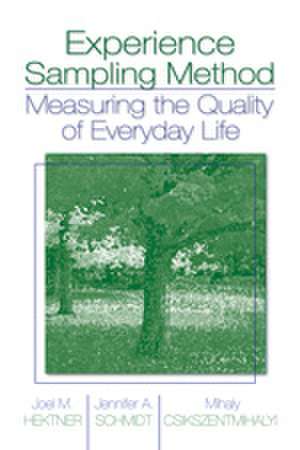
Experience Sampling Method
Autor Joel M Hektner, Mihaly Csikszentmihalyi, Jennifer A Schmidten Limba Engleză Paperback – aug 2006
Notăm cu interes acest manual metodologic, Experience Sampling Method, care reprezintă prima lucrare ce reunește fundamentele teoretice și aplicațiile practice ale unei metodologii indispensabile în științele sociale contemporane. Semnat de Joel M Hektner, Mihaly Csikszentmihalyi și Jennifer A Schmidt, volumul propune o trecere de la studiul în condiții de laborator la măsurarea calității vieții de zi cu zi în mediul natural al subiecților. Reținem că textul este structurat în două părți esențiale: prima explorează originile și validitatea epistemologică a auto-raportării subiective, în timp ce a doua oferă un ghid logistic riguros pentru colectarea și gestionarea datelor. Remarcăm o atenție deosebită acordată conceptului de 'flow', Mihaly Csikszentmihalyi detaliind modalitățile prin care această stare optimă de experiență poate fi cuantificată empiric. Lucrarea acoperă aceeași arie metodologică precum Researching Daily Life de Paul J Silvia, însă Experience Sampling Method oferă o perspectivă mai tehnică și mai aprofundată asupra validității psihometrice și a integrării datelor în context cultural și biologic. Spre deosebire de The Experience of Psychopathology, care se concentrează strict pe zona psihiatriei, volumul de față are o aplicabilitate interdisciplinară extinsă, oferind exemple din domenii precum educația, sociologia familiei și sănătatea ocupațională. Progresia capitolelor, de la fundamentare teoretică la dezvoltarea codebook-ului și curățarea datelor, indică o resursă concepută pentru a susține un proiect de cercetare de la stadiul de ipoteză până la publicare.
Preț: 821.60 lei
Preț vechi: 1001.95 lei
-18%
Carte tipărită la comandă
Livrare economică 27 noiembrie-11 decembrie
Specificații
ISBN-10: 1412925576
Pagini: 368
Ilustrații: Illustrations
Dimensiuni: 152 x 229 x 20 mm
Greutate: 0.5 kg
Ediția:1
Editura: Sage Publications, Inc
Locul publicării:Thousand Oaks, United States
V-ar putea interesa
-
 The Examined LifeStephen Grosz-37%Preț: 57.99 lei92.46 lei
 -
 -15%Preț: 350.16 lei413.55 lei
 -
 -30%Preț: 433.94 lei620.22 leiNou
 -
 -23%Preț: 163.71 lei212.75 lei
 -
 Twenty-Four Hours a DayANONYMOUS-41%Preț: 92.16 lei157.12 lei
 -
 Research MethodologyHerman Aguinis-22%Preț: 1055.00 lei1352.56 lei
 -
 Preț: 382.13 lei
 -
 Designing Small Evaluation StudiesElizabeth Tipton-18%Preț: 500.82 lei610.76 lei
 -
 Preț: 423.09 lei
 -
 Qualitative Research - A Guide to Design and Implementation, Fifth EditionElizabeth J. TisdellPreț: 412.28 lei
 -
 Research MethodsBob Matthews-13%Preț: 492.88 lei566.53 lei
 -
 Researching Daily LifePaul J SilviaPreț: 380.31 lei
 -
 -8%Preț: 436.19 lei474.11 lei
 -
 -15%Preț: 447.70 lei526.71 lei
 -
 Time and WorldHartmut RosaPreț: 142.10 lei
 -
 Digital ExhaustionPaul LeonardiPreț: 123.50 lei
 -
 The Pathway to FlowJulia F. ChristensenPreț: 79.49 lei
 -
 Everyday RitualsPearl KatzPreț: 151.71 lei
 -
 Preț: 97.90 lei
 -
 Research Methods in InformationAlison Jane Pickard-19%Preț: 558.33 lei689.30 lei
De ce să citești această carte
Recomandăm această carte cercetătorilor și studenților din psihologie, sociologie sau educație care doresc să captureze experiența umană în timp real. Cititorul câștigă acces la o metodologie riguroasă care elimină erorile de memorie specifice chestionarelor retrospective. Este un instrument esențial pentru oricine vrea să înțeleagă cum fluctuează starea de bine și atenția în contextul activităților cotidiene autentice.
Despre autor
Mihaly Csikszentmihalyi, unul dintre cei mai citați psihologi la nivel mondial, este recunoscut pentru definirea conceptului de 'flow' și pentru contribuțiile sale fundamentale în psihologia pozitivă. Joel M. Hektner este profesor de dezvoltare umană și științe ale familiei, specializat în adaptarea socială a copiilor. Jennifer A. Schmidt completează echipa de autori cu expertiză în psihologie educațională. Împreună, aceștia au rafinat Experience Sampling Method ca un standard de aur în cercetarea comportamentală, publicând numeroase studii sub egida Sage Publications, Inc.
Descriere scurtă
Recenzii
Cuprins
Acknowledgments
Part I: The Origins of ESM
Chapter 1: Epistemological Foundations for the Measurement of Experience
A Systematic Phenomenology
The Experience Sampling Method
A Brief History
How Trustworthy Are Subjective Self-Reports?
What Can We Learn From ESM?
Chapter 2: Theoretical Foundations of ESM
Biology, Culture, and Daily Behavior
Subjective Experience in Context: The Interplay of Psychological Processes and Cognitive Functions
Interaction of Individuals and Environments
Experience Fluctuations, Well-Being, and Development
A Theoretical Compass for Exploring Experience
Part II: How to Measure the Quality of Everyday Life
Chapter 3: Collecting the Data
Designing a Study Using ESM
Equipment and Signaling Schedules
Designing the Form
Other Design Decisions
Implementing the Study
Documentation
Chapter 4: Dealing With the Data: Coding, Entry, Cleaning, and Data Management
Developing a Codebook
Coding the External Coordinates of Experience
Conding the Internal Coordinates of Experience
What to Do With the Codes Once They Are Developed: Physically Coding and Entering the Data
Setup, Cleaning, and Manipulation of Data Files
Response-Level Data and Person-Level Data
Postentry Data Manipulation
Data File Management and Documentation
Chapter 5: Types of Analyses
Qualitative Approaches
Graphic and Numeric Descriptive Information
Planning for Statistical Analyses
OLS Statistical Techniques
Multilevel and Other Complex Statistical Techniques
Chapter 6: Psychometrics of ESM Data
Validity of Method
Validity of ESM Measurements
Reliability of ESM Measurements
Part III: Uses of ESM in Social Science Research
Chapter 7: Samples of Experience
The Who, What, Where, When, and How of Daily Experiences
Quality of Experience in Selected Activities
Quality of Experience of Selected Groups of People
Emotions, Well-Being, and Flow
Chapter 8: The Experience of Males and Females
Differences in Activities
Differences in Companionship
Similiarities and Differences in Emotional Experience
Other Gender Differences in Adolescence
Chapter 9: The Experience of Family Life
Methodological Concerns and Variations
The Couple Relationship
The Arrival of the First Child
Juggling Work and Family Roles
The Adolescent's Experience of Family
Transmission of Emotions Between Family Members
Comparisons Between Families: Optimal Conditions for Adolescent Development
Chapter 10: The Experience of Work
Methodological Concerns and Variations
Time and Work
The Quality of Experience at Work: General Trends
The Quality of Experience Across Workers
The Quality of Experience Across Work Activities
The Intersection of Work and Family
The Experience of Unemployment
Adolescent Work
Chapter 11: Examining Cross-Cultural Differences
Methodological Concerns and Variations
Culture and Time Use
Cross-Cultural Variation in General Affective Experience
Culture and Subjective Experience in Various Activities
Cross-Cultural Examination of Flow
Studies of American Subcultures
Chapter 12: Educational Applications
Methodological Concerns and Variations
Time Use and Structure of Classrooms
The Quality of Students' Classroom Experiences
Comparing Students' Classroom Experiences
After-School Programs
Studies of Adult Learners
The Experience of Teachers
Chapter 13: Clinical Applications
Methodological Concerns and Variations
Use of ESM for Describing and Contextualizing Experiences of Disorder
Use of ESM in Therapy and in Treatment Evaluation
Concluding Thoughts
Ten Major Issues ESM Illuminates
Appendix A: Sample ESM Data Collection Forms (ESFs)
Appendix B: ESM Coding Scheme Used in the Sloan Study of Youth and Social Development
References
Index
About the Authors