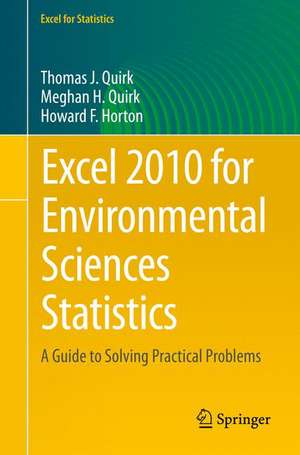
Excel 2010 for Environmental Sciences Statistics: Excel for Statistics
Autor Thomas J. Quirk, Meghan H. Quirk, Howard F. Hortonen Limba Engleză Paperback – 8 dec 2015
Bazându-ne pe documentația oferită de editura Springer și pe structura cursurilor universitare de profil, Excel 2010 for Environmental Sciences Statistics reprezintă un instrument pedagogic esențial pentru cei care doresc să stăpânească analiza datelor fără a fi experți în matematică. Suntem de părere că această lucrare elimină barierele tehnice prin utilizarea unui software familiar, Microsoft Excel, transformându-l dintr-un simplu tabel într-un laborator statistic performant. Spre deosebire de manualele teoretice rigide, volumul adoptă o abordare aplicată, ghidând cititorul prin pași expliciți către rezolvarea problemelor reale din știința mediului. Structura este progresivă: se începe cu noțiuni de bază precum deviația standard și eroarea medie, avansând către tehnici complexe ca regresia multiplă și analiza varianței (ANOVA). Fiecare capitol se finalizează cu probleme de practică, iar existența unui test general la finalul cărții asigură consolidarea cunoștințelor. Această ediție acoperă aceeași arie metodologică ca Excel 2010 for Engineering Statistics, dar cu o abordare contextualizată strict pentru problemele de mediu, oferind seturi de date și scenarii relevante pentru acest domeniu specific. În cadrul operei vaste a autorului Thomas J. Quirk, care include și Excel 2019 for Biological and Life Sciences Statistics, acest volum rămâne o bază solidă pentru utilizatorii de Excel 2010, demonstrând versatilitatea metodei sale didactice în diverse discipline științifice. Este o resursă care prioritizează claritatea și aplicabilitatea în detrimentul abstracțiilor matematice intimidante.
Din seria Excel for Statistics
-
 Preț: 358.70 lei
 -
 Preț: 391.62 lei
 -
 Preț: 373.57 lei
 - 5%
 Preț: 530.94 lei
 -
 Preț: 487.08 lei
 -
 Preț: 374.91 lei
 -
 Preț: 392.00 lei
 -
 Preț: 377.13 lei
 -
 Preț: 370.85 lei
 -
 Preț: 404.94 lei
 - 5%
 Preț: 374.63 lei
 -
 Preț: 406.68 lei
 - 19%
 Preț: 622.83 lei
 - 5%
 Preț: 528.17 lei
 -
 Preț: 455.13 lei
 - 15%
 Preț: 585.16 lei
 -
 Preț: 389.02 lei
 - 15%
 Preț: 528.78 lei
 - 15%
 Preț: 482.10 lei
 - 15%
 Preț: 402.83 lei
 - 19%
 Preț: 506.70 lei
Preț: 391.06 lei
Carte disponibilă
Livrare economică 07-21 noiembrie
Specificații
ISBN-10: 3319239694
Pagini: 264
Ilustrații: XVII, 246 p. 162 illus., 2 illus. in color.
Dimensiuni: 155 x 235 x 14 mm
Greutate: 0.45 kg
Ediția:1st edition 2015
Editura: Springer
Colecția Excel for Statistics
Seria Excel for Statistics
Locul publicării:Cham, Switzerland
V-ar putea interesa
-
 SimulationSheldon M. Ross-32%Preț: 520.53 lei766.79 lei
 -
 -33%Preț: 786.42 lei1170.59 lei
 -
 Models for Discrete Longitudinal DataGeert Molenberghs-18%Preț: 1289.25 lei1572.26 lei
 -
 The Bayesian ChoiceChristian Robert-15%Preț: 653.70 lei769.06 lei
 -
 S ProgrammingWilliam Venables-15%Preț: 675.09 lei794.23 lei
 -
 CausalityCarlo Berzuini-19%Preț: 511.23 lei631.15 lei
 -
 Adaptive TestsO'Gorman-9%Preț: 941.44 lei1034.54 lei
 -
 Modern Statistical Methods for AstronomyEric D. Feigelson-14%Preț: 755.89 lei878.94 lei
 -
 Excel 2010 for Educational and Psychological StatisticsThomas J. QuirkPreț: 404.26 lei
 -
 Superconcentration and Related TopicsSourav Chatterjee-15%Preț: 662.58 lei779.51 lei
Public țintă
Upper undergraduateDe ce să citești această carte
Recomandăm această carte studenților și profesioniștilor din domeniul mediului care au nevoie de rezultate statistice precise fără a investi timp în învățarea unor limbaje de programare complexe. Veți câștiga abilitatea de a interpreta datele de teren și de laborator folosind doar instrumentele standard din Excel. Este ghidul ideal dacă doriți o metodă de învățare bazată pe exerciții practice, nu pe teorie pură.
Despre autor
Thomas J. Quirk este un autor prolific și profesor cu o experiență vastă în predarea statisticii aplicate. Este cunoscut pentru dezvoltarea seriei Excel for Statistics, prin care a adaptat instruirea statistică pentru diverse domenii, de la psihologie și educație, până la inginerie și științele vieții. Alături de Meghan H. Quirk și Howard F. Horton, acesta a creat un sistem pedagogic recunoscut pentru simplitatea sa, destinat celor care doresc să utilizeze potențialul maxim al software-ului Microsoft Excel în analiza datelor științifice.
Cuprins
Notă biografică
Textul de pe ultima copertă
Excel, a widely available computer program for students and managers, is also an effective teaching and learning tool for quantitative analyses in environmental science courses. Its powerful computational ability and graphical functions make learning statistics much easier than in years past. However, Excel 2010 for Environmental Sciences Statistics: A Guide to Solving Practical Problems is the first book to capitalize on these improvements by teaching students and managers how to apply Excel to statistical techniques necessary intheir courses and work.
Each chapter explains statistical formulas and directs the reader to use Excel commands to solve specific, easy-to-understand environmental science problems. Practice problems are provided at the end of each chapter with their solutions in an appendix. Separately, there is a full Practice Test (with answers in an Appendix) that allows readers to test what they have learned.
Dr. Meghan H.Quirk holds both a Ph.D. in Biological Education and an M.A. in Biological Sciences from the University ofNorthern Colorado (UNC) and a B.A. in Biology and Religion at Pri
lik Lake, Alaska, and Wind Cave, South Dakota. He has co-authored articles in The International Journal of Speleology and The Journal of Cave and Karst Studies. He was a National Science Foundation Fellow GK-12, and a District Wildlife Manager with the Colorado Division of Parks and Wildlife. He is currently the Angler Outreach Coordinator for Colorado Parks and Wildlife (USA).