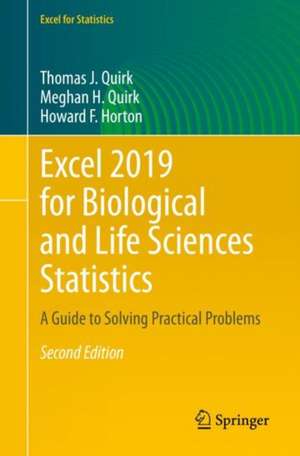
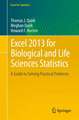
Excel 2019 for Biological and Life Sciences Statistics: Excel for Statistics
Autor Thomas J. Quirk, Meghan H. Quirk, Howard F. Hortonen Limba Engleză Paperback – 17 mar 2020
Găsim în această a doua ediție a Excel 2019 for Biological and Life Sciences Statistics un instrument de lucru riguros, proiectat să transforme Microsoft Excel dintr-un simplu program de calcul într-un laborator de analiză cantitativă pentru științele vieții. Utilitatea practică este imediată: clinicianul sau cercetătorul va putea să execute teste statistice complexe — de la calculul erorii standard la analize de varianță (ANOVA) — urmând pași procedurali clar definiți, fără a depinde de software-uri statistice costisitoare sau dificil de configurat. Notăm cu interes structura didactică a volumului, care evită încărcarea teoretică excesivă în favoarea aplicabilității. Fiecare capitol este construit în jurul unei probleme specifice de biologie, ghidând cititorul prin comenzile Excel necesare pentru obținerea rezultatelor. Progresia narativă este logică, începând cu statistica descriptivă elementară și generatorul de numere aleatorii, avansând spre inferențe statistice, corelații și regresii multiple. Clinicienii care folosesc Excel 2019 for Business Statistics ca referință vor găsi aici o adaptare necesară, unde seturile de date abstracte sunt înlocuite cu parametri biologici reali, oferind un context relevant pentru interpretarea rezultatelor medicale. Putem afirma că acest titlu consolidează abordarea autorului Thomas J. Quirk, observată și în lucrările sale anterioare precum Excel 2010 for Educational and Psychological Statistics. Dacă în volumele precedente accentul era pus pe mediul educațional, aici metodologia este calibrată pentru rigoarea cercetării din biologie. Cartea se distinge prin includerea unui test de practică integral și a unui apendice generos cu soluții, elemente care permit o autoevaluare precisă a competențelor dobândite în manipularea datelor experimentale.
Din seria Excel for Statistics
-
 Preț: 358.70 lei
 -
 Preț: 391.62 lei
 -
 Preț: 391.06 lei
 -
 Preț: 373.57 lei
 -
 Preț: 487.08 lei
 -
 Preț: 374.91 lei
 -
 Preț: 392.00 lei
 -
 Preț: 377.13 lei
 -
 Preț: 370.85 lei
 -
 Preț: 404.94 lei
 - 5%
 Preț: 374.63 lei
 -
 Preț: 406.68 lei
 - 19%
 Preț: 622.83 lei
 - 5%
 Preț: 528.17 lei
 -
 Preț: 455.13 lei
 - 15%
 Preț: 585.16 lei
 -
 Preț: 389.02 lei
 - 15%
 Preț: 528.78 lei
 - 15%
 Preț: 482.10 lei
 - 15%
 Preț: 402.83 lei
 - 19%
 Preț: 506.70 lei
Preț: 530.94 lei
Preț vechi: 558.87 lei
-5%
Carte disponibilă
Livrare economică 07-21 noiembrie
Livrare express 24-30 octombrie pentru 36.74 lei
Specificații
ISBN-10: 3030392805
Pagini: 264
Ilustrații: XIX, 244 p. 165 illus., 162 illus. in color.
Dimensiuni: 155 x 235 x 14 mm
Greutate: 0.46 kg
Ediția:Second Edition 2020
Editura: Springer
Colecția Excel for Statistics
Seria Excel for Statistics
Locul publicării:Cham, Switzerland
De ce să citești această carte
Această carte este esențială pentru studenții și profesioniștii din științele biologice care doresc să stăpânească statistica aplicată fără a se pierde în teorie matematică pură. Cititorul câștigă abilitatea de a procesa date clinice rapid, utilizând o interfață familiară. Este un ghid practic ce transformă Excel 2019 într-un aliat de încredere pentru validarea ipotezelor de cercetare prin teste t, regresii și ANOVA.
Despre autor
Thomas J. Quirk este un profesor și cercetător prolific, recunoscut pentru expertiza sa în utilizarea instrumentelor informatice pentru analiza statistică. Cu o carieră dedicată simplificării proceselor complexe de calcul, el a dezvoltat seria Excel for Statistics, publicată de Springer, care acoperă domenii diverse de la inginerie la psihologie. Împreună cu Meghan H. Quirk și Howard F. Horton, autorul adaptează în acest volum cele mai noi funcționalități ale Excel 2019 la nevoile specifice ale cercetării în biotehnologie și medicină, menținând standardul de claritate și rigoare metodologică care i-a consacrat lucrările anterioare.
Cuprins
Notă biografică
Dr. Meghan H. Quirk holds both a PhD in Biological Education and an MA in Biological Sciences from the University of Northern Colorado (UNC), and a BA in Biology and Religion at Principia College in Elsah, Illinois. She has done research on food web dynamics at Wind Cave National Park in South Dakota and research in agro-ecology in Southern Belize. She has co-authored an article on shortgrass steppe ecosystems in Photochemistry and Photobiology and has presented papers at the Shortgrass Steppe Symposium inFort Collins, Colorado, the Long-term Ecological Research All Scientists Meeting in Estes Park, Colorado, and participated in the NSF Site Review of the Shortgrass Steppe Long-Term Ecological Research in Nunn, Colorado. She is a National Science Foundation Fellow GK-12 and currently is a public school administrator in Parker, Colorado.
Howard F. Horton holds an MS in Biological Sciences from the University of Northern Colorado (UNC) and a BS in Biological Sciences from Mesa State College. He has worked on research projects in Pawnee National Grasslands, Rocky Mountain National Park, Long-Term Ecological Research at ToolikLake, Alaska, and Wind Cave, South Dakota. He has co-authored articles in The International Journal of Speleology and The Journal of Cave and Karst Studies. He is a National Science Foundation Fellow GK-12 and is currently the Angler Outreach Coordinator with the Colorado Division of Parks and Wildlife.