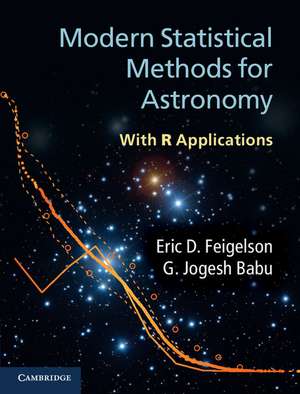
Modern Statistical Methods for Astronomy
Autor Eric D. Feigelson, G. Jogesh Babuen Limba Engleză Hardback – 11 iul 2017
Concepută ca o resursă fundamentală pentru nivelurile de studiu masteral și doctoral, această lucrare publicată de Cambridge University Press reprezintă un punct de cotitură în literatura de specialitate dedicată astrofizicii computaționale. Observăm o tranziție necesară de la metodele statistice tradiționale la tehnici avansate, impusă de volumul uriaș de date (megadatasets) generat de telescoapele moderne. Structura cărții este riguros logică, începând cu bazele teoriei probabilităților și evoluând spre subiecte complexe precum analiza multivariată, clustering-ul și tratamentul datelor cenzurate (nondetections). Remarcăm integrarea organică a limbajului R, autorii oferind nu doar suport teoretic, ci și instrumente practice, gata de utilizare, pentru cercetarea astronomică contemporană. Modern Statistical Methods for Astronomy extinde cadrul metodologic propus în volumele anterioare de conferință ale autorilor, precum Statistical Challenges in Modern Astronomy, transformând discuțiile academice într-un manual aplicat. În comparație cu Practical Statistics for Astronomers de J. V. Wall, care se concentrează pe fundamente și simulări Monte Carlo, lucrarea de față plonjează mai adânc în statistica non-parametrică și analiza proceselor spațiale, oferind o bibliotecă de cod mult mai vastă. De asemenea, spre deosebire de abordarea pur bayesiană din Bayesian Models for Astrophysical Data, Eric D. Feigelson și G. Jogesh Babu oferă o perspectivă echilibrată, acoperind atât metodele frecventiste, cât și pe cele moderne de data mining, esențiale pentru interpretarea obiectelor cerești variabile.
Preț: 755.89 lei
Preț vechi: 878.94 lei
-14%
Carte tipărită la comandă
Livrare economică 02-16 decembrie
Specificații
ISBN-10: 052176727X
Pagini: 504
Ilustrații: 100 b/w illus. 12 colour illus. 30 tables 59 exercises
Dimensiuni: 208 x 260 x 31 mm
Greutate: 1.29 kg
Ediția:New.
Editura: Cambridge University Press
Locul publicării:Cambridge, United Kingdom
V-ar putea interesa
-
 The Oxford Handbook of Applied Bayesian AnalysisAnthony O' Hagan-19%Preț: 469.16 lei579.21 lei
 -
 A Dictionary of AstronomyIan Ridpath-18%Preț: 100.78 lei122.92 lei
 -
 Astrophysics for People in a HurryNeil de Grasse TysonPreț: 105.21 lei
 -
 Probability with MartingalesDavid WilliamsPreț: 370.11 lei
 -
 New Camb Statistical Tables 2edD. V. LindleyPreț: 138.38 lei
 -
 Astronomy MethodsHale Bradt-19%Preț: 663.50 lei819.14 lei
 -
 Probability TheoryE. T. Jaynes-14%Preț: 897.19 lei1043.24 lei
 -
 The Cambridge Encyclopedia of Amateur AstronomyMichael E. Bakich-23%Preț: 729.19 lei947.01 lei
 -
 -11%Preț: 645.38 lei725.14 lei
 -
 Neutron StarsKatia MoskvitchPreț: 224.15 lei
 -
 A Probability PathSidney I. Resnick-15%Preț: 539.53 lei634.73 lei
 -
 Truth or TruthinessHoward WainerPreț: 240.46 lei
 -
 Modeling Count DataJoseph M. HilbePreț: 371.72 lei
 -
 Preț: 299.82 lei
 -
 Statistics with JMPPeter Goos-23%Preț: 657.73 lei854.20 lei
 -
 Astronomy with a Budget TelescopePatrick MoorePreț: 264.76 lei
 -
 Stars and PlanetsGiles Sparrow-14%Preț: 64.34 lei75.05 lei
 -
 -25%Preț: 71.21 lei94.83 lei
 -
 Superconcentration and Related TopicsSourav Chatterjee-15%Preț: 662.58 lei779.51 lei
 -
 Fourier Analysis and Stochastic ProcessesPierre BrémaudPreț: 272.57 lei
 -
 Séminaire de Probabilités XLVICatherine Donati-MartinPreț: 405.14 lei
 -
 Fluctuations in Markov ProcessesTomasz Komorowski-15%Preț: 655.08 lei770.67 lei
De ce să citești această carte
Această carte este indispensabilă cercetătorilor care doresc să depășească analizele statistice rudimentare. Cititorul câștigă competențe practice în utilizarea R pentru procesarea datelor astronomice complexe, beneficiind de expertiza unor autori care au definit domeniul astrostatisticii. Este recomandată celor care lucrează cu seturi mari de date și au nevoie de soluții riguroase pentru regresie, clasificare și serii de timp, validate prin exerciții și exemple reale.
Despre autor
Eric D. Feigelson este profesor în cadrul Departamentului de Astronomie și Astrofizică la Pennsylvania State University, fiind un astronom observațional de renume mondial. De peste 25 de ani, acesta colaborează strâns cu statisticieni pentru a integra metodologii avansate în cercetarea astrofizică, fiind unul dintre fondatorii disciplinei moderne de astrostatistică. Împreună cu G. Jogesh Babu, a organizat seria de simpozioane „Statistical Challenges in Modern Astronomy”, contribuind fundamental la crearea unei punți de comunicare între matematică și studiul cosmosului. Opera sa include lucrări de referință în astroinformatică, axate pe gestionarea structurilor de date complexe și a bazelor de date satelitare de mari dimensiuni.
Descriere scurtă
Cuprins
Recenzii
'This book covers in a single volume both the basic statistical material and more specialized material (clustering, classification, data mining, non-detections, time series analysis, and spatial point processes) that is essential for modern astronomers. 'The astronomical context' sections, which provide motivation for the ensuing statistical development, are particularly valuable … The decision to use R to illustrate the ideas, methods, and tools, and to apply them to real astronomical data sets, will significantly enhance the value of the volume. The discipline of astrostatistics is experiencing a dramatic blossoming, and this book will provide the necessary vehicle for the new generation of astronomers.' David Hand, Imperial College London
'While many astrophysicists have deep training in statistical theory and great practical abilities, others have no or only elementary training in these areas, propagate old mistakes, and carry out sub-optimal data analysis. Modern Statistical Methods for Astronomy addresses this problem and will likely make a significant contribution. And just in time! The age of 'digital astronomy' - with its notoriously complex and huge data arrays - is already challenging our knowledge of advanced statistical methods and abilities to apply them in practice. Each chapter surveys statistical science relevant to a specific area in a way that should be easily comprehensible by all graduate and many undergraduate students, followed in most cases by selected applications in R. Serious readers of this text will be well-equipped to learn the most advanced techniques on their own.' Jeffrey D. Scargle, NASA Ames Research Center
'This one book is required reading as it tackles the often ignored need for profitability analysis in observational or measured data.' Spaceflight
'… excellent effort at bridging the gap between astronomy and advanced statistical methods … written with rigour but without excessive technical detail … This book can be considered a timely and most welcome addition to the toolbox of any astronomer involved in data analysis.' Roberto Trotta, Mathematical Reviews
'… statistics textbooks for astronomy are surprisingly rare, so this book represents a welcome addition to the literature … the text is written clearly and is easy to understand … an excellent text. Graduate students would especially benefit from this book … but seasoned researchers are likely to discover new methods for their research as well.' Jason C. Speights, Journal of the American Statistical Association